A new simulated benchmark runs the same robot memory tasks twice, once with the world paused while the model thinks and once with it running. Scores that look near perfect fall sharply, and the ranking of models changes.
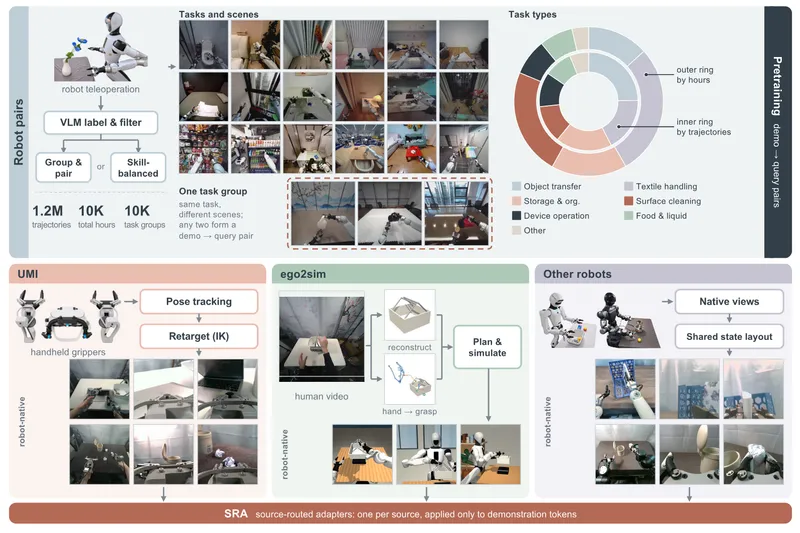
A preprint from Galbot and Chinese universities trains a robot to follow a single example of a new task, shown by a person, a simulator, a handheld gripper or another robot. It beats vision-language-action models given 50 task examples each.
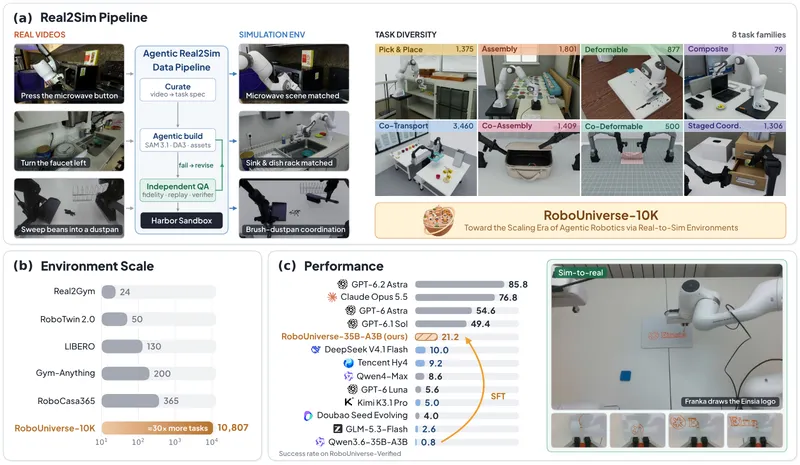
A preprint turns real robot videos into thousands of simulated tasks for AI coding agents that control robot arms. Top closed models do well, open models mostly fail, and a small open model trained on the set improves sharply but stays far behind.
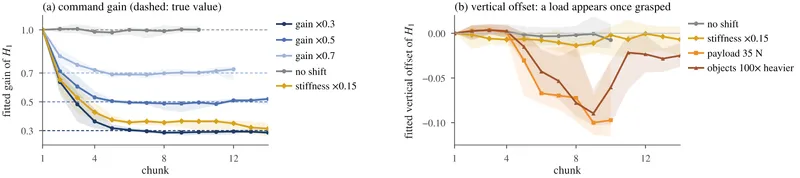
A test-time method corrects the commands of frozen robot policies such as π0 and Cosmos Policy when weight, wear or lag change how the robot moves. The results come from simulation and a preprint that has not been peer reviewed.
A 4.5-billion-parameter robot model from NVIDIA and university partners remembers about a minute of a task without slowing down. It tops several simulation benchmarks and beats two open baselines on real robots. It is a preprint, and no code or weights are confirmed as released.
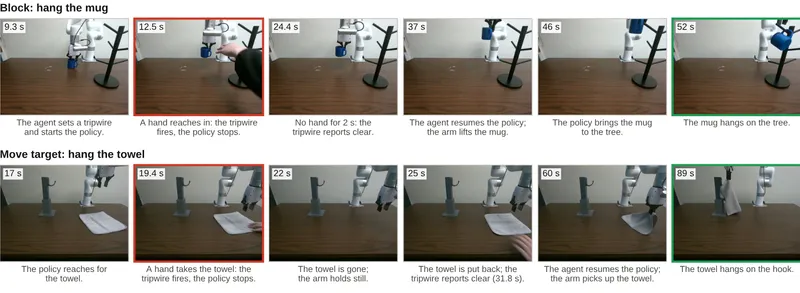
A preprint lets a robot's AI agent write small watch programs that stop the robot mid-task when a person comes close. In simulated kitchens it roughly halved contact with a person, without lowering task success.
MIT researchers had four coding agents design small brick-style robots and then built every design that worked in simulation. Most held up on real obstacle courses, and watching videos of their failures let the agents fix most of the rest.
A Freiburg-led team trained robot arm skills from people's demonstrations, which record no robot commands, and then improved them inside a learned simulator. Robot recordings are still needed to translate those skills into motor commands.
Researchers trained a 27-billion-parameter open-weight reasoning model to control robot arms using only simulated practice. On a real two-armed robot it had never seen, it succeeded in 18 of 30 trials. The work is a preprint and has not been peer reviewed.
A preprint describes DexSeed, a method that expands a few recordings of human hands into simulated robot training data. A robot trained only on that data picked and placed real objects, with mixed success.
A preprint adds a learned controller to a robot model that predicts future video before it acts. The controller cuts thinking time by about a third against its closest rival, with small gains in success.
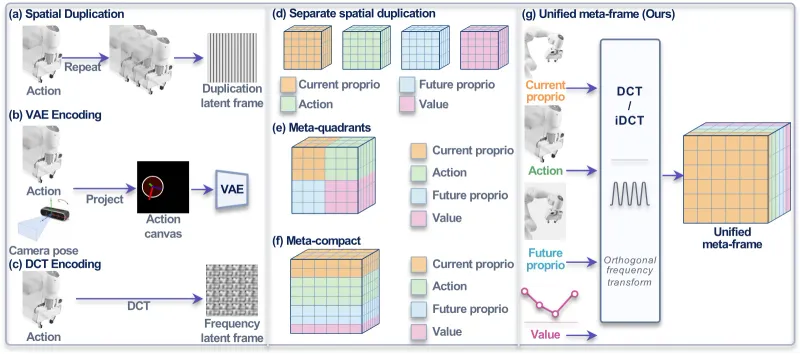
A preprint from the National University of Singapore folds a robot's actions, joint readings and value estimates into a single frame that a pretrained video model treats as natural. Queries run 39% faster and simulated benchmark scores rise slightly.