Packing robot signals into one video frame speeds up world action models
A preprint from the National University of Singapore folds a robot's actions, joint readings and value estimates into a single frame that a pretrained video model treats as natural. Queries run 39% faster and simulated benchmark scores rise slightly.

What the study shows
The work concerns world action models: robot controllers built on pretrained video diffusion models, which generate video by gradually removing noise. These systems predict the robot's next actions and what its cameras will see next, together. To do that, they must feed low-dimensional robot data into a model trained only on natural video. That data includes proprioception (the robot's own joint and gripper readings), action chunks (short sequences of planned moves), task type and a value estimate (a prediction of how well the attempt will go).
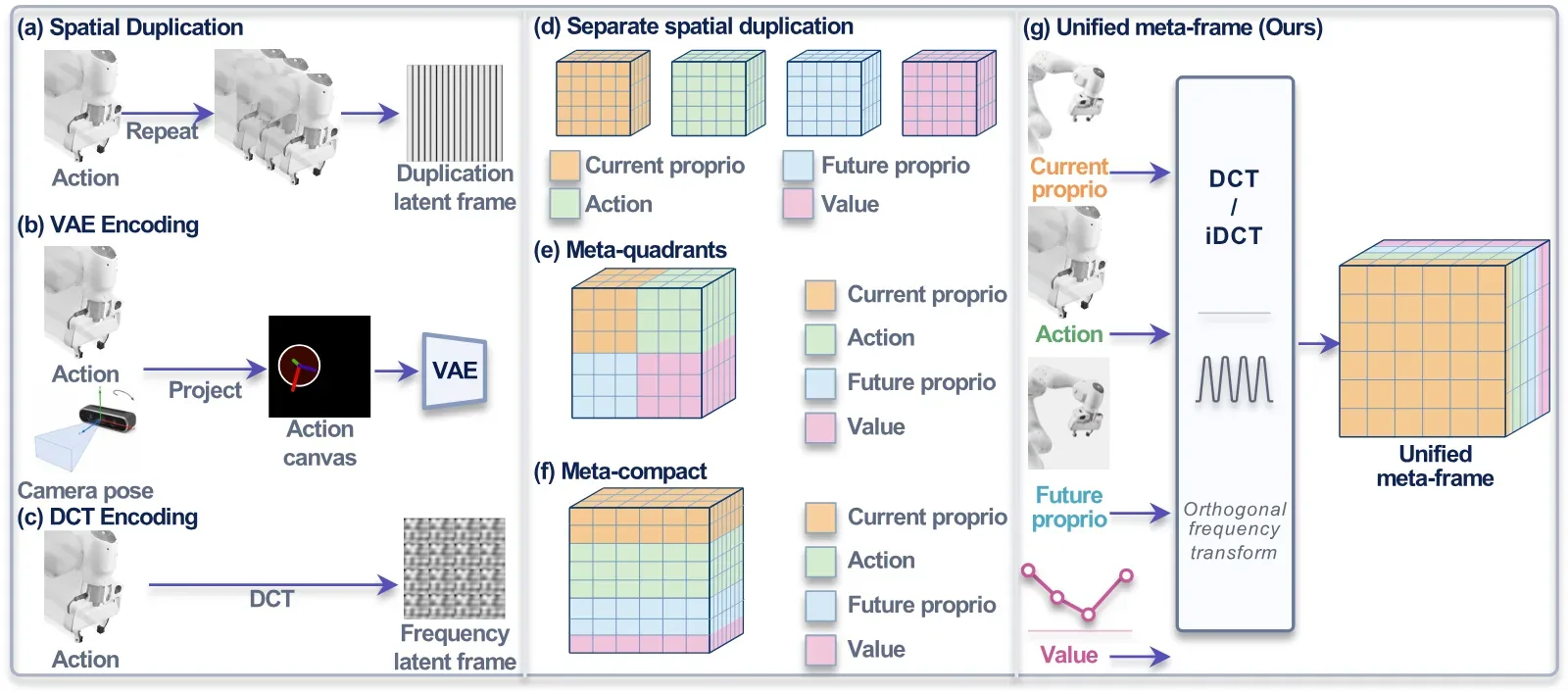
Existing designs either give each robot signal its own latent frame (a compressed image slot inside the video model) or add new encoder and decoder modules. Extra frames make the sequence longer, and attention cost grows with the square of sequence length. Extra modules change the pretrained model.
The authors first ran a diagnostic. They injected robot signals into a frozen Cosmos-Predict2 denoiser in several ways and measured how much the denoiser 'corrected' them, relative to their size. A smaller correction suggests the input looks more like the video data the model was trained on. The test used 30 action chunks from RoboCasa. At the middle noise level, writing a single signal as DCT coefficients scored 0.5922. DCT, the discrete cosine transform, describes a signal as a sum of smooth waves. Tiling the raw values across the frame scored 0.6459, and rendering them as an image and encoding that through the video model's VAE (its image compressor) scored 0.6379. For several signals at once, their combined layout scored 0.5613, against 0.6178 for separate frames and 0.6234 and 0.6730 for two single-frame layouts based on spatial regions. The combined layout was lowest at all five noise levels tested.
The method, called MetaWAM, gives each signal its own band of channels in one 'meta-frame', writes the values as frequency coefficients and converts them into an ordinary spatial latent with an inverse DCT. Reading the prediction back out is a fixed calculation, so no learned decoder is needed. A fixed mask decides, per training sample, which signals are inputs and which are targets. This lets one model learn three jobs: the policy (what to do), the world model (what will happen) and the value (how well it will go). The model sequence shrinks to eight frames. The authors estimate that this cuts pairwise attention by roughly 47%, a calculated figure rather than a measurement.
On RoboCasa (24 simulated kitchen tasks, 50 human demonstrations each, 3,600 trials over three random seeds), MetaWAM reached 68.9% average success. Cosmos Policy, trained on the same data, scored 67.1%, and the next best listed method scored 66.4% with 300 demonstrations per task. In an ablation on RoboCasa, the frame count fell from 11 to 8 and latency fell from 0.479 s to 0.291 s per query. The two other single-frame layouts ran at the same speed but scored 68.1% and 65.9%.
On standard LIBERO, MetaWAM averaged 98.1%, slightly below Cosmos Policy's 98.5%. On LIBERO-Plus, which adds seven kinds of disturbance, it scored 83.4% in total against 82.2% for Cosmos Policy. It led on camera, language, lighting, sensor noise and layout changes. It was weaker on background changes (72.6% against 88.9%) and on changes to the robot's starting pose (59.9% against 63.3%). Those baseline figures come from another paper.
On a real Franka Panda arm, with three tabletop tasks, 80 demonstrations per task and 20 trials per task, MetaWAM succeeded 85.0% of the time on familiar scenes and 68.3% on scenes with distractors, new placements and changed backgrounds. Cosmos Policy scored 78.3% and 63.3%, and pi0.5 scored 71.7% and 46.7%. The paper is a preprint and has not been peer reviewed.
Our reading
In our reading, the clearest result is the efficiency gain, not the accuracy gain. Three fewer frames and a 39% faster query, with no architectural change, is a concrete saving. It came with no loss in success rate on RoboCasa. The accuracy gains over Cosmos Policy are small: 1.8 points on RoboCasa and 1.2 points on LIBERO-Plus, with a small loss on standard LIBERO. The paper reports no confidence intervals or significance tests.
The diagnostic idea is useful as a way to compare designs before spending GPU time on full training. The authors are careful here. They say the score ranks layouts in the same order as task success on RoboCasa, but they do not treat it as a predictor of success. We agree with that caution. Four layouts ranked in matching order is suggestive, not proof.
On readiness, we rate this level III, open source available. Public benchmark results meet level II. The paper states that code and models are released on GitHub, which meets level III on the paper's own account, though we have not yet checked what the repository contains. There is no documented use by a named organisation, so level IV is not met.
Read the rest of this story
Membership is free. You get every article in full and the Issue every Sunday.
We send a sign-in link, no password needed. Already a member? Sign inReadiness assessment
| Level | Status | Evidence |
|---|---|---|
| I Lab only | Met | The method was developed and tested in simulation and on three real Franka tasks. |
| II Benchmarked | Met | Public benchmark results on RoboCasa (68.9% vs 67.1% for Cosmos Policy), LIBERO (98.1%) and LIBERO-Plus (83.4% total), compared with published baselines. |
| III Open source | Met | The abstract states that code and models are available at https://github.com/showlab/MetaWAM. We could not check the repository or its licence from the paper alone. |
| IV In production | Not yet | No documented deployment by a named organisation outside the authors' own lab experiments. |
What would move it up
Documented use by a named organisation in a real product or long-running deployment would reach level 4. Independent replication, more real-world trials with confidence intervals, and evidence that the diagnostic predicts task success would strengthen level 2 and 3.
Checked automatically every week, last on 16 November.
The study
Guoqiang Liang, Yiqi Lin, Yanzhe Chen et al.. From Video Frames to Robot Meta-Frames: A Unified Latent Interface for World Action Models. arXiv, 10 November 2026. doi:10.48550/arxiv.2611.14365
Notes
- Liang, Lin, Chen, Ma and Shou, 'From Video Frames to Robot Meta-Frames: A Unified Latent Interface for World Action Models', arXiv preprint, 10 November 2026, CC BY. Source
- Code and models, as stated by the authors. Source
- Readiness: level III, open source available. Level II is met by public RoboCasa, LIBERO and LIBERO-Plus results. Level III is met on the paper's statement that code and models are released; repository contents and licence not yet checked. Level IV is not met: no documented use by a named organisation.
Edited and signed by
Stefan PerdalEditor and publisher86 stories editedStefan read the study, set the readiness level and approved this story. An AI system found the paper and wrote the first draft.
How this was made
An AI model read the study and wrote this article in the structure Science Underway uses. An editor reviewed it and approved it for publication. Check the original study before you rely on the details.
How we workNo corrections