Opus 5.5 and GPT-6 agents design robots; failure videos fix most flaws
MIT researchers had four coding agents design small brick-style robots and then built every design that worked in simulation. Most held up on real obstacle courses, and watching videos of their failures let the agents fix most of the rest.

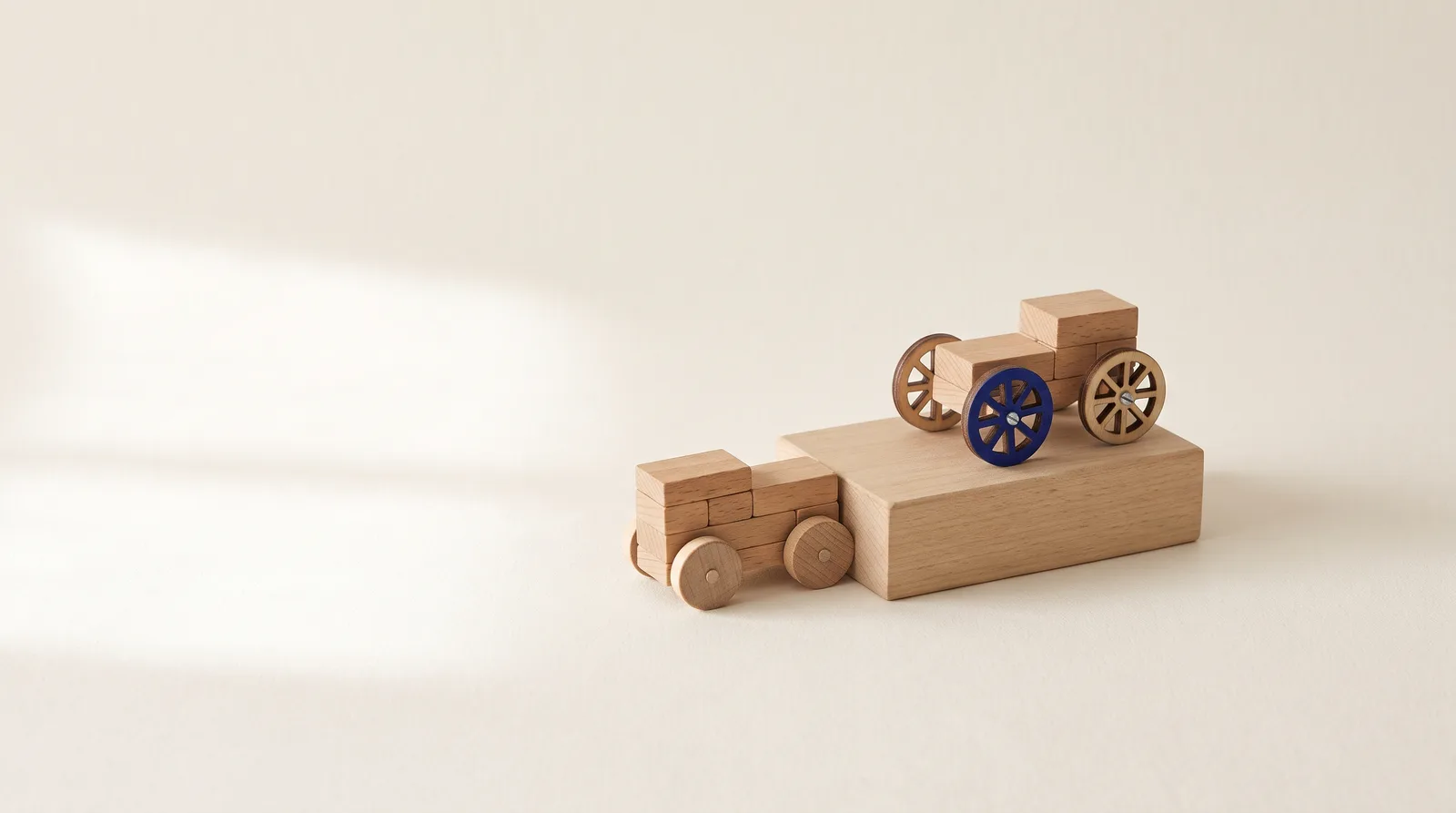 AI illustration
What the study shows
The researchers built a test in which coding agents design a robot and its motor program. Coding agents are AI models that write and run code on their own. The robots use standard brick-style parts, motors and, if needed, one custom 3D-printed part. They must cross ten obstacles, such as a ramp, a wall and a rope, each at three levels of difficulty. The work is a preprint and has not been peer reviewed.
Four agents were tested: Opus 5.5 and Sonnet 5.5 in Claude Code, and GPT-6 Astra and GPT-6.1 Sol in Codex. With a printed part allowed, they passed 98% of the easiest tasks in simulation, 70% at level 2 and 48% at level 3. Automated search over the same parts, with the same budget of 30 simulations, passed none. A single model call without a simulator passed almost nothing.
Simulation alone misled badly at first. With a simulator built from public part data, none of 15 passing designs crossed the real course. Tyres slipped, joints pulled apart and gears jumped out of mesh. One agent then tuned the simulator using bench tests and videos of real runs. After that, about two thirds of simulated passes crossed for real.
The researchers then closed the loop. Each real failure at levels 1 and 2 went back to the agent that designed it, as video. The agent could correct its own copy of the simulator and then redesign. This cut real failures from 18 to 5, and the share of simulated passes that crossed for real rose from 73% to 93%.
Building one robot for all ten easy obstacles was much harder. The best single robot crossed six of ten on the real courses, because the obstacles make conflicting demands. The bumps need clearance, the bridge a narrow track, the rope a light frame hung from above.
The authors built 135 robots by hand, from about 13,000 pieces, in an estimated 240 hours. They report 16,427 simulations of 12,774 distinct robots.
Our reading
In our reading, the strongest result is the failure of the first simulator. Not one of 15 designs that passed in a standard physics model worked in the real world. That is a useful warning for anyone who trusts a simulated score as proof that an AI-designed machine works. A model of the parts is not a model of how a small, loosely built robot fails.
The hardware loop is the practical idea. An agent watches its robot stall at a step, notes the cause, and tries again. On the bumps course, Opus 5.5 saw its spoked wheels spinning against a ridge, lowered a friction value in its simulator, and switched to a different wheel design that crossed. This is roughly how an engineer works with a prototype. The authors are careful that this measures recovery on the same course, not success on new tasks.
We rate the work at level II, Benchmarked, on our four-level readiness scale. It sets out a new benchmark with results for four agents and several baselines. Code and data are promised under open licences, but the paper does not confirm they are public yet.
Read the rest of this story
Membership is free. You get every article in full and the Issue every Sunday.
We send a sign-in link, no password needed. Already a member? Sign inReadiness assessment
| Level | Status | Evidence |
|---|---|---|
| I Lab only | Met | Research demonstration with real hardware tests of agent-designed robots, with simulation and physical builds. |
| II Benchmarked | Met | Introduces a benchmark (10 obstacles x 3 levels, ALL-IN-ONE task) with results for four agents and baselines, and 135 physical builds. The authors' own benchmark, not an independent public one. |
| III Open source | Not yet | The paper promises code under MIT and data under CC BY 4.0 (dataset card, Sec. J.1) and gives a project page, but the text does not confirm that code, weights or data are already public. The part list and obstacle instructions are also described as 'will release'. |
| IV In production | Not yet | No documented use by a named organisation in production. The work is a lab benchmark with small brick-style robots. |
What would move it up
To reach level 3, confirm the promised code, simulator, designs and the 461 paired real videos are public and usable, along with the part list and obstacle build instructions. Level 4 would need documented use by an outside organisation, and independent replication on other hardware and with repeated runs.
The study
Ghadi Nehme, Dahyun Nam, Akshay Govind Srinivasan et al.. RoboBuilder: Agentic Robot Co-Design with Real-world Video Feedback in the Loop. arXiv, 18 November 2026. Read the paper
Notes
- Nehme, Nam, Srinivasan and Ahmed, RoboBuilder: Agentic Robot Co-Design with Real-world Video Feedback in the Loop. arXiv preprint, 18 November 2026, not peer reviewed. Source
- Project page. The paper says code will be released under the MIT licence and data under CC BY 4.0; we have not confirmed that they are public. Source
- Pass rates in simulation with the printed part allowed: 98% at level 1, 70% at level 2, 48% at level 3 (Table 2). Real crossing of simulated passes with the learned simulator: 57 of 86, 66% overall; 77%, 68% and 42% by level (Tables 23 and 25).
- Hardware loop at levels 1 and 2: real pass rate 73% before, 93% after; real failures 18 before, 5 after (Table 12). Of 18 redesigns, 14 crossed for real (Table 13).
- Combined score: Opus 5.5 73.9, GPT-6 Astra 57.6, GPT-6.1 Sol 55.1, Sonnet 5.5 44.3 (of 100). Bootstrap interval for Opus 5.5: 60.9 to 87.1 (Table 19).
Edited and signed by
Stefan PerdalEditor and publisher86 stories editedStefan read the study, set the readiness level and approved this story. An AI system found the paper and wrote the first draft.
How this was made
An AI model read the study and wrote this article in the structure Science Underway uses. An editor reviewed it and approved it for publication. Check the original study before you rely on the details.
How we workNo corrections