Add-on more than doubles robot policy success on LIBERO under hidden physics
A test-time method corrects the commands of frozen robot policies such as π0 and Cosmos Policy when weight, wear or lag change how the robot moves. The results come from simulation and a preprint that has not been peer reviewed.
scienceunderway.com/articles/add-on-more-than-doubles-robot-policy-success-on-libero-under-hidden-physics

What the study shows
Modern robot policies, the software that turns camera images and an instruction into movements, decide what to do from what they see. Some of the physics that decides success is invisible. A box can look light and be very heavy. A worn joint or a slow controller looks the same as a healthy one. In these cases the plan is often still right, but the robot carries it out as if nothing had changed, and falls short.
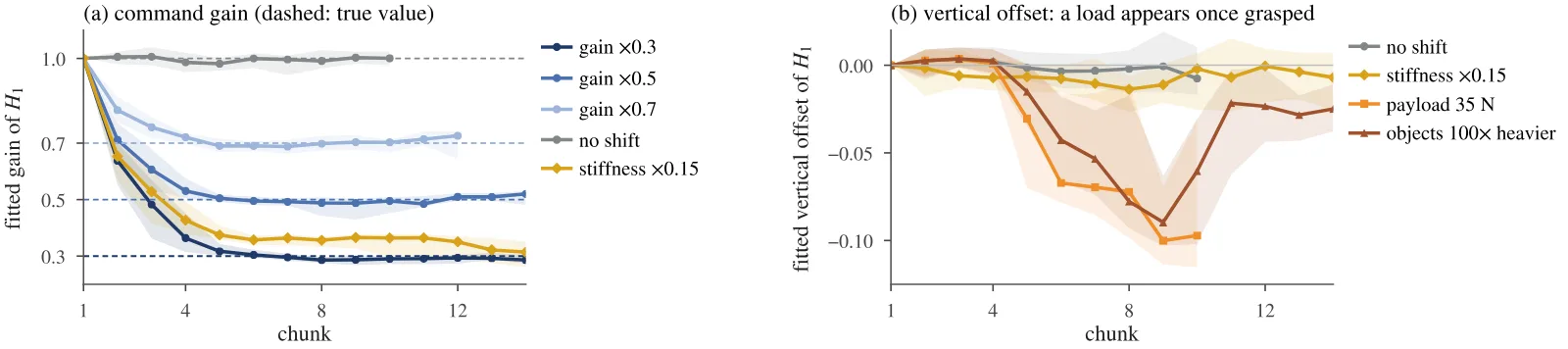
The authors propose RoboAda, which leaves the policy and its plan untouched and only changes the commands sent to the robot. After each short burst of actions, called a chunk, it uses an inverse-dynamics model. This is a model, trained on the original robot, that works out which command would have produced the motion that actually happened. Comparing that with the command really sent gives a free label at every step. If the robot moved only half as far as asked, the label is half the command.
RoboAda keeps three competing explanations for each direction of movement: the robot is unchanged, the robot scales and shifts every command, or its response depends on its state, as when it grips a load. Each is weighted by how well it predicted the newest labels. The next commands are then chosen to make the plan happen under that weighted picture. It needs no reward signal, no retraining and no data from the changed robot.
The authors tested it in the LIBERO simulator with five public policies: Cosmos Policy, Fast-WAM, π0, π0.5 and OpenVLA-OFT. Under eleven hidden physical changes, such as weaker commands, added delay, a softer controller, a payload and weakened joints, average success rose from about 28% to about 63%. With objects 100 times heavier than they looked, the five-policy average rose from 59% to 72%.
Against seven other test-time adaptation methods, which the authors re-implemented at a shared interface, RoboAda scored best on Cosmos Policy: about 70% against 52% for the strongest rival, GrBAL. With no physical change, it matched the unaided policy. On a second simulator, RoboTwin 2.0, with a two-armed robot controlled joint by joint, success under small joint offsets rose from about 25% to 79%.
The authors report that the method identified the true change within four to six chunks when commands were weakened, and that it added about 1 to 2% to the time per control step. All experiments are in simulation.
Our reading
In our reading, the useful idea here is a clean split between planning and execution. Large robot models are expensive to retrain, and most of their skill lies in choosing the right movement. RoboAda treats that skill as fixed and asks a narrower question: how does this particular robot, today, turn commands into motion? That question can be answered from the robot's own joint readings, cheaply and continuously.
A concrete case: a warehouse arm whose wrist motor has worn so it moves only about half as far as commanded. A policy trained on a new arm would keep falling short of the shelf. On the evidence here, an add-on like this could notice the shortfall after a few movements and scale up its commands, without anyone retraining the model.
The caveats are substantial. Every result is from simulation, and the physical changes were injected by the authors. Many of those changes, such as scaling commands or adding offsets, are close to what the method's own explanations can express. The rival methods were rebuilt by the authors for a setting none of them was designed for. The gains are large and consistent across five policies, but they have not yet been tested on hardware or reproduced by others.
The rest of this story is for members. Membership is free: read it at scienceunderway.com/articles/add-on-more-than-doubles-robot-policy-success-on-libero-under-hidden-physics
Read the rest of this story
Membership is free. You get every article in full, and can save stories and follow topics.
We send a sign-in link, no password needed. Already a member? Sign inReadiness assessment
| Level | Status | Evidence |
|---|---|---|
| I Lab only | Met | Method described and tested in simulation on five policies and two simulators. |
| II Benchmarked | Met | Results on public benchmarks: LIBERO, LIBERO-Plus, LIBERO-PRO, LIBERO-MAX and RoboTwin 2.0, with comparison against seven baselines and the RobustVLA protocol. |
| III Open source | Met | The paper gives a project page and code link (https://RoboAda.github.io). I could not check what is actually released, such as weights, licence or runnable scripts. |
| IV In production | Not yet | No documented use by a named organisation, and no real-robot results. The authors say all experiments are in simulation. |
What would move it up
To reach level 4, it needs documented use on real robots, ideally by an organisation outside the authors' group. That means showing the gains on real hardware with real wear, loads and latency, and showing that the inverse-dynamics model transfers. Independent re-runs of the baseline comparison would also strengthen the case. Confirming that the code and models are public and reproducible would secure level 3.
The study
Yunbei Zhang, Zijian Jin, Shuaicheng Niu et al.. RoboAda: Adapting Frozen Robot Policies at Test Time to Physics They Cannot See. arXiv, 23 November 2026. Read the paper
Notes
- Zhang, Jin, Niu, Chen, Ye, Hamm and Du. RoboAda: Adapting Frozen Robot Policies at Test Time to Physics They Cannot See. arXiv preprint, 23 November 2026, not peer reviewed. CC BY 4.0. Source
- Project page and code link given in the paper. We have not confirmed what is released. Source
- Main result: average success of five frozen policies under eleven physical shifts rose from 27.8% to 62.9% on LIBERO, 4,400 paired episodes per policy (Table 2).
- Heavy objects (100 times LIBERO masses): Cosmos Policy 58.0% to 76.5% on 400 paired held-out episodes; five-policy average 59.0% to 72.4% (Table 11, Figure 4).
- Baselines on Cosmos Policy, all shifts: RoboAda 69.6%, GrBAL 52.3%, frozen 33.0%; no shift, RoboAda and frozen both 95.0% (Table 3).
- RoboTwin 2.0 with Fast-WAM, eight tasks, joint-target offsets: 24.9% to 78.8% (Table 6).
- Overhead: mean time per control step 107.9 to 109.1 ms on Cosmos Policy and 85.9 to 87.8 ms on Fast-WAM (Appendix A).
Edited and signed by
Stefan PerdalEditor and publisher142 stories editedStefan read the study, set the readiness level and approved this story. An AI system found the paper and wrote the first draft.
How this was made
An AI model read the study and wrote this article in the structure Science Underway uses. An editor reviewed it and approved it for publication. Check the original study before you rely on the details.
How we workNo corrections