Galbot robot learns unseen tasks from one demonstration, beating fine-tuned GR00T
A preprint from Galbot and Chinese universities trains a robot to follow a single example of a new task, shown by a person, a simulator, a handheld gripper or another robot. It beats vision-language-action models given 50 task examples each.
scienceunderway.com/articles/galbot-robot-learns-unseen-tasks-from-one-demonstration-beating-fine-tuned-gr00t

What the study shows
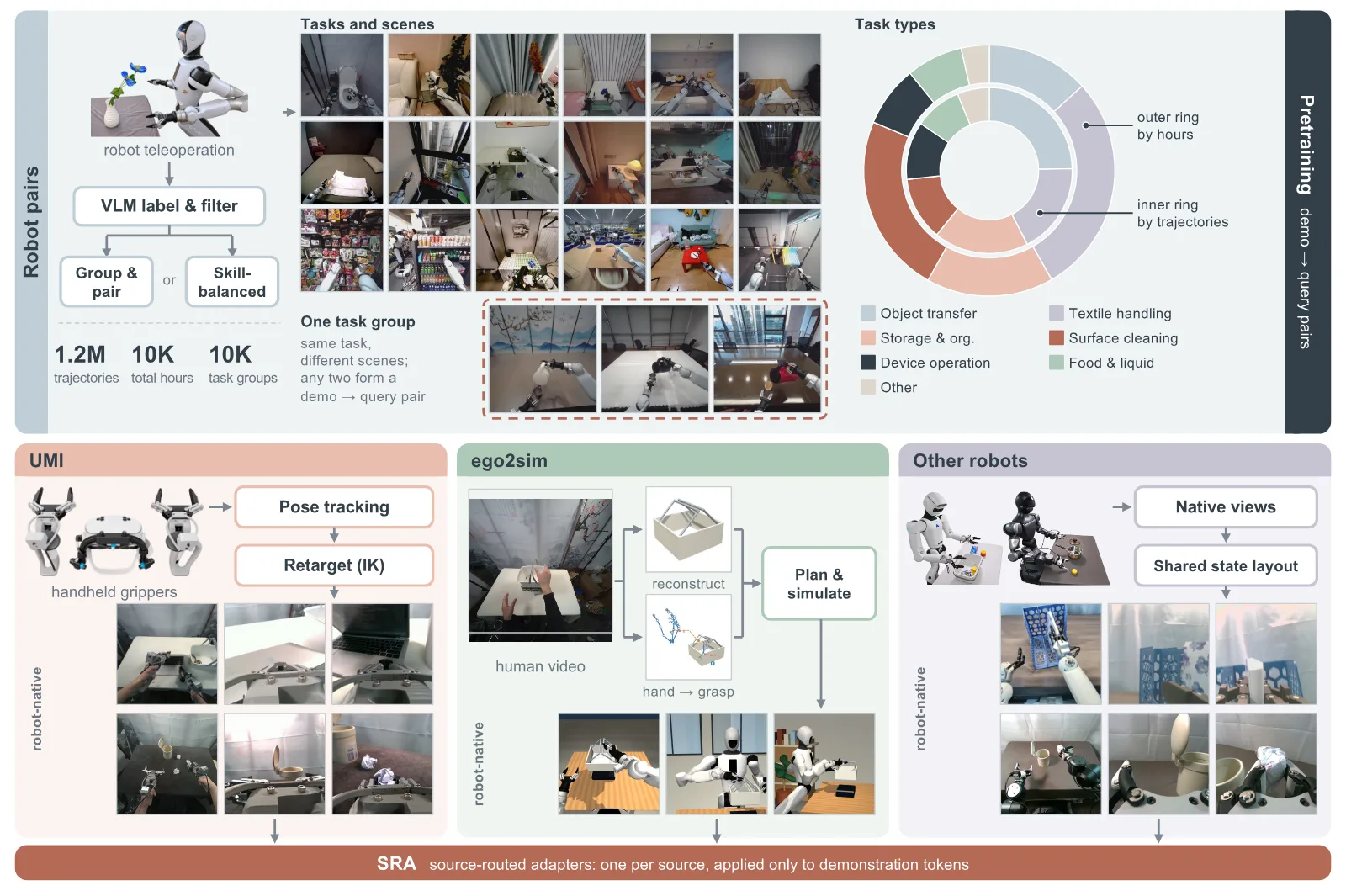
The authors built a robot model that learns by example at the moment of use. This is called in-context learning: the model is shown a demonstration of a task and copies it, without its internal settings being changed. The robot that does the work is the executor. Whatever supplies the example, whether a person, a simulator or another robot, is the demonstrator.
The central idea is to translate every demonstration into the executor's own point of view. That means the same three cameras (one on the head, one on each wrist) and the same set of joint movements. A human video is first re-enacted by a simulated copy of the robot. A recording from another robot has its joint movements converted. Once translated, all examples look roughly the same to the model.
The model learned to follow examples from pairs of recordings of the same task, made by people remotely steering Galbot G1 robots. The collection holds 1.2 million recordings, about 10,000 hours, across about 10,000 tasks. It is built on NVIDIA's Cosmos-Predict2 video model and predicts both the robot's next two seconds of movement and what the scene should look like.
The authors report two real-world tests of six tasks each, all absent from training, with 100 trials per task. On the first set, which recombines skills the robot already had, it succeeded 57.5% of the time from one example and no extra training. The vision-language-action models π0.5 and GR00T N1.7, which follow text instructions and were fine-tuned on 50 examples per task, reached 43% and 47.5%. Two earlier example-following methods, retrained on the same robot data, reached under 20%.
On the second set, which needs skills the robot never learned, such as handling a cloth bag or pouring with both arms, every in-context method was first trained on 20 examples per task. The model reached 72.7%, against 47.5% for GR00T N1.7 with 50 examples. On the public RoboTwin 2.0 simulation benchmark it scored 53.1% on seven unseen tasks, against 47.0% for the earlier method Zero-WAM.
For other kinds of demonstrator, the authors added small plug-in adapters, trained on 200 example pairs per source while the main model stayed fixed. With these, examples from simulation, human video, a handheld gripper and two other robot brands kept 74% to 91% of the success the robot achieved with its own examples. Without the adapters, other robots' examples almost never worked.
A simple tracker, which needs no training, keeps the model looking at the part of the example that matches where the robot is now. If a step fails, for instance a dropped object, the tracker jumps back so the robot redoes it. Turning this off cost 11 points of success. This is a preprint and has not been peer reviewed.
Our reading
In our reading, the strongest evidence is that the example itself carries the task. When the authors removed the demonstration and gave only a text instruction, success fell from 65% to 26% with the same training data. When they gave a deliberately wrong example, the robot mostly followed the example, not the instruction. That is what an example-following system should do, and it is checked on a real robot.
The headline comparison needs care. The fine-tuned models and this model were tested under different rules by design: 50 task examples for them, none or 20 for it. That is the point of the method, but it is not a like-for-like contest. All the rival methods were also retrained or fine-tuned by the authors on their own robot, so the result depends on how well that was done.
The 74% to 91% figure is relative, not absolute. Human-video examples gave about 58% success and other robots about 48% to 51%, against 65% for the robot's own examples. That gap is real but modest, given each new source needed only 200 example pairs. In practice, a warehouse could film a worker packing a new item once and have the robot attempt it, though roughly four tries in ten would still fail.
The rest of this story is for members. Membership is free: read it at scienceunderway.com/articles/galbot-robot-learns-unseen-tasks-from-one-demonstration-beating-fine-tuned-gr00t
Read the rest of this story
Membership is free. You get every article in full, and can save stories and follow topics.
We send a sign-in link, no password needed. Already a member? Sign inReadiness assessment
| Level | Status | Evidence |
|---|---|---|
| I Lab only | Met | Working model with a full method description and appendix, tested on a real robot. |
| II Benchmarked | Met | Evaluated on the public RoboTwin 2.0 benchmark (53.1% vs 47.0% for Zero-WAM, baseline numbers taken from its paper), plus the authors' own twelve real-world tasks against four baselines. |
| III Open source | Not yet | The paper links only a project page (https://any2act.github.io). It does not state that code, weights or the 1.2M-trajectory dataset are released. |
| IV In production | Not yet | No documented use by a named organisation outside the authors' own evaluation. Galbot is an author affiliation, and all tests are in-house benchmarks. |
What would move it up
Releasing code and model weights, and ideally the training data or a comparable open set, would reach level 3. Level 4 needs documented use by an outside organisation, or independent replication on other robots, and on contact-rich tasks.
The study
Ziang Ren, Zifan Wang, Zhuoyang Li et al.. Any2Act: Scaling In-Context Robot Learning from Heterogeneous Demonstrations. arXiv, 24 November 2026. Read the paper
Notes
- Ren, Wang, Li et al. Any2Act: Scaling In-Context Robot Learning from Heterogeneous Demonstrations. arXiv preprint, 24 November 2026, CC BY 4.0. Source
- Project page. The paper does not state that code, weights or data are released. Source
- Main real-world results (Table 2): new tasks with no training, 57.5% against 43.0% (π0.5) and 47.5% (GR00T N1.7), both fine-tuned on 50 examples; HOST 15.7%, Zero-WAM 19.7%. Harder tasks with 20 examples: 72.7% against 47.5% for GR00T N1.7. All twelve tasks: 65.1%.
- Other sources with adapters (Table 5): simulation 59.1%, human video 57.9%, handheld gripper 55.1%, Astribot S1 51.0%, Spirit Moz1 48.2%, against 65.1% with the robot's own examples.
- RoboTwin 2.0, seven unseen tasks (Table 3): 53.1% against 47.0% for Zero-WAM and 11.0% for WAN-Action. Reported latency: 180 ms per two-second action chunk on one H200 GPU.
Edited and signed by
Stefan PerdalEditor and publisher142 stories editedStefan read the study, set the readiness level and approved this story. An AI system found the paper and wrote the first draft.
How this was made
An AI model read the study and wrote this article in the structure Science Underway uses. An editor reviewed it and approved it for publication. Check the original study before you rely on the details.
How we workNo corrections