Fine-tuning Qwen3.6 on 10,807 video-built robot simulations lifts success to 21%
A preprint turns real robot videos into thousands of simulated tasks for AI coding agents that control robot arms. Top closed models do well, open models mostly fail, and a small open model trained on the set improves sharply but stays far behind.
scienceunderway.com/articles/fine-tuning-qwen3-6-on-10-807-video-built-robot-simulations-lifts-success-to-21

What the study shows
The work is a preprint from Tsinghua University, the start-up Einsia.AI and several other universities. It has not been peer reviewed. It focuses on what the field calls agentic robotics: a language model controls a robot arm by writing and running short programs, rather than mapping camera pixels straight to motor commands.
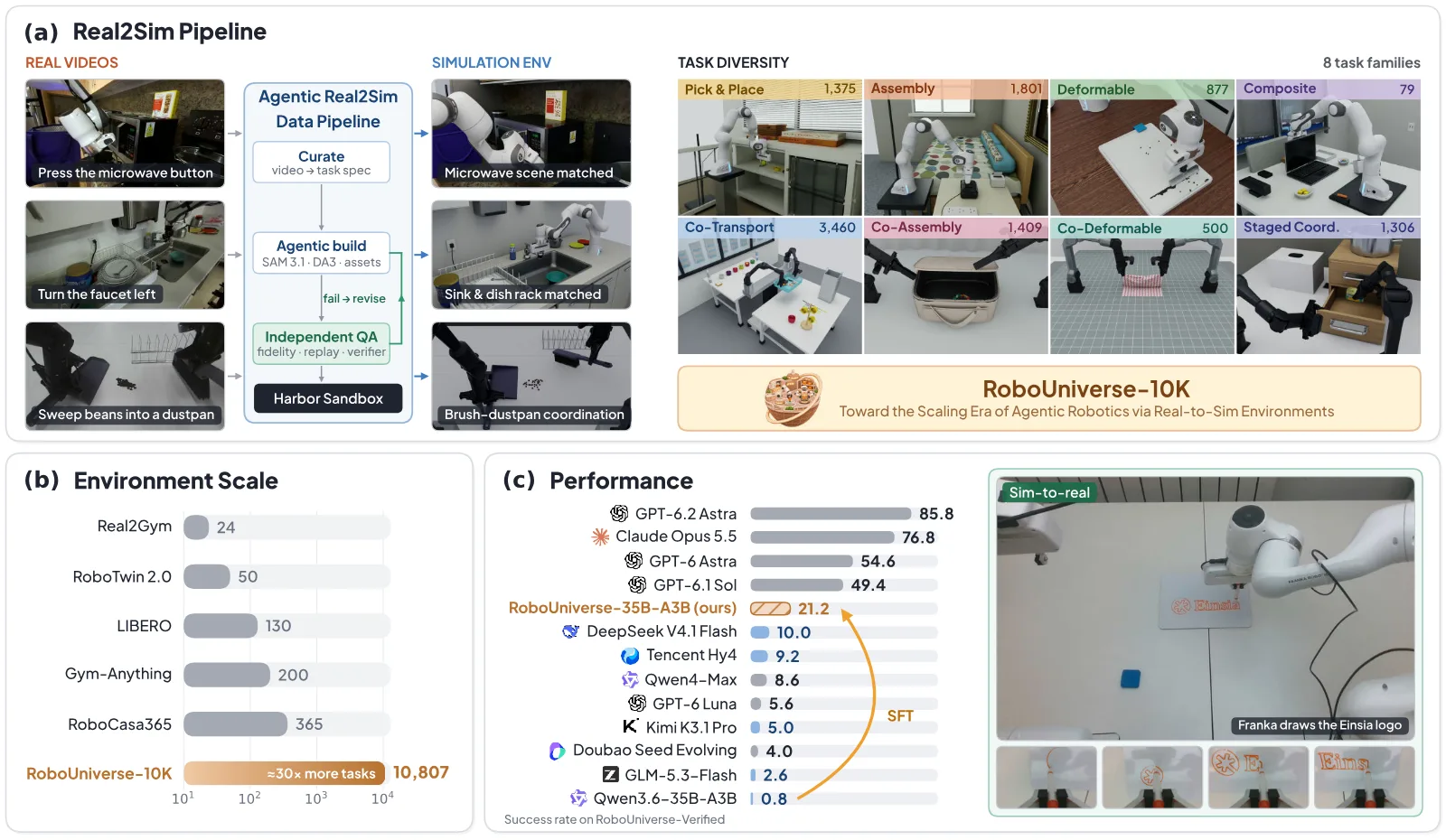
The authors built 10,807 tasks in NVIDIA Isaac Sim, a physics simulator, from public videos of real robot arms. About 4,100 use one Franka arm and about 6,700 use two AgileX arms. A coding agent rebuilds each scene, writes a reference solution and writes a hidden checker, called a verifier, that decides pass or fail. A second agent audits each task for realism and for loopholes. The comparison sets cited in the paper have between 24 and 365 tasks.
They held back 500 tasks as a test set, checked by 10 human experts. Eleven models each got one attempt per task, with only camera images and joint readings. GPT-6.2 Astra solved 85.8% and Claude Opus 5.5 solved 76.8%. No model scored between 10% and 49%. The best of the seven weaker models, DeepSeek V4.1 Flash, reached 10.0%.
The authors report that weaker models fail mainly at grasping. On tasks that only need a push or topple they succeed about a third of the time, but on tasks needing a grasp they almost never succeed. Even the top models struggle with cloth, such as folding a towel in half. About 80% of their failures happen after they have already touched the object, for example a lid placed 6 mm off centre or a button pressed too hard.
Finally, the authors fine-tuned the open model Qwen3.6-35B-A3B on about 17,000 worked examples recorded from GPT-6 Astra. This is supervised fine-tuning: the smaller model learns to copy the larger one. Success on the test set rose from 0.8% to 21.2%, ahead of every open model tested. Gains were large on single-arm tasks and small on two-arm tasks.
Our reading
In our reading, the main contribution is the scale of the task set, not the trained model. Building a graded robot task by hand is slow, which has kept robot benchmarks small. Using agents to convert videos into tasks, then having another agent check them, is a plausible way to get thousands. If the tasks hold up, they could play the role that large repository-mined task sets played for software agents.
The benchmark results are useful mainly as a diagnosis. They point to physical skill rather than understanding as the gap: weaker models seem to know what to do but cannot grip reliably. A concrete example: an agent asked to put a lid on a pot may produce a final image that looks right, yet the lid sits a few millimetres off and the task fails. Camera images alone make such errors hard to see.
The fine-tuned model's jump is real on this benchmark but needs context. It reaches about a fifth of tasks, while its teacher scores more than half. And the test tasks come from the same pipeline as the training tasks, so they may share styles and sources.
The rest of this story is for members. Membership is free: read it at scienceunderway.com/articles/fine-tuning-qwen3-6-on-10-807-video-built-robot-simulations-lifts-success-to-21
Read the rest of this story
Membership is free. You get every article in full, and can save stories and follow topics.
We send a sign-in link, no password needed. Already a member? Sign inReadiness assessment
| Level | Status | Evidence |
|---|---|---|
| I Lab only | Met | A working pipeline, environments and a fine-tuned model exist, and the paper includes a qualitative real-robot demonstration. |
| II Benchmarked | Met | The authors report results for 11 models on a 500-task held-out benchmark, with a fine-tuned model that improves from 0.8% to 21.2%. The benchmark is the authors' own and is not an independently established public benchmark. It is public in the sense that it is released and the results are tabulated. |
| III Open source | Met | The paper states that the environments and the model are open-sourced and gives a homepage (https://lab.einsia.ai/robo-universe). I could not check the repository or licence from the paper alone, so the release is taken from the authors' statement. |
| IV In production | Not yet | No named organisation reports using the environments or model in production. The real-robot test is a single drawing demonstration. |
What would move it up
Documented use by a named third party, or a robot team reporting gains in real deployment, would support level 4. Independent replication of the benchmark results, real-robot success rates over many trials and tasks, and an RL result on the released environments would strengthen the case.
The study
Jinkun Liu, Yingze Wang, Situ Wang et al.. RoboUniverse-10K: Toward the Scaling Era of Agentic Robotics via Real-to-Sim Environments. arXiv, 23 November 2026. Read the paper
Notes
- Liu, Wang, Wang, Hong, Gao, Li, Chi and others. RoboUniverse-10K: Toward the Scaling Era of Agentic Robotics via Real-to-Sim Environments. arXiv preprint, 23 November 2026, CC BY 4.0. Source
- Project homepage, where the authors say the environments and model are released. Not independently checked. Source
- Exact figures: overall success GPT-6.2 Astra 85.8%, Claude Opus 5.5 76.8%, GPT-6 Astra 54.6%, GPT-6.1 Sol 49.4%, DeepSeek V4.1 Flash 10.0%, GLM-5.3-Flash 2.6%. Qwen3.6-35B-A3B 0.8% before and 21.2% after fine-tuning (single-arm 2.0% to 40.5%, dual-arm 0.0% to 8.3%).
- Training data: about 17,000 trajectories, 0.79 billion tokens, generated by GPT-6 Astra at medium effort; about 1,500 H100 GPU hours.
- Readiness: level III (open source available), on the authors' stated release. Level IV not met: no documented production use.
Edited and signed by
Stefan PerdalEditor and publisher142 stories editedStefan read the study, set the readiness level and approved this story. An AI system found the paper and wrote the first draft.
How this was made
An AI model read the study and wrote this article in the structure Science Underway uses. An editor reviewed it and approved it for publication. Check the original study before you rely on the details.
How we workNo corrections