A Freiburg-led team trained robot arm skills from people's demonstrations, which record no robot commands, and then improved them inside a learned simulator. Robot recordings are still needed to translate those skills into motor commands.
Researchers trained a 27-billion-parameter open-weight reasoning model to control robot arms using only simulated practice. On a real two-armed robot it had never seen, it succeeded in 18 of 30 trials. The work is a preprint and has not been peer reviewed.
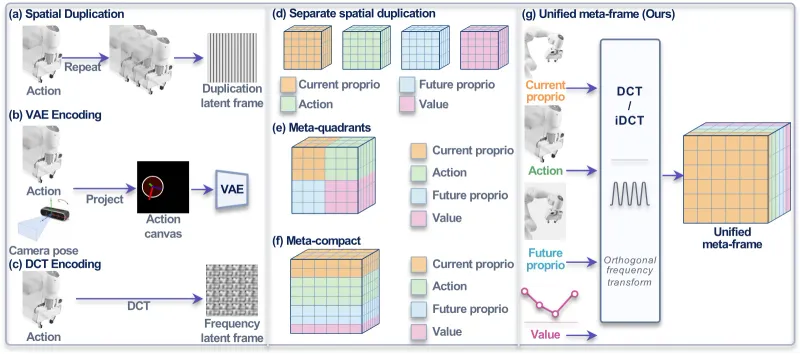
A preprint from the National University of Singapore folds a robot's actions, joint readings and value estimates into a single frame that a pretrained video model treats as natural. Queries run 39% faster and simulated benchmark scores rise slightly.