Self-written interrupts halve robot contact with simulated people in RoboCasa365 kitchens
A preprint lets a robot's AI agent write small watch programs that stop the robot mid-task when a person comes close. In simulated kitchens it roughly halved contact with a person, without lowering task success.
scienceunderway.com/articles/self-written-interrupts-halve-robot-contact-with-simulated-people-in-robocasa365

What the study shows
Many robot systems now pair a large AI model, the 'agent', with a pretrained robot skill called a policy. The agent plans; the policy moves the arm. The agent usually waits until the policy finishes before it looks again. If a person steps in mid-move, the agent does not notice.
The authors, from the University of Massachusetts Amherst and the University of Minnesota, propose a harness they call TRIP. With each action, the agent writes a short Python program, a tripwire. It runs alongside the policy and asks a small vision model simple questions, such as where the nearest person is. It combines the answer with depth readings and timers. When a condition is met, it halts the robot and wakes the agent with the reason. The agent then decides what to do and can rewrite the tripwire. No model is retrained.
To test it, the authors built RoboHD: 168 simulated kitchen scenes based on the RoboCasa365 benchmark, each with an animated person who blocks the path, moves objects, closes doors or works nearby. Any contact with the person counts as failure. They tried four existing robot policies, including Xiaomi-Robotics-1, the strongest.
The main comparison is against a turn-based harness with the same agent, tools and instructions. The only difference is when the agent gets to look again. With Xiaomi-Robotics-1, the authors report safety rising from 61.3% to 81.3%. Safety here means episodes without contact, among scenes the robot can solve. Task success with the person rose from 31% to about 39%. Without the person, both were about equal. Safety was higher with TRIP for all four policies.
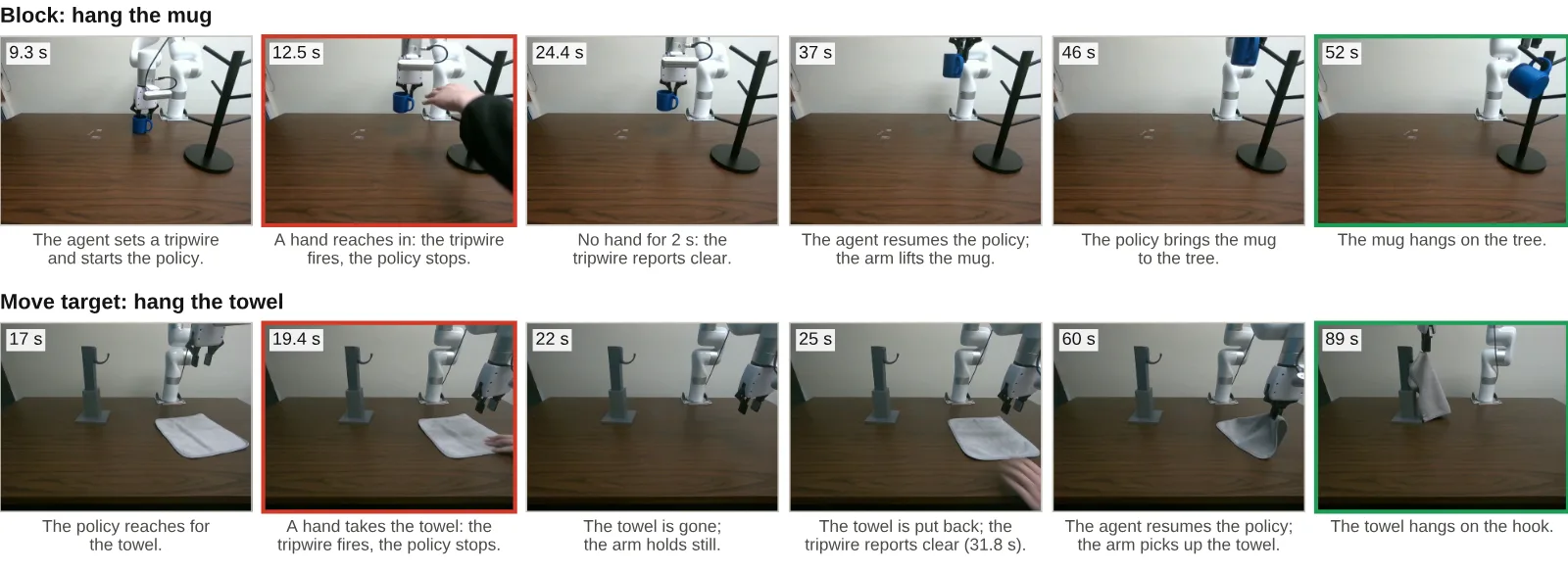
On a real robot arm hanging a mug or a towel, a person blocked the arm or took the object away. TRIP succeeded in 25 of 40 such trials. The turn-based harness managed 5, and the policy alone 1. A tripwire check took about a quarter of a second. A full agent decision took over 4 seconds. This is a preprint and has not been peer reviewed.
Our reading
In our reading, the useful idea is simple. Watching for a person is a perception job, not a reasoning job. A small vision model can do it several times a second. The expensive planner only needs waking when something changes. TRIP turns that split into code the planner writes for itself.
The comparison is fairly clean. The baseline uses the same agent, tools and prompt, so the safety gain is plausibly due to the tripwires, as the authors argue. The ablation supports this. A fixed rule that freezes the robot when anyone is within 0.6 m was the safest setup, at 86%, but success fell to about 16%. Letting the agent rewrite its tripwire as the situation changed balanced safety and progress better.
A practical example: a kitchen or warehouse robot could keep working beside someone chopping vegetables, pause when a hand reaches towards the gripper, and resume once the hand has gone. The paper's real-robot clips show exactly this pattern, though on a small scale. On our Readiness Scale we rate the work level II, benchmarked: there are results on a benchmark, but it is the authors' own, and no code is released.
The rest of this story is for members. Membership is free: read it at scienceunderway.com/articles/self-written-interrupts-halve-robot-contact-with-simulated-people-in-robocasa365
Read the rest of this story
Membership is free. You get every article in full, and can save stories and follow topics.
We send a sign-in link, no password needed. Already a member? Sign inReadiness assessment
| Level | Status | Evidence |
|---|---|---|
| I Lab only | Met | A working method is described and tested in simulation and on a real robot arm. |
| II Benchmarked | Met | Results on RoboHD, a new benchmark built by the authors on RoboCasa365, compared against a policy-alone baseline and a turn-based agentic baseline across four policies. The benchmark is the authors' own, not an established public one. |
| III Open source | Not yet | The paper gives no link to code, benchmark scenes or weights. The agent is a closed commercial model. |
| IV In production | Not yet | No documented use by a named organisation outside the authors' own lab tests. |
What would move it up
Releasing the TRIP harness, the RoboHD scenes and the avatar controller would reach level 3. Level 4 would need use by a third party around real people, with safety measured against real human motion rather than a scripted avatar.
The study
Sunli Chen, Yun Zong, Qinhong Zhou et al.. Tripwire: Robot Agents that Program Their Own Interrupts under Human Disturbance. arXiv, 20 November 2026. Read the paper
Notes
- Chen, Zong, Zhou, Qiu, Chen, Yang and Gan, 'Tripwire: Robot Agents that Program Their Own Interrupts under Human Disturbance', arXiv preprint, 20 November 2026, CC BY-SA 4.0. Source
- Exact figures with Xiaomi-Robotics-1 on 168 scenes: success with person 38.7% (TRIP) vs 31.0% (turn-based) vs 20.8% (policy alone); without person 73.2% vs 73.8%; safety over 150 scenes 81.3% vs 61.3% vs 46.0%. Contacts over all 168 scenes: 32 vs 66 vs 86.
- Ablation: agent-designed fixed tripwire 33.3% success, 61.3% safety; pre-defined fixed rule 86.0% safety, 16.1% success. Agent tool calls 19.4 vs 30.3 per minute of robot time.
- Real robot (UFACTORY xArm 7, π0.5 policies): 25/40 (TRIP), 5/40 (turn-based), 1/40 (policy alone) under disturbance. Tripwire check 0.24 s on average; agent turn 4.3 s. Cost $0.2 to $0.3 per simulated episode.
- No code repository is linked in the paper.
Edited and signed by
Stefan PerdalEditor and publisher142 stories editedStefan read the study, set the readiness level and approved this story. An AI system found the paper and wrote the first draft.
How this was made
An AI model read the study and wrote this article in the structure Science Underway uses. An editor reviewed it and approved it for publication. Check the original study before you rely on the details.
How we workNo corrections