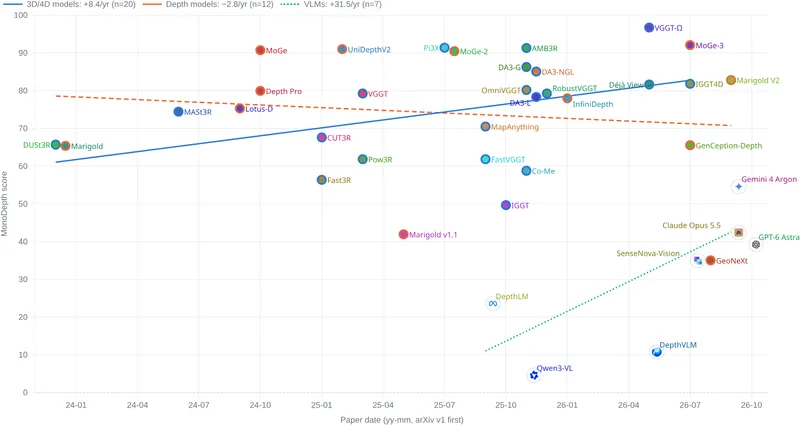
A new open benchmark scores depth, reconstruction and camera-tracking models under one set of rules. Models that look solved on public test sets lose much of their accuracy on large, handheld captures.
NVIDIA wraps one image generator in a plan, check and repair loop. Prompt-following and knowledge scores rise sharply, but the best results lean on a closed GPT-6 agent. Preprint, not peer reviewed.
A preprint describes one model that flags about a thousand findings across many kinds of CT scan, points to where it sees them and drafts a report. It learned all three tasks from ordinary hospital reports, with no hand-drawn lesion outlines.
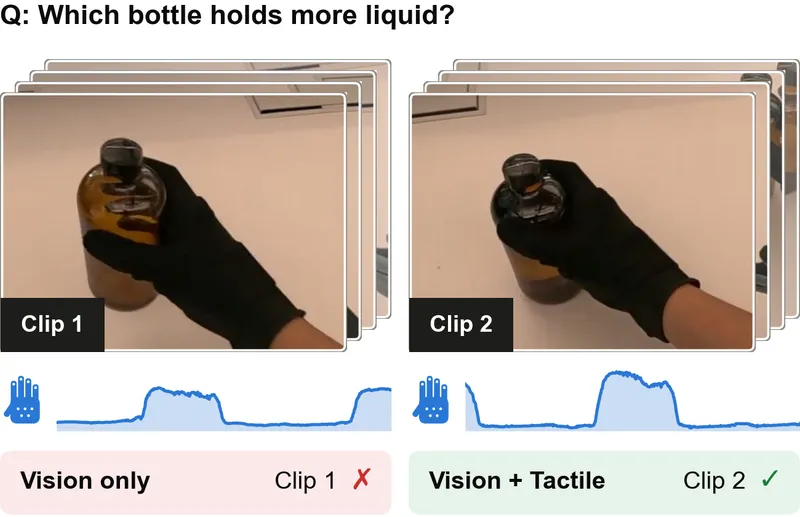
A Meta-led preprint finds that leading vision-language models guess at chance when an object's key property is hidden from the camera. Writing a glove's touch readings into the prompt as plain text recovers part of the gap, mainly when comparing two objects.
A Danish study trained deep learning models on about 27,700 routine smartphone face photos from emergency patients. The resulting face score ranked mortality risk better than blood tests or vital signs, but it has only been tested inside one region's data.
Researchers at Kyutai shrank a slow talking-head video model into one that keeps pace with speech. The smaller version runs faster than real time on a single GPU. The work is a preprint and has not been peer reviewed.
A preprint finds that online AI services shrink or reject large photos before the model sees them. Cutting photos into tiles, or letting the model zoom, recovered much of the lost accuracy.
A small machine learning model learns weather forecasting and data blending straight from 18 kinds of instrument. Near the ground it beats the main US ensemble for up to 12 hours, but it trails operational systems higher up.
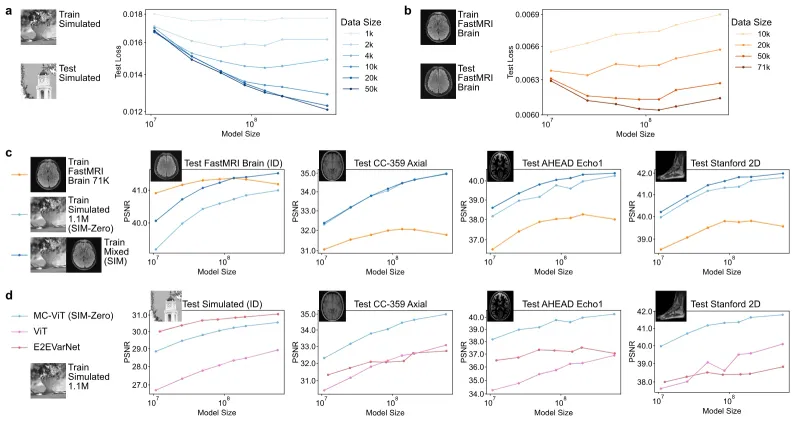
A preprint trains an MRI reconstruction model mostly on fake scanner data made from everyday photographs. On scans from other hospitals and machines, it beat methods trained on real patient scans.
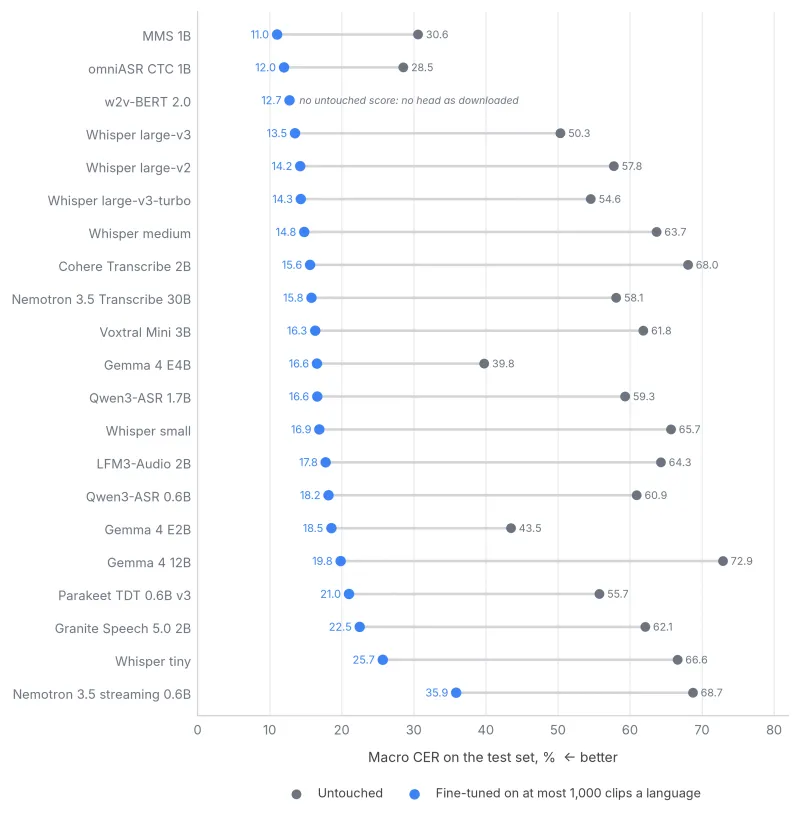
A large preprint fine-tunes 24 open speech recognisers on 50 low-resource languages. Every model improves sharply, but the output is still a draft that needs human correction.
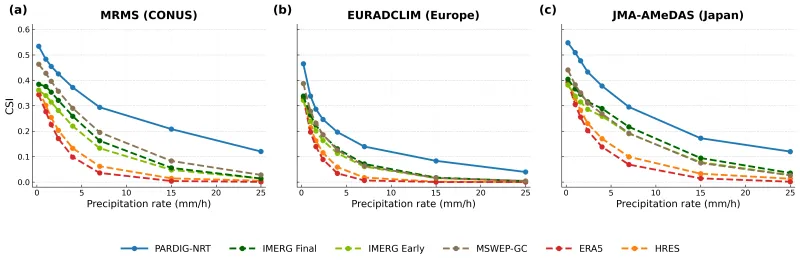
A Google DeepMind and Google Research model turns weather data and satellite images into rain maps every 15 minutes. In the authors' tests it beats the main existing products, most clearly in heavy rain. The paper is a preprint and has not been peer reviewed.
A preprint benchmark of 12 image-counting tasks finds that free, off-the-shelf vision-language models are a strong starting point for estimating totals with a small human-labelled sample. Letting the model pick which images people check usually helps further.
A single-author preprint retrains a small open streaming model so its median word appears about 90 ms before the speaker finishes it, each word tagged with a usable confidence. The cost is more words taken back, and it is less accurate than larger models.