Image services erase small details; tiling and zooming win most back
A preprint finds that online AI services shrink or reject large photos before the model sees them. Cutting photos into tiles, or letting the model zoom, recovered much of the lost accuracy.

 AI illustration
What the study shows
The study comes from Carnegie Mellon University and is a preprint, not yet peer reviewed. It tested seven vision-language models, AI models that answer questions about images. Six were commercial: Claude Haiku 5.5 and Sonnet 5.5, Gemini 3.5 Flash-Lite and 3.8 Flash, and GPT-6 Luna and GPT-6.1 Sol. The seventh was the open model Qwen3.8-27B.
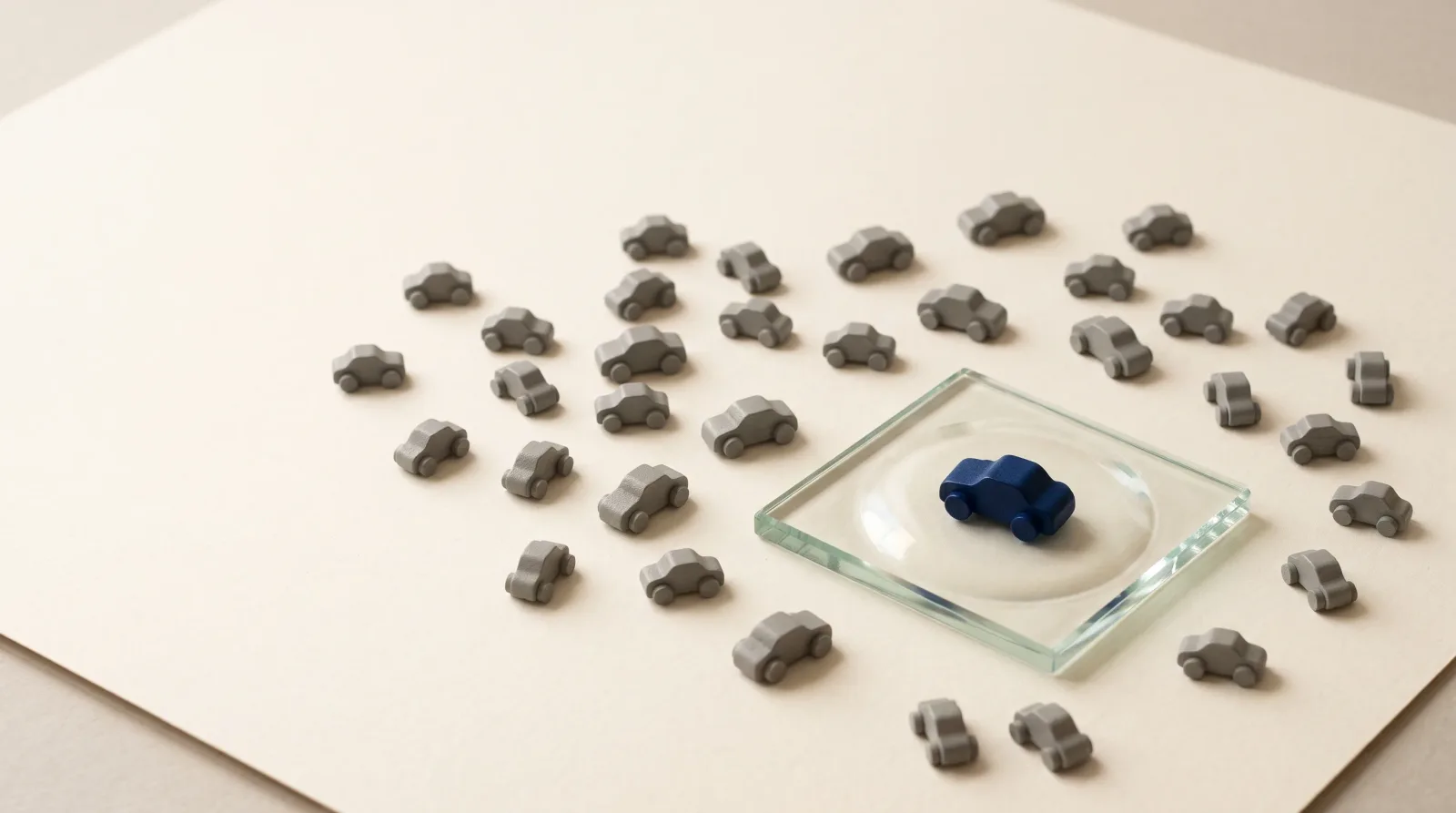
The starting point is plumbing. Each service fits images to its own limits. Claude shrinks a large image to a fixed size. Gemini caps the number of tokens, the small units a model reads. OpenAI keeps the full image by default but rejects very large ones. The authors give an example: a car 20 pixels wide in a large drone photo reaches Claude about 6 pixels wide.
To measure the damage, the authors built an eye exam. It is a set of random printed codes at ten text sizes, on plain grey images of four sizes. On the smallest image, every model read text 6 pixels tall or less at least half the time. On the largest, the text had to be much bigger. Sonnet, for example, went from about 4 pixels to 12. For a typical 8K photo at default settings, the authors' fitted curves predict a readable height of about 10 to 13 pixels.
They then asked 601 multiple-choice questions about small objects in large photos, drawn from three public benchmarks. Splitting each photo into up to nine tiles raised accuracy by 11 to 15 percentage points for Claude and Gemini. OpenAI's default rejected about a third of the photos. Tiles avoided the rejections and lifted GPT-6.1 Sol from about half right to about 84%.
A cheaper method, the two-step zoom, first asks the model which region it needs, then sends that crop with an overview. It used about 40% of the image tokens of tiles. On Gemini it scored slightly above tiles, though the gap is within statistical noise. On Claude it was level with tiles for Haiku and 2.5 points behind for Sonnet.
When a detail was lost, Claude and Gemini both said they could not tell about half the time. The rest of their answers differed. The authors report that Gemini gave a confident wrong answer in 43% to 48% of these cases, and Claude in only 5% to 9%.
Finally, the authors tested ways for an agent to decide when to zoom. A check before the call, based on a 16-pixel detail size, almost never triggered and missed most of the gain. On Claude, the model's own reply worked better. Tiling only after an unsure reply came within 1.4 points of always tiling, with about two thirds of the image tokens.
Our reading
In our reading, the most useful finding is that a large share of apparent model blindness is preprocessing. GPT-6.1 Sol looked weak at about half right overall. Yet on the photos the service actually accepted, it scored 79%. The weakness was mostly rejected images, not poor sight. Anyone comparing vision models on large images should first check what each service does to the file.
The confidence result matters for anyone building agents, systems that act on a model's answers without a person checking each one. A model that says it is unsure gives the system a cheap signal to try again. A model that guesses confidently does not. In practice, a team checking drone photos of a car park could send each photo once to Claude, and re-send it as tiles only when the model hedges. With Gemini, the authors suggest always using the two-step zoom instead.
We rate the work at level III, open source available. The authors say they release the eye exam, every model answer and the code, though we have not checked the link or its licence. Results are on public benchmarks. No organisation is documented as using these rules in production.
Read the rest of this story
Membership is free. You get every article in full and the Issue every Sunday.
We send a sign-in link, no password needed. Already a member? Sign inReadiness assessment
| Level | Status | Evidence |
|---|---|---|
| I Lab only | Met | The work started as lab measurement: a synthetic eye exam and a set of questions run through commercial APIs. |
| II Benchmarked | Met | Results on three public benchmarks (V*Bench, HR-Bench 8K, MME-RealWorld Lite) across seven models, with bootstrap intervals and pre-stated hypotheses (H1 to H4, several of which failed). |
| III Open source | Met | The authors state they release the eye exam, every model answer and the code at https://siddvoh.com/know-when-to-zoom. We could not check the link or the licence from the paper alone. |
| IV In production | Not yet | No named organisation is documented as using the zoom or tiling rules in production. The paper offers five rules but reports no deployment. |
What would move it up
Documented use of the zoom or reply-triggered tiling rules by a named organisation in production, with before and after results. Independent replication on newer model versions and on medical or radar images would also strengthen the case.
The study
Siddharth Vohra, Min Xu. Know When to Zoom: How Small Is Too Small for Vision-Language Models?. arXiv, 17 November 2026. Read the paper
Notes
- Vohra, S. and Xu, M. Know When to Zoom: How Small Is Too Small for Vision-Language Models? arXiv preprint 2611.22709, 17 November 2026. Not peer reviewed. Source
- Eye exam, model answers and code, as stated by the authors. Link and licence not checked by us. Source
- Exact accuracies, as is against 3 by 3 tiles: Haiku 59.2% to 73.7%, Sonnet 72.4% to 83.5%, Flash-Lite 58.6% to 70.5%, Flash 68.1% to 80.5%, Sol 50.7% to 83.7%. Two-step zoom: Flash-Lite 72.2%, Flash 83.0%, Haiku 73.5%, Sonnet 81.0%. Qwen as is: 71.5% (Table 3).
- OpenAI's default rejected 215 of 601 photos, including 144 of 150 HR-Bench photos. Sol scored 79.0% on the 386 accepted photos.
- Reply-triggered tiling on Claude reached 72.4% (Haiku) and 82.9% (Sonnet), within 1.4 points of always tiling, using 62% to 70% of the image tokens.
- Figure 4 of the paper shows accuracy against image tokens for each method. The arXiv licence does not allow reuse, so we link to it rather than reproduce it. Source
Edited and signed by
Stefan PerdalEditor and publisher86 stories editedStefan read the study, set the readiness level and approved this story. An AI system found the paper and wrote the first draft.
How this was made
An AI model read the study and wrote this article in the structure Science Underway uses. An editor reviewed it and approved it for publication. Check the original study before you rely on the details.
How we workNo corrections