Claude and Qwen cannot see hidden properties; glove readings as text help
A Meta-led preprint finds that leading vision-language models guess at chance when an object's key property is hidden from the camera. Writing a glove's touch readings into the prompt as plain text recovers part of the gap, mainly when comparing two objects.
scienceunderway.com/articles/claude-and-qwen-cannot-see-hidden-properties-glove-readings-as-text-help

What the study shows
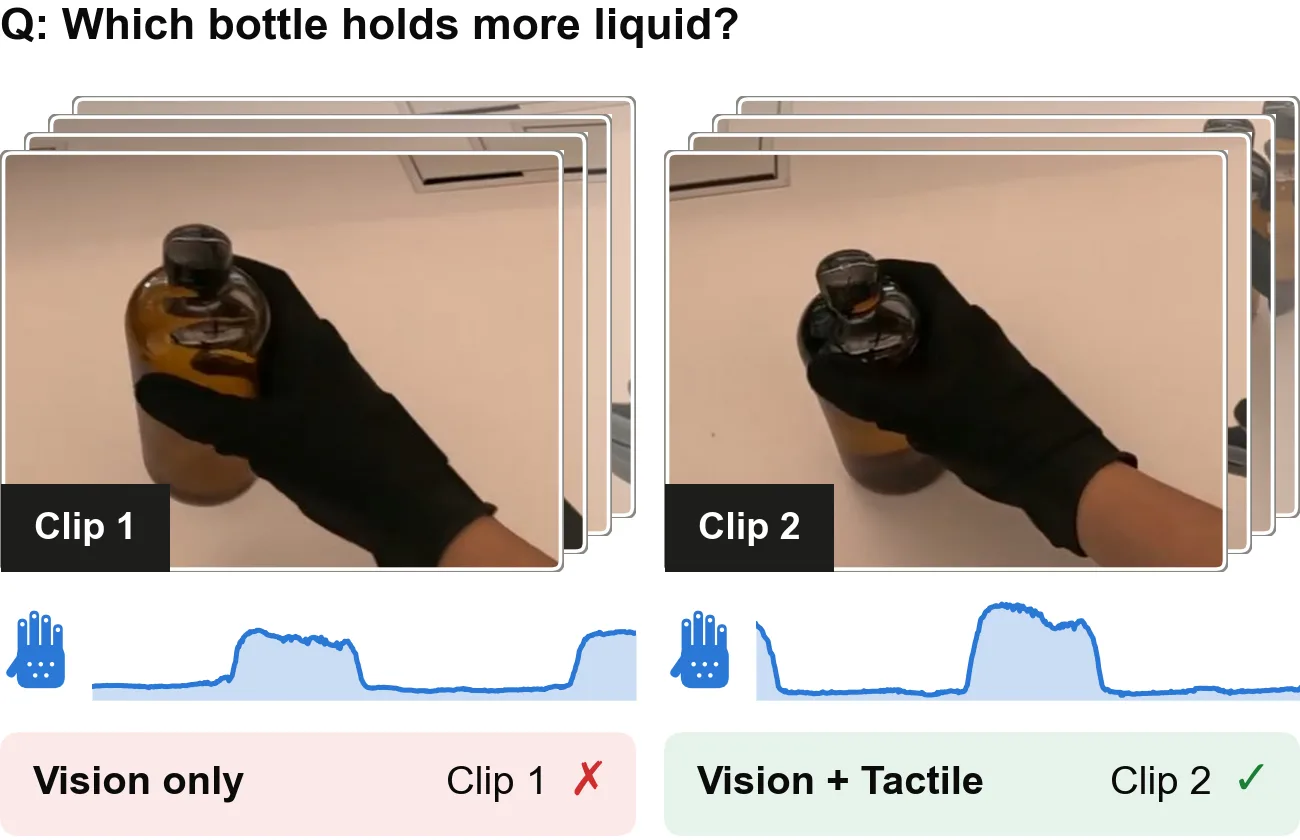
The authors, from Meta Reality Labs, Yale and Texas A&M, built a test set called TouchBench. Five people handled everyday objects while wearing a head camera and a glove with 137 sensor channels. The result is 900 short clips across 11 tasks, such as squeezing balls, lifting bottles and tightening caps.
Each question is labelled by whether the answer is visible in the video. In Tier A it is, for example the fill level of a clear bottle. In Tier B it is hidden, for example the fill level of an opaque bottle or a surface covered by the hand. Tier A acts as a control: a model that passes it can do the task when it can see.
Four vision-language models, which answer questions about images and text, were tested: InternVL3-8B, Qwen3.5-9B, Claude Sonnet and Claude Opus. With video alone they averaged about 66% when comparing two visible clips. On hidden properties they averaged about 50%, which is chance for a two-choice question.
The near-chance scores were not random guessing. Three of the four models picked the second clip in roughly three quarters of hidden-property comparisons, even though correct answers were split evenly. Their answers depended on the order of the clips.
The authors then tried Tactile-as-Prompt, their name for turning the glove signal into 34 summary numbers, such as peak force, contact area and vibration, written as one line of text in the prompt. With no training, this raised average accuracy on hidden properties from about 50% to about 63%. The touch text alone, without video, did even better, at about 69%.
After fine-tuning Qwen3.5-9B on four participants and testing on the fifth, video plus touch text reached about 73% on hidden properties. Video alone reached about 67%, and a conventional trained tactile encoder also reached about 67%. The gains were largest for properties that push back on the hand: ball inflation, wind strength, pillow filling and bottle fill level.
This is a preprint and has not been peer reviewed.
Our reading
In our reading, the most useful part of this paper is the control, not the method. Many benchmarks cannot tell whether a model fails because a task is hard or because the information is simply absent. Splitting questions by whether the answer is visible makes that distinction. The result is a clear warning: on hidden properties, these models produce answers shaped by clip order, not by evidence.
The touch-as-text idea is simple and practical. It needs no access to model weights, so it works with closed commercial models as well as open ones. The authors also check that the fine-tuned model really reads the numbers: swapping touch text between clips drops its accuracy by about 13 points. Removing the force statistics removes most of that effect, which suggests force carries the useful signal.
On our readiness scale we rate this level II, benchmarked. The results come from the authors' own small benchmark with many controls. The paper links no code, data or glove details, so it does not reach level III.
The rest of this story is for members. Membership is free: read it at scienceunderway.com/articles/claude-and-qwen-cannot-see-hidden-properties-glove-readings-as-text-help
Read the rest of this story
Membership is free. You get every article in full, and can save stories and follow topics.
We send a sign-in link, no password needed. Already a member? Sign inReadiness assessment
| Level | Status | Evidence |
|---|---|---|
| I Lab only | Met | The work is a research prototype evaluated on a purpose-built lab benchmark with a custom tactile glove. |
| II Benchmarked | Met | Results are reported on a new benchmark (TouchBench) against four VLMs, video-only baselines, a learned-token encoder, other training-free formats and a tree classifier. Controls include order swaps, shuffled tactile text, unseen objects and users, and a 20-hour public corpus. The benchmark is the authors' own, not an established public one, and it is small. |
| III Open source | Not yet | The paper gives no link to code, data, benchmark or weights. The prompt template and feature definitions are in the appendix, so TaP could be reimplemented, but nothing is released. |
| IV In production | Not yet | No deployment by any named organisation is documented. The glove is a lab sensor and evaluation is offline. |
What would move it up
Releasing the TouchBench clips, glove data, questions and the TaP code would reach level 3. Level 4 would need documented use in a real assistive or robotic system with a named organisation. Before that, a larger benchmark with more participants, more than one glove, an agreement study for tier labels, and tests on more backbones would strengthen level 2.
The study
Ziyao Zeng, Ziyi Kou, Chuan Qin et al.. TouchBench: Can Vision-Language Models Feel Invisible Physical Properties?. arXiv, 19 November 2026. Read the paper
Notes
- Zeng et al., TouchBench: Can Vision-Language Models Feel Invisible Physical Properties? arXiv preprint, November 2026, CC BY 4.0. Source
- Exact figures: zero-shot video-only relative accuracy 66.4% (Tier A) and 49.8% (Tier B); TaP zero-shot Tier B 62.9%, tactile text alone 68.7%; fine-tuned Tier B 73.1% (video plus TaP), 67.4% (video only), 67.3% (learned tokens). Table 1.
- Shared-dimension Tier B: fine-tuned TaP 62.2% against video only 62.9% (Table D3). Per-participant gain of TaP over video: 8.9, 12.0, 0.3, 2.9 and 0.0 points (Table D7).
- Unseen objects with an unseen user: Tier B relative gain +4.2 points item-weighted, +1.7 under dimension macro-average; absolute Tier B −2.0 points (Table 4, Section D.4).
- Web-scale contact QA on the EgoTouch corpus: 67.1% to 75.5% after fine-tuning; caption-only prior 59.8%; chance 33.3% (Section 5.7, Table E1).
- No code or data release is linked in the paper.
Edited and signed by
Stefan PerdalEditor and publisher142 stories editedStefan read the study, set the readiness level and approved this story. An AI system found the paper and wrote the first draft.
How this was made
An AI model read the study and wrote this article in the structure Science Underway uses. An editor reviewed it and approved it for publication. Check the original study before you rely on the details.
How we workNo corrections