VGGT-Ω tops a 52-model 3D vision test, but real-world scenes trip every model
A new open benchmark scores depth, reconstruction and camera-tracking models under one set of rules. Models that look solved on public test sets lose much of their accuracy on large, handheld captures.
scienceunderway.com/articles/vggt-tops-a-52-model-3d-vision-test-but-real-world-scenes-trip-every-model

What the study shows
The study comes from MVP Lab and Imperial College London. It is a preprint and has not been peer reviewed. The authors built a benchmark that scores 52 models on five tasks. These run from estimating depth in a single photo to SLAM, short for simultaneous localisation and mapping, where a system tracks a moving camera and builds a map as it goes.
The test uses 23 public datasets. The authors added 30 new indoor and outdoor scenes, such as museums, stations, gardens and streets. They captured them with a handheld rig: a laser scanner (LiDAR) and three cameras. Two of the cameras look up and sideways, so their images are tilted.
The authors report that scoring choices matter a great deal. Most models predict shape only up to an unknown scale, so every prediction must be lined up with the true answer before scoring. A simple fitting method raised the depth error of the top model by more than half against a robust fit. The standard method for lining up camera paths understated error by up to 2.6 times, in tests on simulated and deliberately corrupted trajectories.
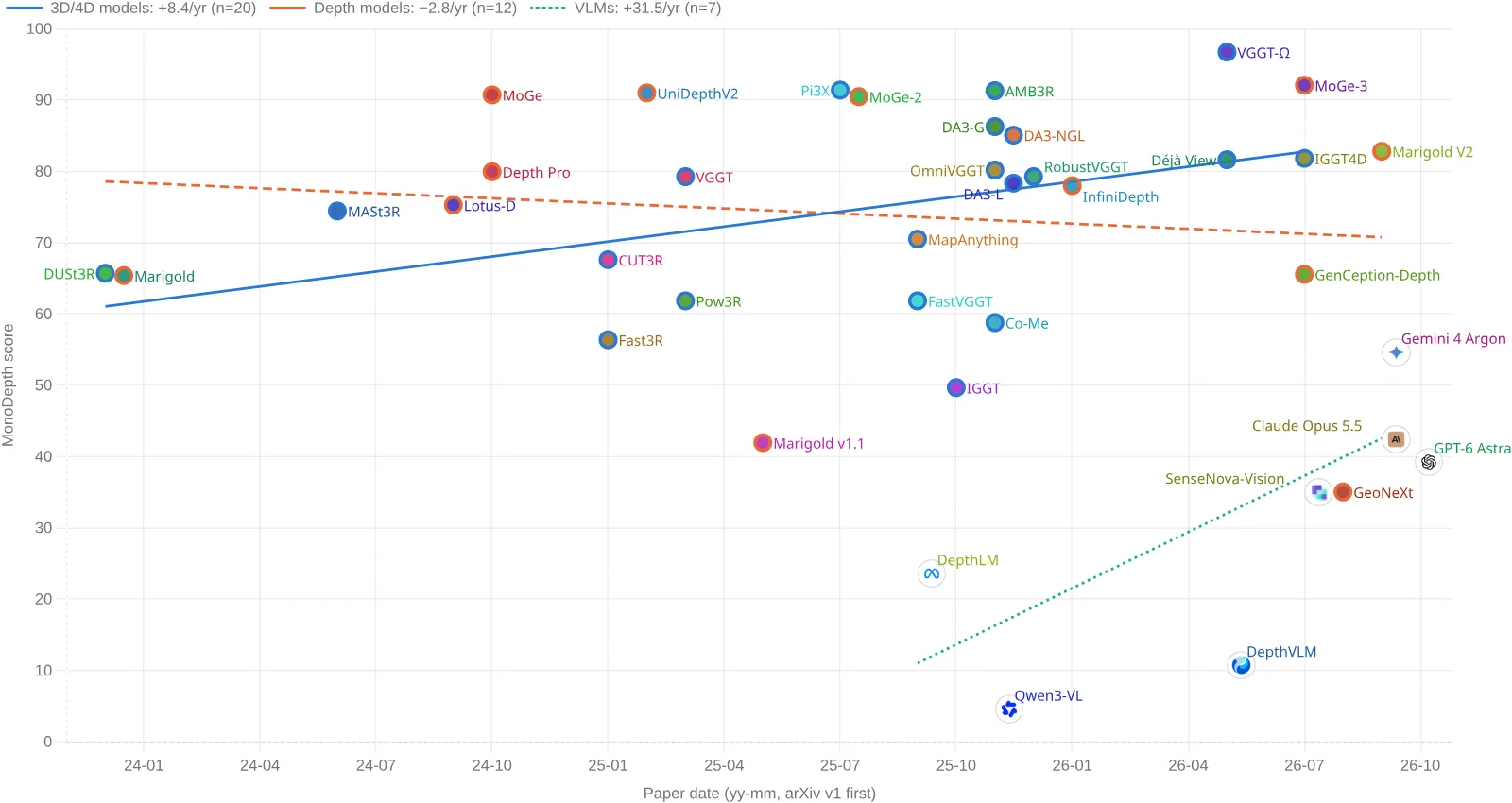
On public depth benchmarks, the best single-image model barely improved in two years. On the new scenes, the typical model's error was about 3.3 times higher. Errors roughly doubled on the tilted side cameras, and every analysed model placed far objects, beyond 20 metres, too close.
Models that reason over many views at once, known as feed-forward 3D/4D models, took the top 20 overall places. VGGT-Ω ranked first. On video depth, the best of these models had about half the error of the best dedicated video depth model. Vision-language models, including commercial ones from Anthropic, OpenAI and Google, were the weakest family at measuring depth.
Our reading
In our reading, the most useful result is not the leaderboard itself. It is the evidence that public rankings transfer only partly to harder conditions. For depth, the order of models on the new scenes broadly matches the public order. For short camera-tracking runs, the authors report almost no match at all. A model chosen from a public leaderboard may be the wrong choice outside the lab.
A concrete case: a team building a drone or a body-worn camera, where the image is often tilted, might pick a depth specialist that leads public tables. On tilted views in this study, such models made about twice the error they made on upright views. The authors note the effect is measured by comparing different cameras, not by rotating the same image, so tilt is the likely main cause but not proven.
The finding on scoring methods also matters beyond this benchmark. If the way a prediction is lined up can move a score by half, then many published comparisons between models may reflect evaluation choices as much as model quality.
The rest of this story is for members. Membership is free: read it at scienceunderway.com/articles/vggt-tops-a-52-model-3d-vision-test-but-real-world-scenes-trip-every-model
Read the rest of this story
Membership is free. You get every article in full, and can save stories and follow topics.
We send a sign-in link, no password needed. Already a member? Sign inReadiness assessment
| Level | Status | Evidence |
|---|---|---|
| I Lab only | Met | The benchmark and its analyses are described in full with code-level detail, including algorithms and ablations. |
| II Benchmarked | Met | 52 models are scored on 23 public datasets (NYUv2, KITTI, ETH3D, Sintel, 7-Scenes, Tanks&Temples and others) plus the new scenes, with per-dataset tables. |
| III Open source | Met | The paper lists a GitHub repository (mvp-ai-lab/SpatialArena) and a Hugging Face dataset. The abstract says they 'will be publicly released', so contents and licence were not verifiable from the paper. |
| IV In production | Not yet | No named organisation is documented as using SpatialArena in production or in decisions. It is a new evaluation tool, so production use is not applicable yet. |
What would move it up
Independent adoption would move it to level 4: other labs or companies reporting results on the leaderboard or using the toolbox in model selection. Confirmed public release of code, data and licence terms would firm up level 3. Third-party reproduction of the alignment findings would also help.
The study
Yu Chen, Haosen Yang, Su Ee Tan et al.. SpatialArena: Where Do Geometric Foundation Models Stand?. arXiv, 24 November 2026. Read the paper
Notes
- Chen, Yang, Tan, Zhang, Song and Deng. SpatialArena: Where Do Geometric Foundation Models Stand? arXiv preprint, November 2026, not peer reviewed. Licence CC BY 4.0. Source
- Code and toolbox (listed in the paper; the abstract says it will be released). Source
- Dataset on Hugging Face (listed in the paper). Source
- Project page. Source
- Exact figures: best public single-image AbsRel 5.5% to 4.9% in two years; best on new scenes 14.2%; median ratio new/public 3.28; VGGT-Ω video depth AbsRel 6.5% against 14.0% for GenCeption-Depth; least-squares fit raises VGGT-Ω AbsRel from 6.56% to 10.40%; Pi-Long large-range drift 27.0% on the new scenes.
- Readiness: proposed level III (open source available), pending confirmation that code and data are public.
Edited and signed by
Stefan PerdalEditor and publisher143 stories editedStefan read the study, set the readiness level and approved this story. An AI system found the paper and wrote the first draft.
How this was made
An AI model read the study and wrote this article in the structure Science Underway uses. An editor reviewed it and approved it for publication. Check the original study before you rely on the details.
How we workNo corrections