A few hours of audio teach speech models languages they never heard
A large preprint fine-tunes 24 open speech recognisers on 50 low-resource languages. Every model improves sharply, but the output is still a draft that needs human correction.

What the study shows
The study tests speech recognition, software that turns spoken audio into text. It takes 28 open models that each handle many languages. It scores them on 50 low-resource languages: languages with little recorded and transcribed speech. These cover 11 writing systems, with 25 test clips per language.
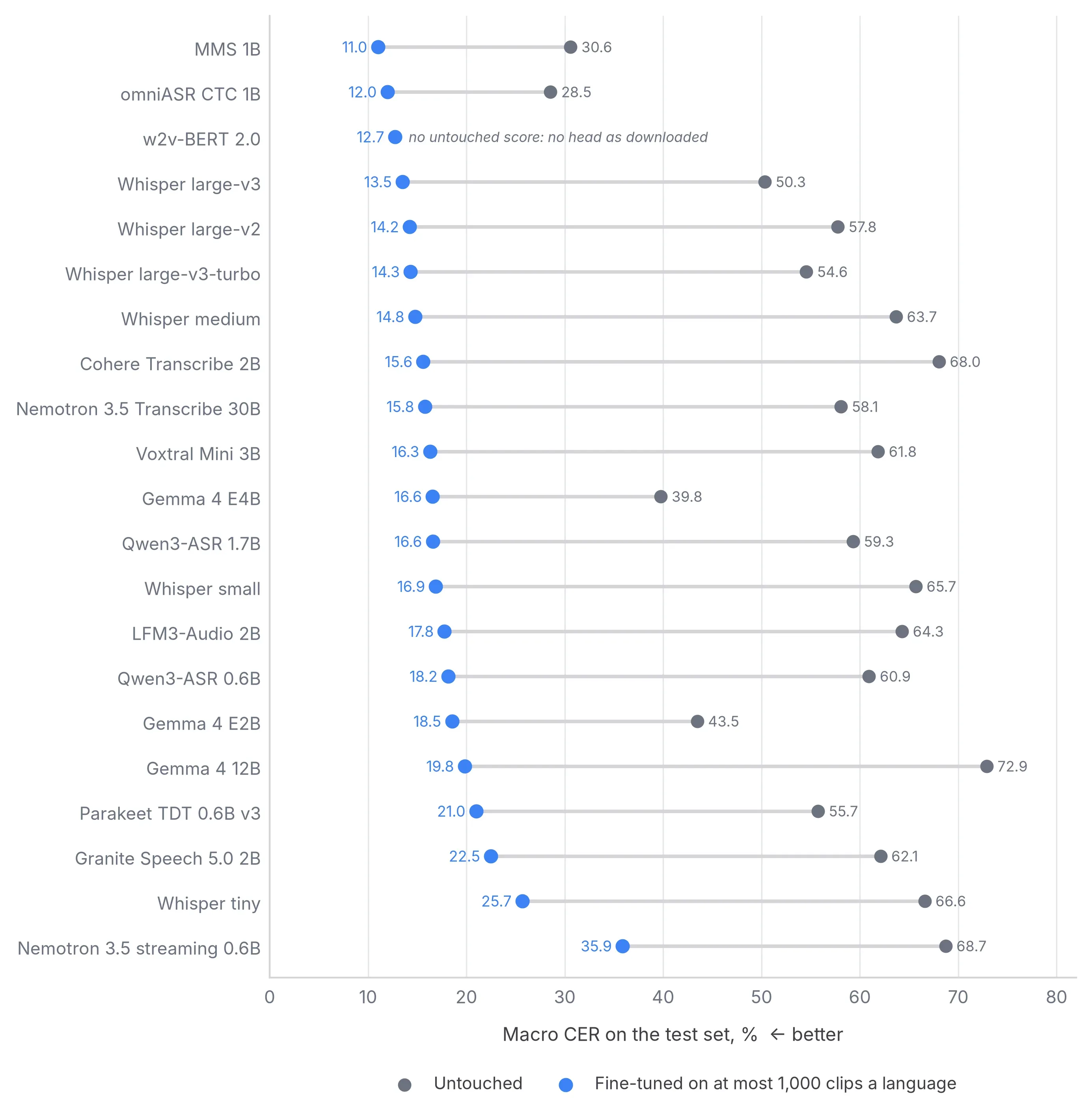
Unchanged, most models did poorly. Many wrote the wrong alphabet entirely. The author then fine-tuned 24 of them. Fine-tuning means continuing to train a model on new examples. Each language had at most 1,000 clips, about 82 hours of audio across all 50 languages.
The main measure is character error rate (CER): the share of letters a model gets wrong. Every model improved, by between about 17 and 53 percentage points. The best main run, Meta's MMS 1B, fell from about 31% wrong to 11%. A larger model from Meta's omniASR family reached 9.5%.
Words are harder than letters. Even with an add-on that checks which words exist, the best word error rate was 34%. The author calls the output a draft to correct, not a finished transcript.
Several controls back the main claim. The same model designs trained from scratch, without prior training, ended 60 or more points worse. So the gain comes from what the models had already learned from other languages. On 12 languages that no model claims to know, every model started at 46% or worse and the best ended near 12%.
The study also reports costs. Fine-tuning made the median model worse on English, Spanish, French and German, by about 6 points. Lightweight adapters, which train only about 4% of the model, came within about a point of full training. On two of three models they also forgot less.
This is a preprint from a single author at Scicom, a Malaysian company. It has not been peer reviewed.
Our reading
In our reading, the most useful finding is how little data it takes to get started. Twenty-five clips per language, about two hours across all 50, already cut one model's error rate by about a third. Gains slowed after that, but did not stop.
The study is careful about what the gain is made of. The from-scratch controls and the 12 unlisted languages make a convincing case that pretraining on other languages does the heavy lifting. A practical example: a public broadcaster with a few hours of transcribed regional-language audio could get a draft transcriber. Editors would then fix about one word in three, rather than typing from nothing.
The main caution is that test and training clips come from the same collections. The models may partly learn how a collection sounds, not just the language. A check on a separate public dataset in four languages kept most of the gain, but four languages is a small sample. On our readiness scale this is level II, Benchmarked: results on public test sets, but no released training code or fine-tuned weights that we could find.
Read the rest of this story
Membership is free. You get every article in full and the Issue every Sunday.
We send a sign-in link, no password needed. Already a member? Sign inReadiness assessment
| Level | Status | Evidence |
|---|---|---|
| I Lab only | Met | The work goes beyond a lab-only demonstration. It reports controlled experiments including random-weight controls, ablations and seed checks. |
| II Benchmarked | Met | All 28 models are scored on a public test set (Low-Language-TTS), with 95% intervals. Results are also checked on public FLEURS, CS-FLEURS and the public Revolab Malay benchmark. |
| III Open source | Not yet | The paper cites the public test-set and parent-corpus datasets and a cross-entropy code repository. It gives no link to its own training code, fine-tuned weights, the training split or the Malay telephony data (which is private). The base models are open, but the study's own artefacts are not clearly released in this text. This is uncertain. |
| IV In production | Not yet | No named organisation is documented as using any of the fine-tuned models in production. Scicom's telephony data is used only for a benchmark experiment. |
What would move it up
Releasing the training recipes, the 1,000-clip training split and the fine-tuned checkpoints under open licences would reach level 3. Level 4 needs a named organisation running a fine-tuned model on real traffic, with results on speech unlike the training corpus.
Checked automatically every week, last on 16 November.
The study
Husein Zolkepli. Low Language Transfer Speech-to-Text. arXiv, 12 November 2026. Read the paper
Notes
- Zolkepli, H. Low Language Transfer Speech-to-Text. Preprint, arXiv:2611.16260, November 2026. Licence CC BY 4.0. Source
- Test set: Low-Language-TTS, 50 languages, 1,250 clips, 2.56 hours, 514 speakers. Source
- Parent corpus from which training and test clips were drawn: Multilingual-TTS. Source
- Exact figures: macro CER gains 16.6 to 53.1 points; MMS 1B 30.6 to 11.0; omniASR CTC 7B 9.5; with word 4-gram, MMS 1B 9.8 CER and 34.4 WER; 12 unlisted languages, best 11.7 from untouched 46 or worse; FLEURS retention 79% median; forgetting 5.7 points median on English, Spanish, French, German; LoRA within 1.1 points of full tuning.
- Malay benchmark used in the paper: Revolab ASR Benchmark (public split). Source
- Cited fused cross-entropy code used for the largest model. This is a dependency, not the study's training code. Source
Edited and signed by
Stefan PerdalEditor and publisher86 stories editedStefan read the study, set the readiness level and approved this story. An AI system found the paper and wrote the first draft.
How this was made
An AI model read the study and wrote this article in the structure Science Underway uses. An editor reviewed it and approved it for publication. Check the original study before you rely on the details.
How we workNo corrections