MIT researchers had four coding agents design small brick-style robots and then built every design that worked in simulation. Most held up on real obstacle courses, and watching videos of their failures let the agents fix most of the rest.
A Freiburg-led team trained robot arm skills from people's demonstrations, which record no robot commands, and then improved them inside a learned simulator. Robot recordings are still needed to translate those skills into motor commands.
Researchers trained a 27-billion-parameter open-weight reasoning model to control robot arms using only simulated practice. On a real two-armed robot it had never seen, it succeeded in 18 of 30 trials. The work is a preprint and has not been peer reviewed.
A preprint describes DexSeed, a method that expands a few recordings of human hands into simulated robot training data. A robot trained only on that data picked and placed real objects, with mixed success.
A preprint adds a learned controller to a robot model that predicts future video before it acts. The controller cuts thinking time by about a third against its closest rival, with small gains in success.
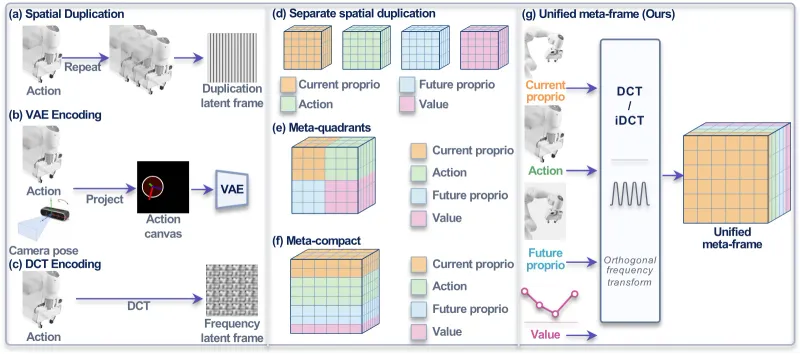
A preprint from the National University of Singapore folds a robot's actions, joint readings and value estimates into a single frame that a pretrained video model treats as natural. Queries run 39% faster and simulated benchmark scores rise slightly.