RoboDojo tests: a mirror cuts robot task success by up to 57 points
Peking University researchers placed mirrors into a standard robot simulation benchmark. All five robot control models they tested did worse, and two more failed more often on a real robot arm.
scienceunderway.com/articles/robodojo-tests-a-mirror-cuts-robot-task-success-by-up-to-57-points

 AI illustration
What the study shows
The team built mirror versions of eight tasks from RoboDojo, an existing benchmark for robot arms that handle objects. Each task ran under four set-ups: no mirror, one upright mirror, two upright mirrors at a right angle, and a mirrored tabletop. Objects, starting positions and success rules stayed the same, so each model was compared against its own mirror-free score.
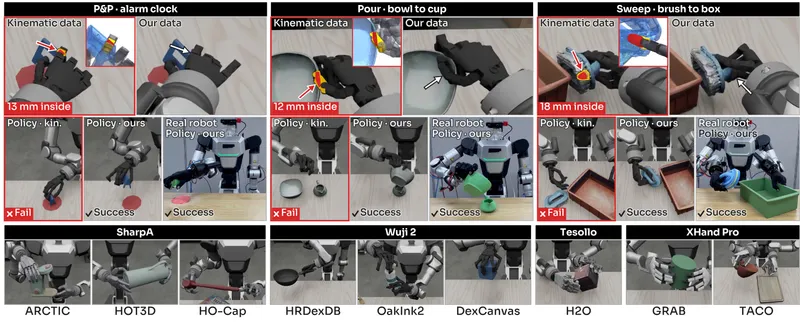
They tested five control models, the software that turns camera images and an instruction into arm movements. These included vision-language-action models, which map images and text straight to actions, world action models, which also predict what the scene will look like next, and GPT-6-Astra, a general AI model that steers the arm by calling movement tools.
Without a mirror, the models succeeded on about 61% to 73% of attempts. Every mirror set-up lowered that. Averaged over the three mirror set-ups, the drop ranged from about 11 to 57 percentage points depending on the model. The worst case was Rex-M1 Preview on a mirrored tabletop, which fell from about 67% to 4%.
A mirror is also a physical obstacle, so the authors swapped it for a matte panel of the same shape, for two of the models. Mirrors caused far more failures than panels: under two mirrors, 42 mirror-only failures against 3 panel-only failures for Awomo-0.5. Between half and seven in eight of the mirror-specific failures happened with no recorded contact with the surface at all.
Close inspection showed robots closing the gripper beside the real object and lifting nothing. On a mirrored tabletop, the VPP2 model did this in almost every attempt, and its success on those tasks fell from about 98% to 4%. Telling the models in words that a mirror was present gave no consistent help.
On a real Franka robot arm, two further models also did worse. π0.5 fell from about 78% success to 28% with a mirrored tabletop, over 10 trials per task. The paper is a preprint and has not been peer reviewed.
Our reading
In our reading, the panel comparison is the most useful part of the paper. Without it, one could argue the mirror simply gets in the way of the arm. With it, the authors show that the reflection itself drives most of the extra failures, at least for the two models they checked.
The failure is easy to picture in practice. A home robot asked to pick up a cup beside a bathroom mirror, or a shop robot working on a glossy display counter, might reach for an object that is not there. The study tests mirrors only, but the result suggests that reflective surfaces deserve a place in any acceptance test for robots that will work outside clean lab settings.
The tool-using GPT-6-Astra agent held up best, losing about 11 points on average, though with a wide uncertainty range. It touched mirrors more often than the others yet still finished tasks. The authors warn that the models ran under different time and call budgets, so this is not a fair ranking.
The rest of this story is for members. Membership is free: read it at scienceunderway.com/articles/robodojo-tests-a-mirror-cuts-robot-task-success-by-up-to-57-points
Read the rest of this story
Membership is free. You get every article in full, and can save stories and follow topics.
We send a sign-in link, no password needed. Already a member? Sign inReadiness assessment
| Level | Status | Evidence |
|---|---|---|
| I Lab only | Met | A new benchmark and diagnostic experiments, with a paper describing the method. |
| II Benchmarked | Met | Evaluated on RoboDojo-Mirror, built on the existing RoboDojo benchmark, across five published policies with paired baselines and bootstrap intervals. |
| III Open source | Met | The paper links code at https://github.com/iPPLab/robodojo-mirror. I could not check what the repository contains, such as scenes, scripts or logs. |
| IV In production | Not yet | No documented use by a named organisation in production. It is an evaluation benchmark, not a deployed system. The real-robot test is a lab experiment. |
What would move it up
Level 4 would need documented adoption, for example a robot maker or lab using the benchmark in its release testing, or a mirror-robust policy deployed. Independent replication of the panel-control result on more policies and the mirrored tabletop would also strengthen the findings.
The study
Xuanchen Liu, Hejun Zhang, Boxuan Dong et al.. Embodied AI Fails the Mirror Test: How a Simple Mirror Breaks Robot Policies. arXiv, 24 November 2026. Read the paper
Notes
- Liu, Zhang et al., Embodied AI Fails the Mirror Test: How a Simple Mirror Breaks Robot Policies. Peking University. arXiv preprint, 24 November 2026, not peer reviewed. Source
- Code linked from the paper. We have not checked what the repository contains. Source
- Mirror-free success rates were 60.8% to 72.5%. Average success-rate drops over three mirror set-ups were 10.8 (GPT-6-Astra, 95% interval 1.7 to 20.0) to 56.7 points (Rex-M1 Preview). The 62.5-point figure in the abstract matches Rex-M1 Preview on the mirrored tabletop, 66.7% to 4.2%.
- Panel control, dual mirrors, 120 matched pairs: mirror-only against panel-only failures were 25 against 2 (WALL-OSS) and 42 against 3 (Awomo-0.5). 50.0% to 87.5% of mirror-specific failures had no recorded contact.
- Mirrored-tabletop grasping diagnostic, VPP2, three tasks, 45 attempts per condition: success 97.8% to 4.4%, empty close-and-lift 0.0% to 95.6%.
- Real robot (Franka FR3), 10 trials per task, model and condition: π0.5 77.5%, 52.5% (upright mirror), 27.5% (mirrored tabletop); FastWAM 60.0%, 30.0%, 10.0%.
Edited and signed by
Stefan PerdalFounder. Twenty-five years of building digital products.160 stories editedStefan read the study, set the readiness level and approved this story. An AI system found the paper and wrote the first draft.
How this was made
An AI model read the study and wrote this article in the structure Science Underway uses. An editor reviewed it and approved it for publication. Check the original study before you rely on the details.
How we workNo corrections