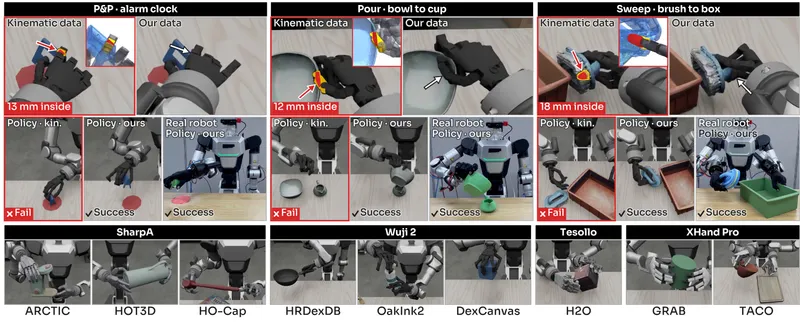
GPT-6 Astra coding agents write robot hand programs that top Bench2Dex
A preprint shows coding agents can write and refine plain Python programs for two-handed robots without human demonstrations. The programs lead two simulated benchmarks, but real-robot reliability is not yet measured.
scienceunderway.com/articles/gpt-6-astra-coding-agents-write-robot-hand-programs-that-top-bench2dex

What the study shows
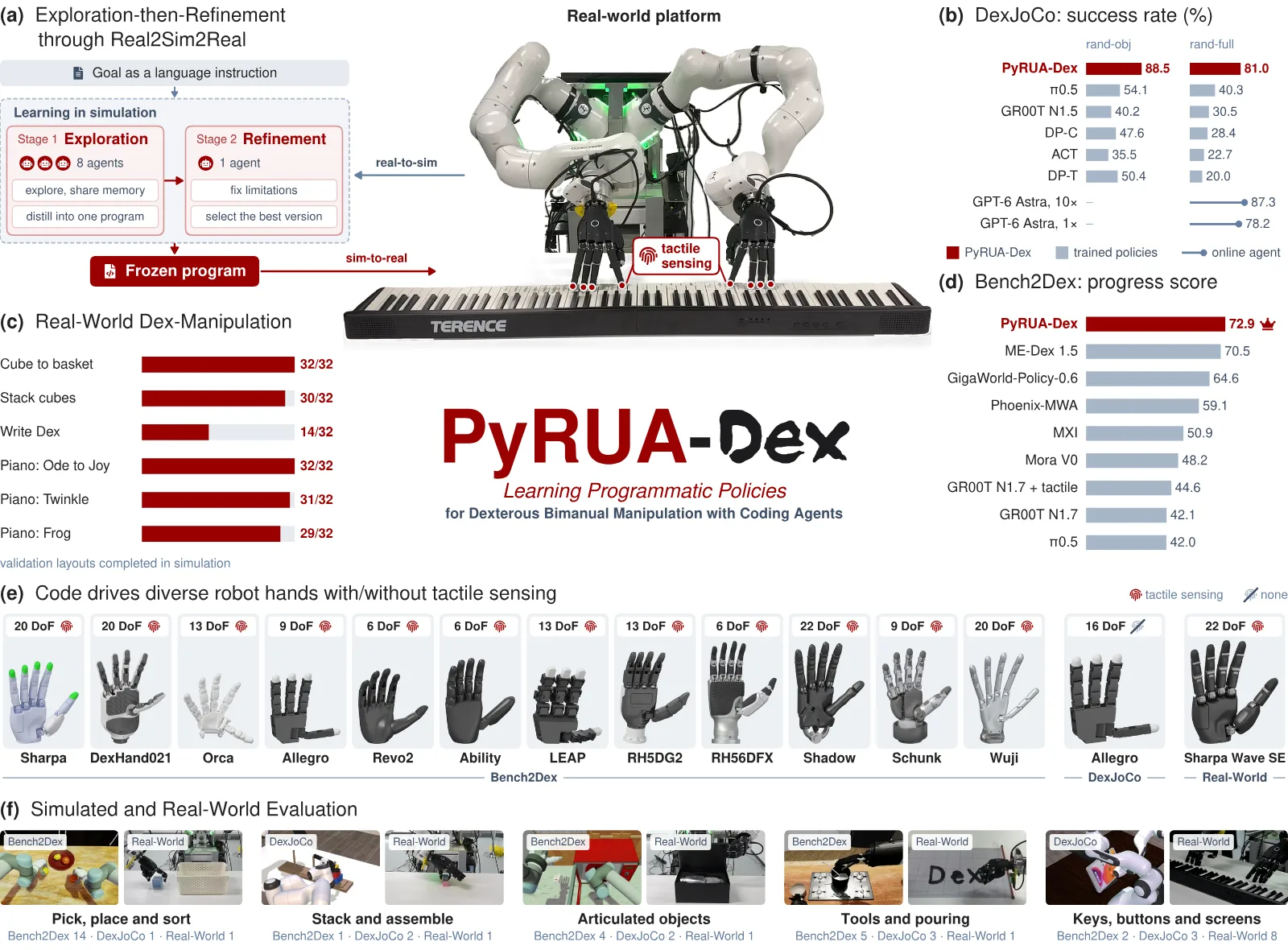
The researchers, from Peking University, NVIDIA and three other universities, asked a coding agent to learn a robot task once and hand over a program that runs on its own. The agents are GPT-6 Astra running in OpenAI's Codex CLI. The final program is ordinary Python. It reads cameras, joint positions and fingertip touch sensors, and calls no language model while the robot works.
The work happens in two stages, all in simulation. First, eight agents explore one task in parallel, share what works through a common memory, and can rewind the simulator to retry a hard step. A further agent condenses their best attempts into one program. Second, a single agent tests that program on many random scene layouts, finds the step that fails most often, and fixes it. A new version is kept only if it does no worse on layouts no agent has seen.
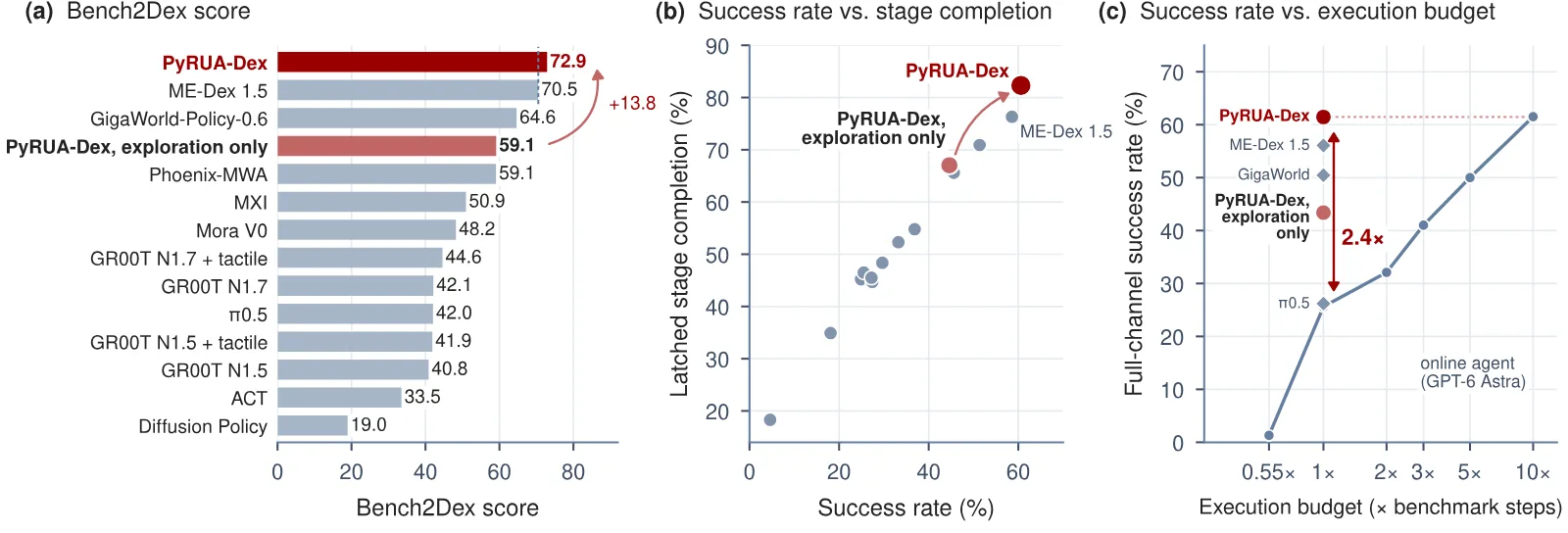
On Bench2Dex, a public benchmark of 26 two-handed tasks across 12 robot arm and hand combinations, the programs score 72.9 on the leaderboard score. The best trained model, ME-Dex 1.5, scores 70.5. The authors report that the programs succeed in about 61% of episodes and lead on 15 of the 26 tasks.
On DexJoCo, a second benchmark with 11 tasks for Allegro hands, the programs succeed in 81% of episodes when objects, cameras, lighting and textures are all randomised. The strongest trained model, π0.5, manages about 40%. The programs lead on every task.
The authors also compare against the same model, GPT-6 Astra, controlling the robot live in every episode. Within the benchmark's normal step limit, the frozen programs succeed about 2.4 times as often. The live agent needs ten times the steps, and about 34 million tokens per episode, to catch up.
On a real robot with two Franka arms and two 22-joint Sharpa hands, the programs stack cubes, open a box, write 'Dex' with a brush and play piano. Once a shared piano skill exists, the authors say a new piece takes 30 minutes to an hour.
Our reading
In our reading, the most useful idea here is not the benchmark lead, which is narrow on Bench2Dex. It is the split between a costly learning phase and a free running phase. The agent does its expensive reasoning once, during development. What reaches the robot is code that can be read, tested and versioned like any other software.
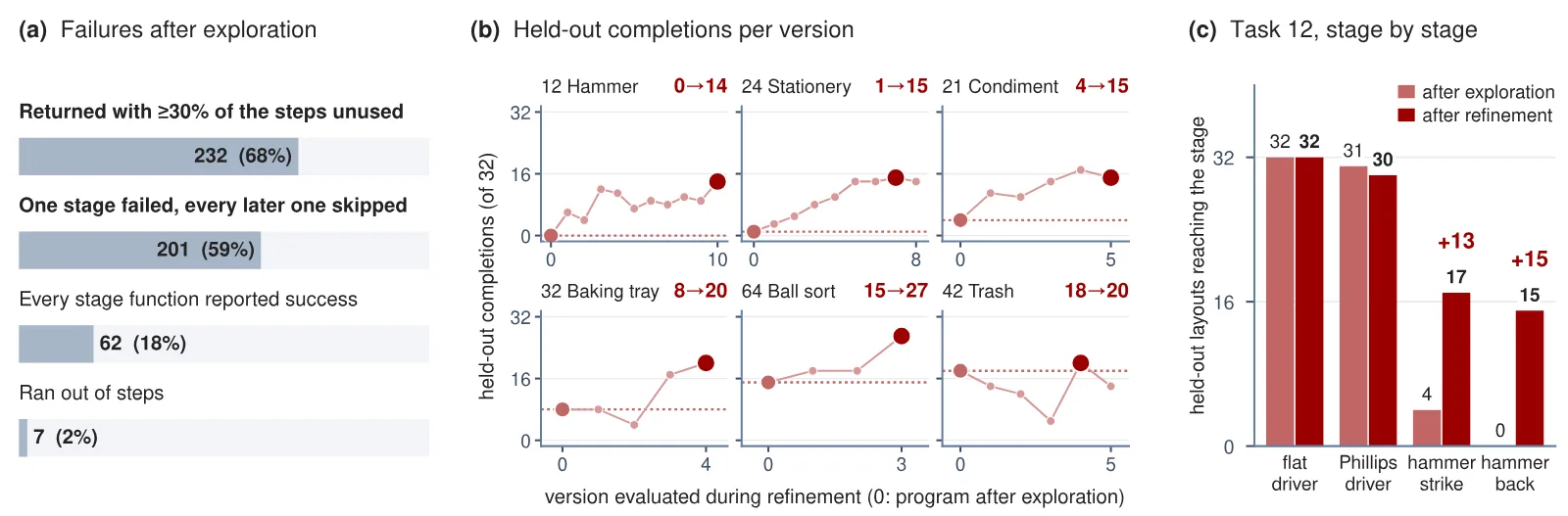
The second stage carries most of the gain. Exploration alone scores 59.1 on Bench2Dex. Refinement lifts that to 72.9. The authors explain why: a multi-step task only succeeds if every step does, so one weak step drags down the whole. After exploration, most failed runs stopped at a single step with plenty of time left. Fixing the weakest step first is a simple engineering habit, and it pays off here.
This is a preprint and has not been peer reviewed. The comparisons against trained models use leaderboard entries submitted by many groups, with different setups. The 2.4 times result against the live agent rests on only 78 episodes taken from another group's report.
The rest of this story is for members. Membership is free: read it at scienceunderway.com/articles/gpt-6-astra-coding-agents-write-robot-hand-programs-that-top-bench2dex
Read the rest of this story
Membership is free. You get every article in full, and can save stories and follow topics.
We send a sign-in link, no password needed. Already a member? Sign inReadiness assessment
| Level | Status | Evidence |
|---|---|---|
| I Lab only | Met | A working method with simulation experiments and a real robot demonstration. |
| II Benchmarked | Met | Public benchmark results: 72.9 score on the Bench2Dex leaderboard (per-episode logs public with the leaderboard) and 81.0% on DexJoCo under the official protocol, against published baselines. |
| III Open source | Met | The paper links a GitHub repository (DAGroup-PKU/PyRUA-Lean, dex branch) and a project page, and describes scripts to reproduce figures and tables. We could not inspect the repo contents, so completeness is unverified. |
| IV In production | Not yet | No documented use by a named organisation outside the authors' own lab. Real-robot results come from the authors' platform and are not measured over repeated trials. |
What would move it up
To reach level 4: repeated real-robot trials with reported success rates, and use by an independent organisation on its own hardware and tasks. Independent replication of the simulation results from the released code would also strengthen level 3.
The study
Feixiang Ruan, Guodong Lv, Kewei Zhang et al.. PyRUA-Dex: Learning Programmatic Policies for Dexterous Bimanual Manipulation with Coding Agents. arXiv, 24 November 2026. Read the paper
Notes
- Ruan, Lv, Zhang, Huang et al. PyRUA-Dex: Learning Programmatic Policies for Dexterous Bimanual Manipulation with Coding Agents. arXiv preprint 2611.33144, 24 November 2026. CC BY 4.0. Source
- Code repository (dex branch), linked from the paper. We have not inspected its contents. Source
- Project page. Source
- Bench2Dex leaderboard, used for the trained-model comparisons. Source
- Exact figures: Bench2Dex score 72.9 vs 70.5 (ME-Dex 1.5); success 60.6% vs 58.6%; exploration only 44.6% and 59.1. DexJoCo 88.5% / 81.0% vs π0.5 54.1% / 40.3%. Live agent 25.6% vs 61.5% on the Full channel at 1x budget (78 episodes).
Edited and signed by
Stefan PerdalFounder. Twenty-five years of building digital products.160 stories editedStefan read the study, set the readiness level and approved this story. An AI system found the paper and wrote the first draft.
How this was made
An AI model read the study and wrote this article in the structure Science Underway uses. An editor reviewed it and approved it for publication. Check the original study before you rely on the details.
How we workNo corrections