GR00T robot policies need physics-corrected human hand data, study finds
A preprint from POSTECH and RLWRLD turns recordings of human hands handling objects into training data for a two-armed robot. Policies trained on the uncorrected version mostly fail; trained on the physics-corrected version, they mostly succeed in simulation.
scienceunderway.com/articles/gr00t-robot-policies-need-physics-corrected-human-hand-data-study-finds

What the study shows
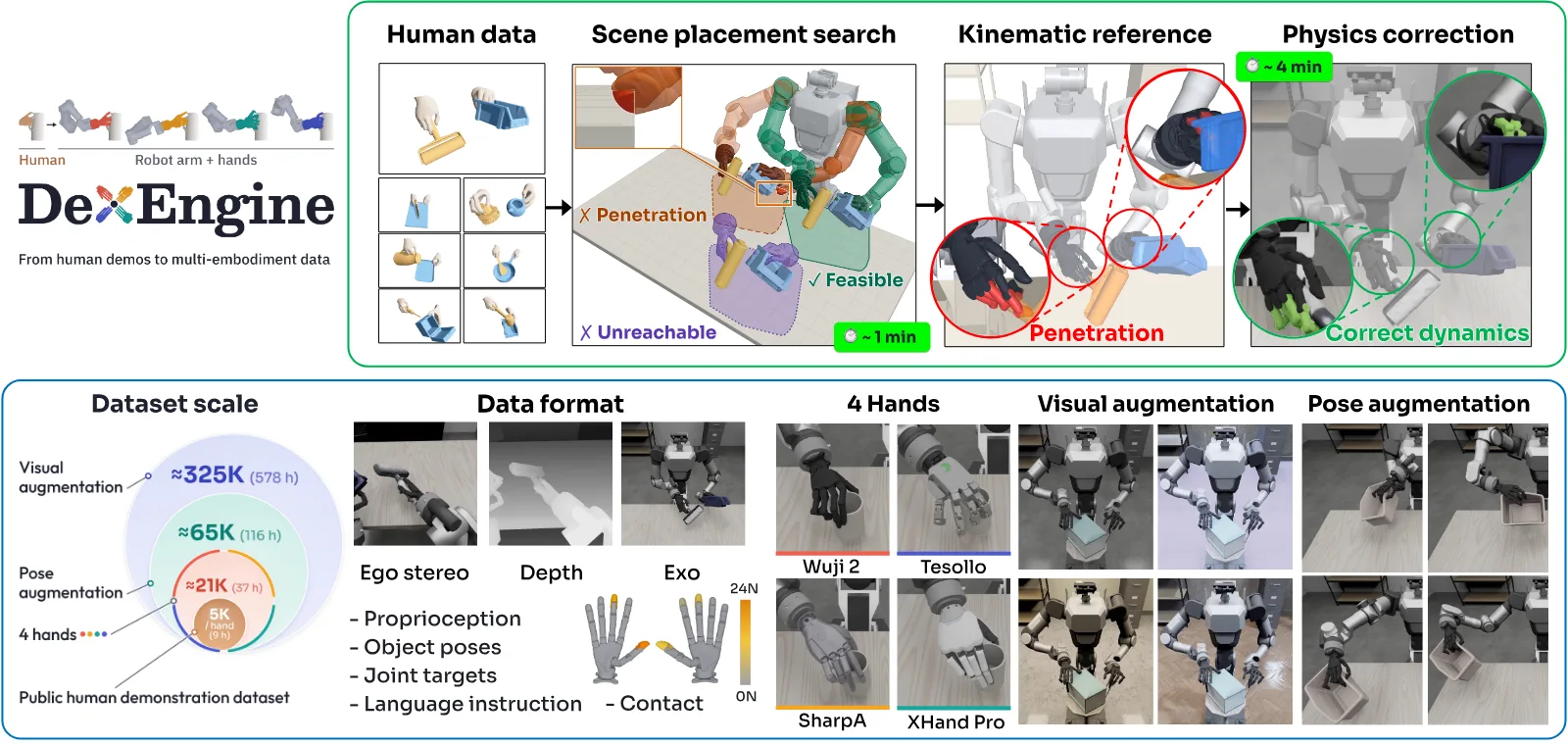
The authors built a pipeline that converts human hand and object recordings into training data for a two-armed robot, the RB-Y1, fitted with dexterous hands. Dexterous hands have many finger joints, like a human hand. They drew on nine public datasets, including HOT3D, OakInk2 and TACO, and produced data for four commercial robot hands.
The pipeline works in three steps. First, it searches for a spot on the table where the robot's arms can actually reach the recorded hand motion. Second, it works out a smooth arm motion that follows the human wrists. Third, it uses reinforcement learning, where a model learns from rewards, to make small corrections in a physics simulator so the robot's fingers truly grip and move each object.
The result is about 65,000 robot trajectories, or 116 hours. With visual variations added, that becomes about 325,000 episodes. The authors say it is the largest physics-checked dataset with arms from any human-to-robot pipeline, and the only one with two arms.
On 64 test clips from the TACO dataset, the authors compared their method with six earlier ones, such as ManipTrans, SPIDER and CHORD. Even with arms attached, it tracked objects more accurately than earlier methods that ignore the arm. It also cost far less computing time: about 4 GPU-minutes per clip, against about 118 for CHORD.
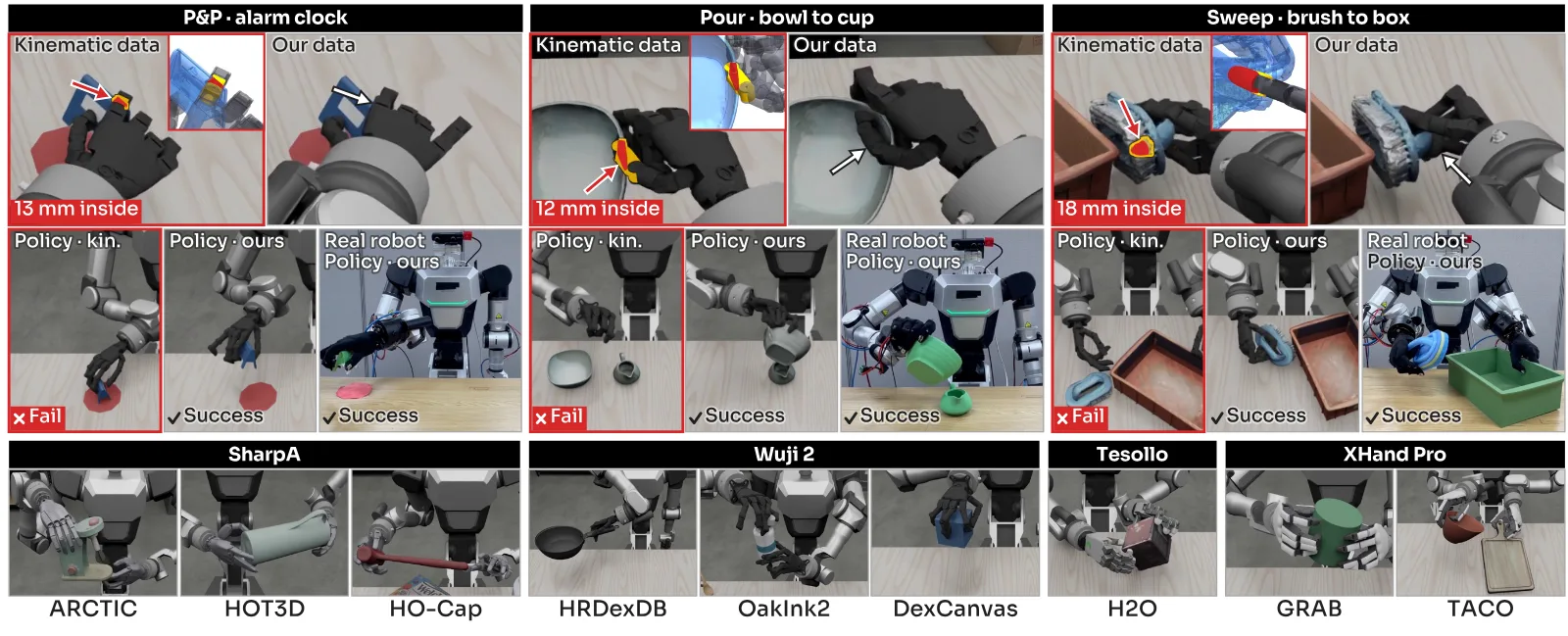
The key test removed only the physics correction. Policies trained on the uncorrected data, where fingers can pass through objects, succeeded in about 6% of simulated attempts at best. The same policies trained on corrected data succeeded in about 65%. The authors tested this with Diffusion Policy and with NVIDIA's GR00T N1.7 robot model.
Pre-training GR00T on the whole dataset before task training, a step the authors call mid-training, lifted simulated success further. On a real robot, it raised success on familiar object positions from 20% to 73%. The study is a preprint and has not been peer reviewed.
Our reading
In our reading, the most useful result is the negative one. Data that looks right, with plausible images and plausible joint movements, taught robots almost nothing when the fingers did not really grip. That is a clear warning for anyone building large robot datasets from human video using geometry alone.
The second lesson is about arms. Most earlier methods correct a floating hand with no arm attached. The authors show that bolting the arm on afterwards loses about a quarter more clips, because the corrected wrist ends up somewhere the arm cannot follow. Solving the arm first avoids this.
We rate the work at level III on our readiness scale, open source available. The paper links code on GitHub and a dataset on Hugging Face. We have not checked what those links contain or their licence.
The rest of this story is for members. Membership is free: read it at scienceunderway.com/articles/gr00t-robot-policies-need-physics-corrected-human-hand-data-study-finds
Read the rest of this story
Membership is free. You get every article in full, and can save stories and follow topics.
We send a sign-in link, no password needed. Already a member? Sign inReadiness assessment
| Level | Status | Evidence |
|---|---|---|
| I Lab only | Met | Working pipeline with full method description, ablations and simulation experiments. |
| II Benchmarked | Met | Compared with ManipTrans, DexMachina, SPIDER, CHORD, EgoEngine and FlashDexRetarget on 64 TACO clips using CHORD's object-tracking evaluation (ADD-AUC, SP-SR, MP-SR). Built on public human datasets. Policy results in simulation and a small real-robot test. |
| III Open source | Met | The paper links a GitHub repository (github.com/wongyun-yu/DexEngine) and a Hugging Face dataset (huggingface.co/datasets/Wongyun/DexEngine). Where source licences forbid redistribution, the code regenerates the data. I could not inspect the links, so contents and licence are unverified. |
| IV In production | Not yet | No documented use in a named organisation's production system. The real-robot test is a small lab experiment with five trials per cell. |
What would move it up
Level 4 needs documented use by a named organisation, such as training deployed policies on this data. Short of that, larger real-robot tests with more tasks, objects, seeds and trials, plus independent reproduction by other groups, would strengthen the case. Support for moving torsos or bases would also raise the share of usable human data.
The study
Wongyun Yu, Honggeun Kim, Donguk Lee et al.. DexEngine: Scaling Human Demonstrations into Physically Executable Whole-Robot Data. arXiv, 25 November 2026. Read the paper
Notes
- Yu, Kim, Lee, Kim, Choe and Cho. DexEngine: Scaling Human Demonstrations into Physically Executable Whole-Robot Data. arXiv preprint, 25 November 2026, not peer reviewed. POSTECH and RLWRLD. Source
- Code repository linked in the paper. Contents and licence not verified by us. Source
- Dataset linked in the paper. Where a source dataset's licence forbids redistribution, the authors release code to regenerate the data instead. Source
- Pipeline comparison (Table 2, 64 TACO clips, SharpA hand): floating hand ADD-AUC 0.93 at 2.8 GPU-minutes per clip; CHORD 0.87 at 118.4; FlashDexRetarget 0.86 at 44.7. Arm attached, 64 clips per policy: 0.90 at 3.9 GPU-minutes. One policy per clip: 0.97 at 290 GPU-minutes. ADD-AUC is an object-tracking accuracy score from 0 to 1.
- Simulation policy results (Table 4, Wuji 2 hands): Diffusion Policy 0% and 1% on kinematic replay data against 53% and 40% on corrected data; GR00T N1.7 6% and 5% against 65% and 50%; with mid-training 76% and 57% (training and held-out placements).
- Real robot (Table 5, RB-Y1, Wuji 2 hands, five trials per task and level): GR00T 20% and 0%; GR00T with mid-training 73% and 27%; open-loop replay of recorded trajectories 87% and 80%.
- Readiness: level III, open source available, based on code and dataset links in the paper. Level IV would need documented use by a named organisation.
Edited and signed by
Stefan PerdalFounder. Twenty-five years of building digital products.160 stories editedStefan read the study, set the readiness level and approved this story. An AI system found the paper and wrote the first draft.
How this was made
An AI model read the study and wrote this article in the structure Science Underway uses. An editor reviewed it and approved it for publication. Check the original study before you rely on the details.
How we workNo corrections