3D object routes steer a frozen π0.5 robot model around obstacles
A small planner that predicts where a held object should travel lets an unchanged robot model succeed in rearranged scenes. Most of the evidence is in simulation, and the work is a preprint that has not been peer reviewed.
scienceunderway.com/articles/3d-object-routes-steer-a-frozen-0-5-robot-model-around-obstacles

What the study shows
Vision-language-action models, or VLAs, turn camera images and a spoken-style instruction into robot movements. They learn by copying many human demonstrations. The authors, from the University of Pennsylvania and the Athena Research Center, argue that VLAs learn how to grasp well but also memorise where things usually go. Move the target or put something in the way, and they carry objects to the wrong spot or into obstacles.
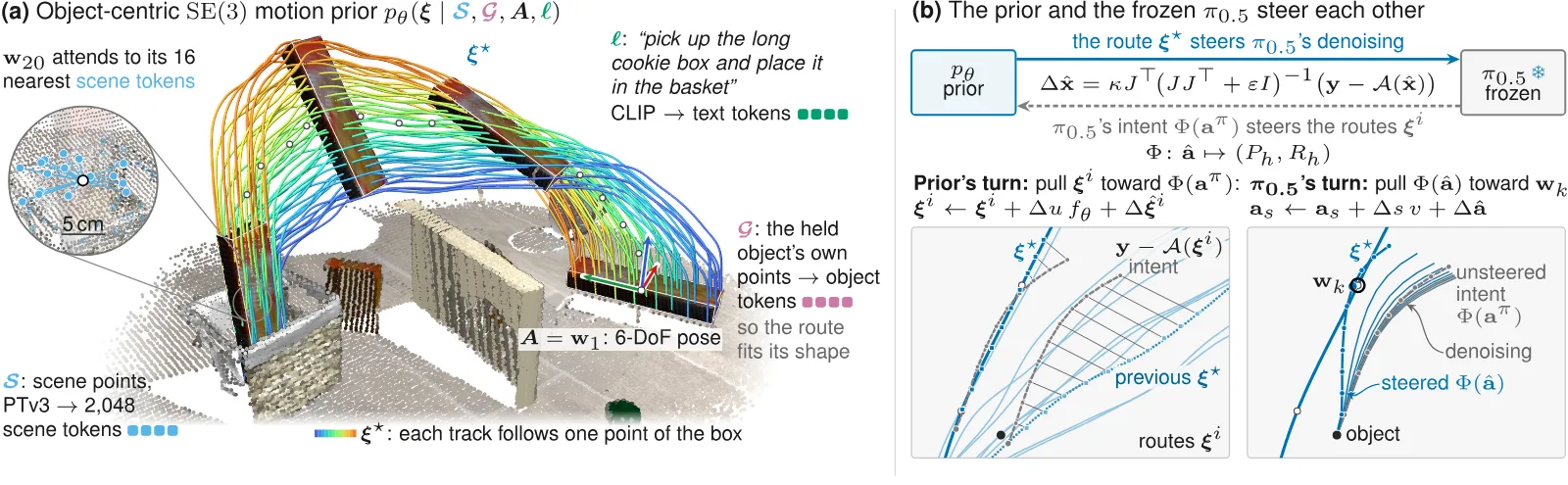
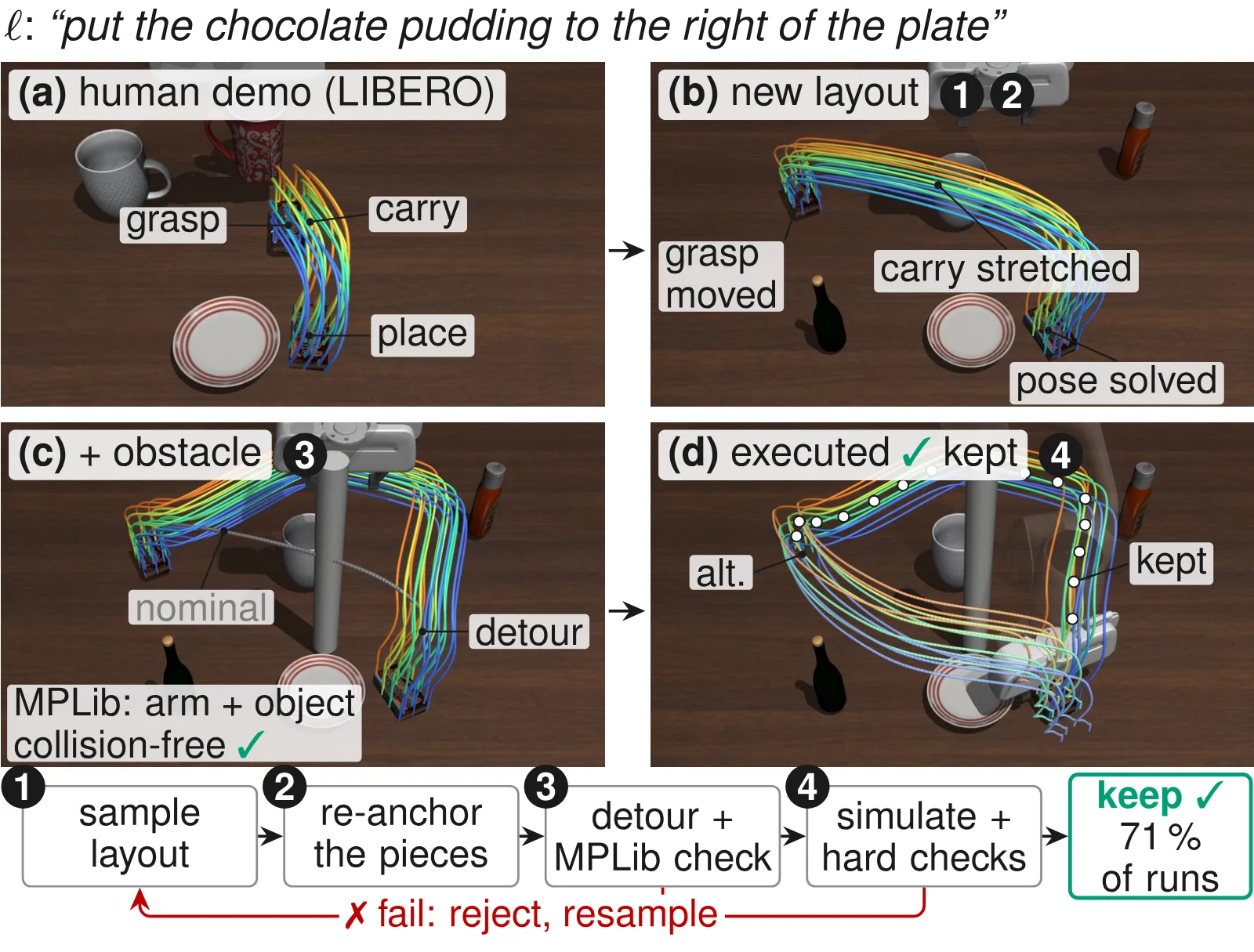
Their method, Cairn, leaves the VLA frozen, meaning its learned weights are not changed. A separate planner of about 4 million parameters reads 3D point clouds, which are sets of measured surface points, of the scene and the held object. It then proposes routes for the object from grasp to release, including how the object should turn to fit through gaps. The planner was trained on simulated demonstrations, generated with moved objects, obstacles and several routes per scene.
At run time the two models guide each other. The VLA's own intended motion helps pick among the planner's routes. The chosen route then nudges each step of the VLA's action generation towards the next waypoint. The authors tested this with π0.5, a widely used VLA from the company Physical Intelligence.
The authors report that on LIBERO-Shift, 1,941 new simulated scenes they built from the LIBERO benchmark, frozen π0.5 succeeded in 24.5% of episodes alone and 95.1% with Cairn. Where a long object had to be turned to pass a gate, pole or bar, success rose from about 13% to about 89%. Two other steering methods, OmniGuide and paths from 3D HAMSTER, did much worse.
Fine-tuning π0.5 on the same layouts reached 91.3%. But it dropped the model's score on standard LIBERO from 96.5% to 70.5%, a sign of forgetting. Cairn left standard LIBERO unchanged. On LIBERO-PRO, a benchmark built by another team, overall success rose from 27.3% to 38.0%.
On a real Franka arm running the public π0.5-DROID model, with a planner trained only in simulation, the robot placed a cube in a bowl behind a box in 9 of 10 trials, against none without Cairn. Placing a cube on a cabinet top near the arm's reach limit went from 0 to 8 of 10.
Our reading
In our reading, the central idea is a sensible division of labour. The VLA keeps doing what it does well: grasping, timing and fine motion. A small specialist supplies the part it lacks, which is where the object should go and how it should get there. This turns a costly retraining problem into a planning problem that can be trained on simulated routes alone.
The headline 95.1% needs care. LIBERO-Shift was built with the same generator that made the planner's training data, even though test layouts are held out. Episodes also start with the object already in the gripper. The third-party LIBERO-PRO result is the fairer test, and there the overall gain is about 11 points. That smaller gain is partly because steering only starts after a correct grasp, and a third of the tasks are not single carries.
On our four-level readiness scale, this sits at level II, Benchmarked. It has public benchmark results, including LIBERO-PRO. The authors say code, models and data will be released, but no link is given, so level III is not yet met.
The rest of this story is for members. Membership is free: read it at scienceunderway.com/articles/3d-object-routes-steer-a-frozen-0-5-robot-model-around-obstacles
Read the rest of this story
Membership is free. You get every article in full, and can save stories and follow topics.
We send a sign-in link, no password needed. Already a member? Sign inReadiness assessment
| Level | Status | Evidence |
|---|---|---|
| I Lab only | Met | A working method is described and tested in simulation and on a real Franka robot. |
| II Benchmarked | Met | Results on the authors' LIBERO-Shift benchmark (24.5% to 95.1%) and on the public third-party LIBERO-PRO benchmark (27.3% to 38.0%), compared with OmniGuide, 3D HAMSTER and fine-tuning. |
| III Open source | Not yet | The abstract says all code, models and data will be made public. No link or release is given in the paper. |
| IV In production | Not yet | No documented use by a named organisation outside the authors' own lab tests. |
What would move it up
Releasing the code, prior weights and the LIBERO-Shift generator would reach level 3. Level 4 would need use by an outside team, or larger real-robot tests across more scenes, objects and VLAs.
The study
Agelos Kratimenos, Kostas Daniilidis, Evangelos Chatzipantazis. Cairn: Object-Centric 3D Trajectory Priors for Steering Frozen VLAs. arXiv, 25 November 2026. Read the paper
Notes
- Kratimenos, Daniilidis and Chatzipantazis, "Cairn: Object-Centric 3D Trajectory Priors for Steering Frozen VLAs", arXiv preprint, November 2026, not peer reviewed. CC BY 4.0. Source
- Code, models and data: promised by the authors, no link given in the paper.
- LIBERO-Shift (frozen π0.5): alone 24.5%, OmniGuide 24.8%, OmniGuide with true target 50.9%, 3D HAMSTER path 29.2%, Cairn 95.1%. Turn scenes 13.4% to 88.8%. Fine-tuned π0.5 91.3%, with Cairn 96.1%. Standard LIBERO: 96.5% (π0.5), 97.0% (Cairn), 70.5% (fine-tuned).
- LIBERO-PRO position axis: all episodes 27.3% to 38.0%; single-carry tasks 32.2% to 48.0%; after a correct grasp 54.4% to 81.1%. 40 tasks, 50 episodes each.
- Planner: 4.35M parameters, 16 routes of 20 waypoints, 0.37 s per grasp on one B200 GPU, against 45.5 s for RRT-Connect on one CPU core. Steering takes 190 ms per action chunk, against 128 ms for π0.5 alone.
- Real robot, Franka FR3 with π0.5-DROID, 10 trials each: bowl 10/10 both; bowl behind box 0/10 to 9/10; cabinet top 0/10 to 8/10.
Edited and signed by
Stefan PerdalFounder. Twenty-five years of building digital products.160 stories editedStefan read the study, set the readiness level and approved this story. An AI system found the paper and wrote the first draft.
How this was made
An AI model read the study and wrote this article in the structure Science Underway uses. An editor reviewed it and approved it for publication. Check the original study before you rely on the details.
How we workNo corrections