Stable Diffusion's hand-picked guidance scales follow from a simple variance rule
An MIT and Toyota Research Institute preprint offers a closed-form way to set the guidance strength in diffusion models. Without any tuning, it lands close to the values that developers chose by hand for eleven image, video, audio and motion models.
scienceunderway.com/articles/stable-diffusion-s-hand-picked-guidance-scales-follow-from-a-simple-variance-rul

What the study shows
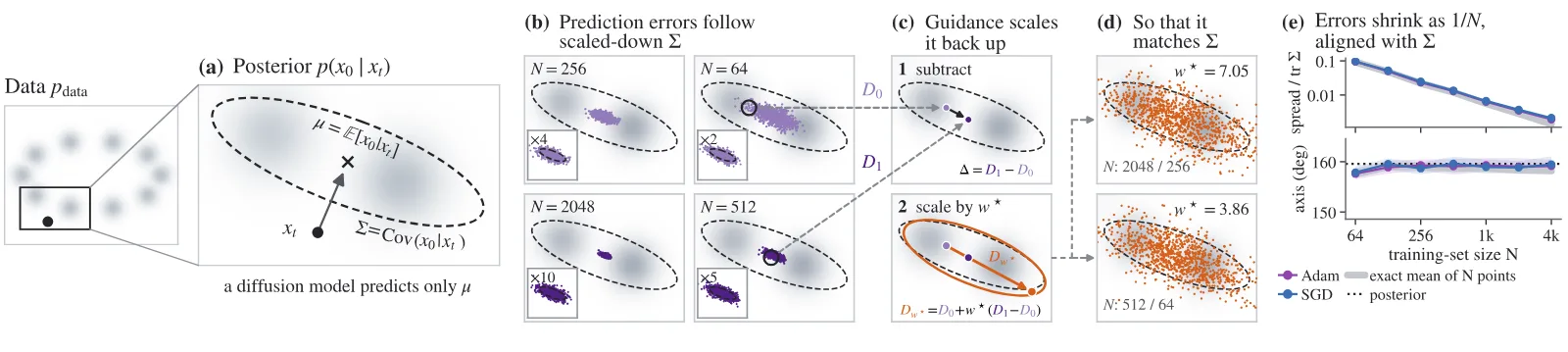
Diffusion models create images, video and sound by starting from noise and cleaning it up step by step. Nearly all of them use guidance: at each step the model makes two predictions, a stronger and a weaker one, and the output is pushed further away from the weaker one. How far it is pushed is set by a number called the guidance scale. Stable Diffusion 1.5, for example, ships with a scale of 7.5. How such numbers are chosen is rarely documented.
The authors first test a common explanation: that guidance makes each step more accurate. They report the opposite. At the scales used in practice, guidance makes the model's step-by-step prediction worse against its own training target. On Stable Diffusion 3.5 Medium the error rose by up to four times at some steps. The scale that would minimise this error sits at or below 1 for most models tested, well under the published values of about 2 to 7.
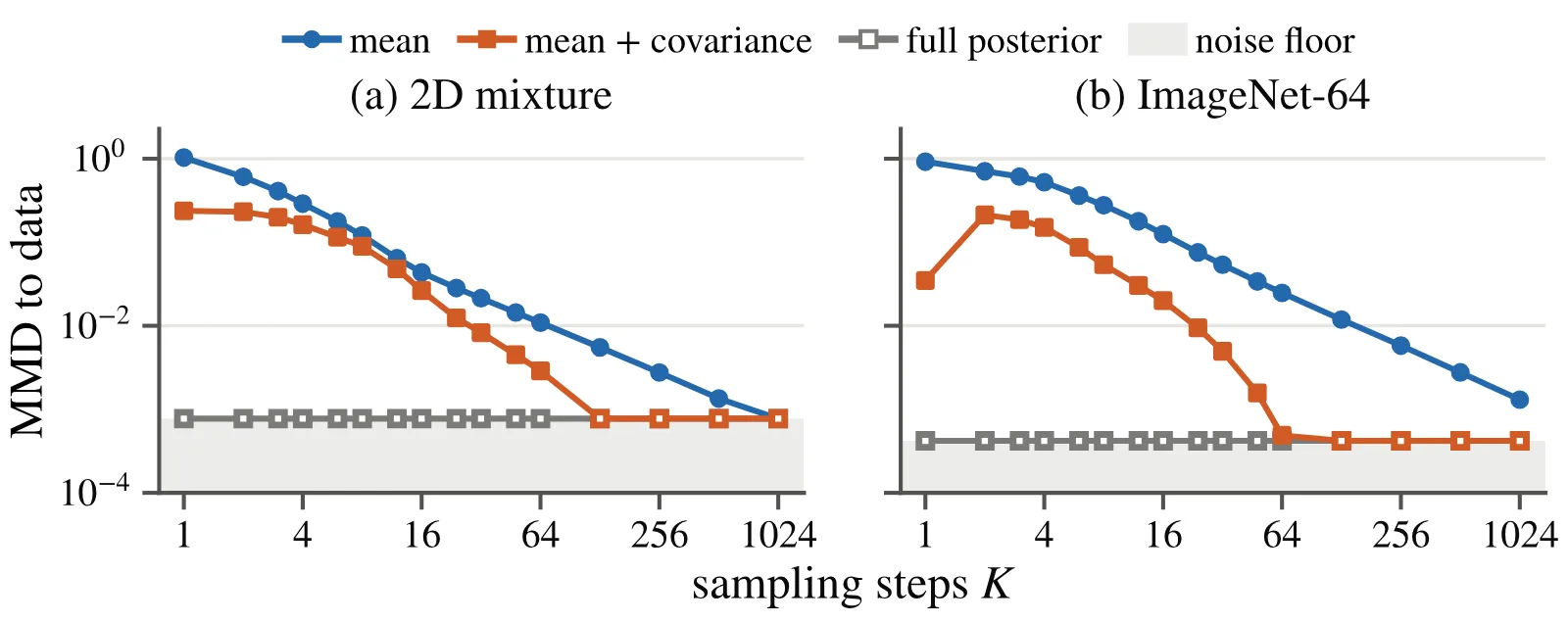
Their alternative idea is about spread. A model trained to predict an average answer produces outputs that vary less than real data does. Guidance, they argue, puts that missing variety back. Their rule, which they call variance-matched guidance, picks the scale at which the variance of the guided predictions equals the variance of real data. It needs only the two model predictions on a few hundred noised real examples, with no images generated.
Across eleven pretrained models, including Stable Diffusion 1.5 and 3.5, FLUX.2 klein, Stable Video Diffusion, Wan2.1, CogVideoX, NVIDIA's Cosmos world model, AudioLDM 2, Stable Audio Open and a human-motion model, the predicted scale closely tracks the published one. For Stable Diffusion 1.5 the rule gives 7.44 against the published 7.5. The rank agreement across all eleven is very high (a correlation of 0.96).
On Stable Diffusion 3.5 Medium, standard quality scores disagree sharply about the best scale: one favours 1.6, another 2.4, a text-alignment score 11.5. In an informal blind test with 41 volunteers, raters preferred images at the rule's scale over images at the two score-tuned scales. A version that changes the scale at each step was preferred over three hand-designed schedules.
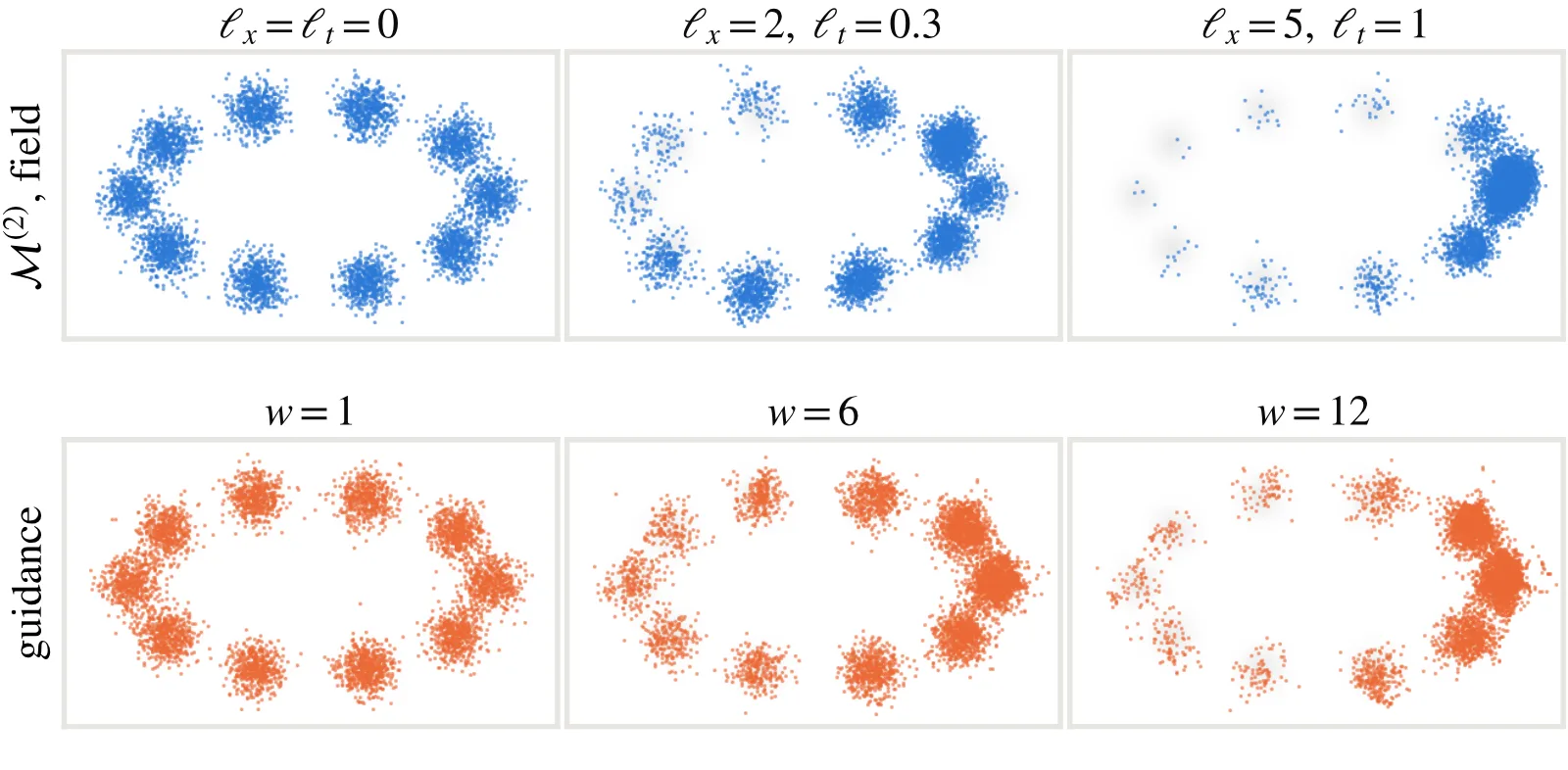
The idea also made two new predictions that the authors tested. First, guidance can work in reverse: pushing Stable Diffusion 1.5 away from CommonCanvas, or CommonCanvas away from Stable Diffusion 1.5, improved both quality scores. Second, guiding a model with an earlier saved copy of itself needs a larger scale than guiding it with a separately trained model. Both held, the second more weakly than the simple theory implied.
This is a preprint and has not been peer reviewed. On our readiness scale it sits at level II, Benchmarked: it reports results on public models and datasets. We could not confirm released code.
Our reading
In our reading, the strongest result is the match to published scales across five kinds of output. A single formula landing near 7.5 for one image model, about 1 for a robot world model and between for audio and video is hard to explain by luck. It suggests the habit of choosing these numbers by eye is tracking something real.
But matching a human choice is not the same as finding the best setting. The authors themselves suspect published scales were picked by judgement. So the rule may be a good model of what developers like, which is useful, but it is not evidence of higher quality on its own. The user study helps, yet it covers one model and is informal.
The practical case is cost. On Stable Diffusion 3.5 Medium, the paper reports that fitting the scale took fewer model runs than generating the test set once, and far fewer than the sweep of 42 scales behind its comparison. A product team adapting an open model to a new style or domain could, in principle, calibrate the dial on a few hundred of its own images instead of running a grid search and arguing over which score to trust.
The rest of this story is for members. Membership is free: read it at scienceunderway.com/articles/stable-diffusion-s-hand-picked-guidance-scales-follow-from-a-simple-variance-rul
Read the rest of this story
Membership is free. You get every article in full, and can save stories and follow topics.
We send a sign-in link, no password needed. Already a member? Sign inReadiness assessment
| Level | Status | Evidence |
|---|---|---|
| I Lab only | Met | Derivation, proofs and toy experiments on 2D mixtures and small EDM2-XS models back the idea. |
| II Benchmarked | Met | Tested on eleven pretrained models with public benchmarks and datasets (COCO, MJHQ-30K, UCF-101, OpenVid-1M, AudioCaps, KIT-ML), reporting FID, FDDINOv2, FVD, CLIP and precision/recall against published scales and baseline schedules. |
| III Open source | Not yet | The text points to a project page (ottogin.github.io/vmg) but states no released code or weights. Algorithm 1 is short enough to reimplement. A repository link could not be confirmed from the paper. |
| IV In production | Not yet | No documented use by a named organisation in production. |
What would move it up
Release code (Algorithm 1 is simple) so others can calibrate scales on their own models. Then show independent adoption, plus formal user studies on more models and an explanation of the ImageNet-512 failure against carefully tuned scales.
The study
Ali Backour, Artem Lukoianov, Frank Permenter et al.. Guidance as Variance Matching. arXiv, 25 November 2026. Read the paper
Notes
- Backour, Lukoianov, Permenter, Jaakkola, Solomon and Sitzmann. Guidance as Variance Matching. arXiv preprint, 25 November 2026, not peer reviewed. CC BY 4.0. Source
- Project page named in the paper. We could not confirm that it hosts code. Source
- Readiness: level II, Benchmarked. Results on eleven public pretrained models and public datasets (COCO, MJHQ-30K, UCF-101, OpenVid-1M, AudioCaps, Song Describer, KIT-ML, Bridge). No confirmed code release and no documented production use.
- Exact figures from Tables 1 and 2 (SD 3.5 Medium): VMG constant 4.14, published 4.5; FID-optimal 1.6, FDDINOv2-optimal 2.4, CLIP-optimal 11.5. User study Elo: VMG constant 1048, FDDINOv2-tuned 985, FID-tuned 874; VMG schedule 1088, TV-CFG 1054, interval 992, linear 959.
- EDM2-XXL ImageNet-512 (Table 6): FID 4.83 published vs 11.98 VMG for classifier-free guidance; 4.41 vs 30.20 for autoguidance.
Edited and signed by
Stefan PerdalFounder. Twenty-five years of building digital products.160 stories editedStefan read the study, set the readiness level and approved this story. An AI system found the paper and wrote the first draft.
How this was made
An AI model read the study and wrote this article in the structure Science Underway uses. An editor reviewed it and approved it for publication. Check the original study before you rely on the details.
How we workNo corrections