Simple retries explain most agentic image-generation gains on GenEval
A preprint audits four recent agentic text-to-image systems against a plain baseline: one image model, a checker and a few retries. On standard benchmarks the retries recover most of the reported gains. On long, complex prompts the agents do add something real.
scienceunderway.com/articles/simple-retries-explain-most-agentic-image-generation-gains-on-geneval

What the study shows
Agentic text-to-image systems wrap an image generator in a loop. A controller model plans, rewrites the prompt, chooses among several generators, asks a vision-language model (an AI that answers questions about images) whether the picture is right, and repeats. Papers on these systems usually compare the result with a single image from a single generator.
The authors argue that this comparison mixes two things. One is selection: making several images and keeping one that a checker, called a verifier, accepts. The other is everything else the agent does. Only the second is specific to the agent.
To separate them, they define a baseline they call Single-tool Rejection Retry. It takes the strongest generator already in each system's own toolbox. It draws images one at a time, scores each with a small off-the-shelf verifier, and stops at the first one that passes. It uses the same maximum number of attempts as the system it is compared with. There is no planning, no prompt rewriting and no memory.
They tested it against four systems published in 2025 and 2026: OctoT2I, GEMS, D-OPCD and GenPilot. They used the official evaluators for GenEval, a benchmark that checks objects, counts, colours and positions, and for T2I-CompBench++, a similar test of how well images follow detailed prompts.
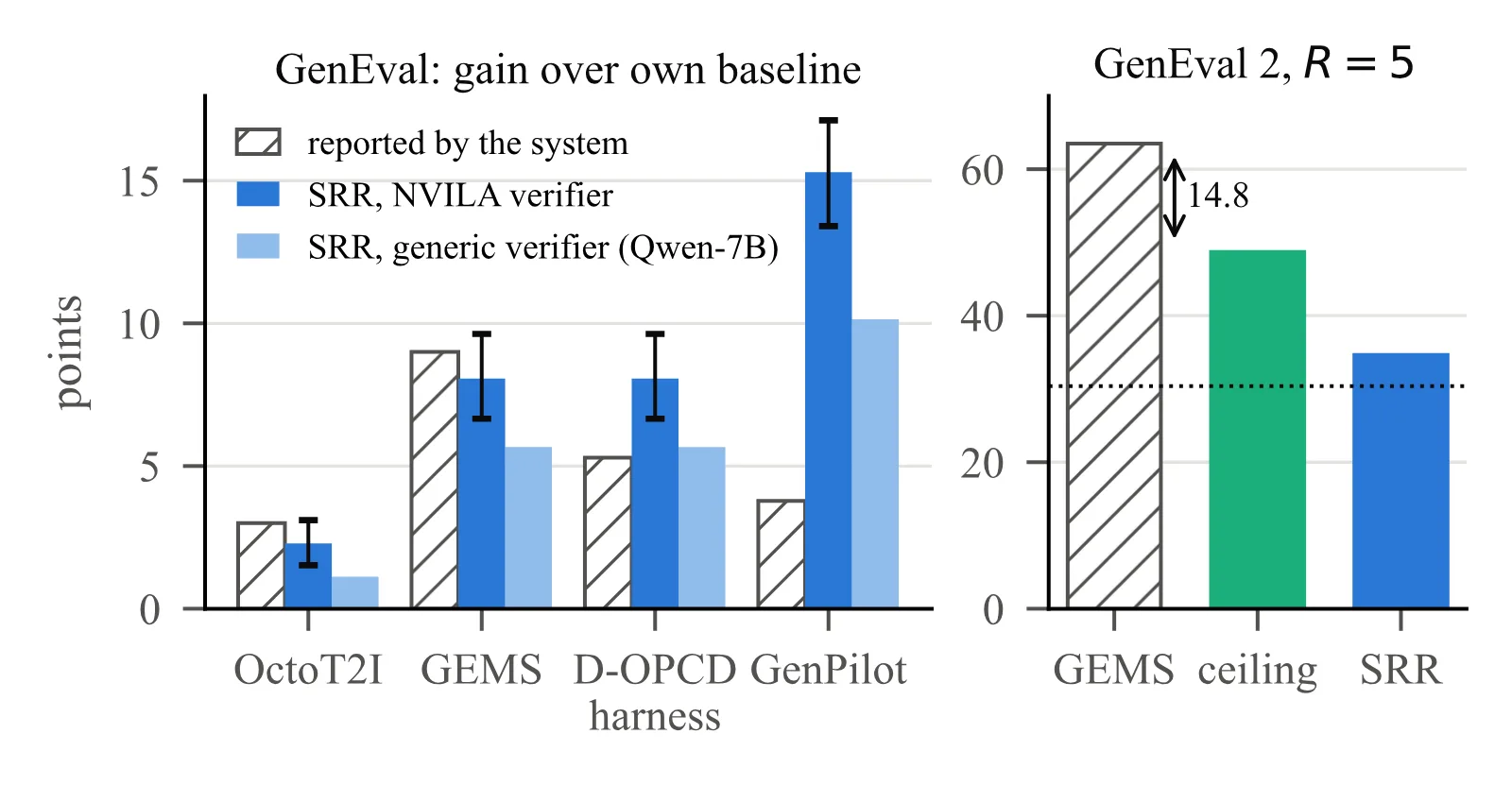
The authors report that retries matched OctoT2I on GenEval (0.962 against 0.96), using about 1.3 attempts per image. Retries recovered between 63% and 90% of the gain GEMS reports, depending on which verifier is counted as a fair match. Against GenPilot, retries scored about 12 points higher with 2.3 attempts per image and no prompt changes. The pattern held for generators not trained on GenEval-style rewards.
The picture reverses on GenEval 2, a newer benchmark with long prompts. There, even picking the best of five images using the benchmark's own scorer stays about 15 points below what GEMS reports. The authors read this as a real gain from planning and prompt rewriting, while noting they could not rerun GEMS themselves.
Two further findings narrow where agentic gains come from. Switching between generators added little accuracy, at most about three points on OctoT2I's own toolbox. But OctoT2I's switching did cut compute to roughly 40% of what retries needed for the same score. And fine-tuning a generator on the images the verifier picked worked no better than fine-tuning on random images from the same prompts.
This is a preprint and has not been peer reviewed.
Our reading
In our reading, the main contribution is a missing control experiment. Best-of-several sampling with a checker is a known, strong technique. The authors show that several agentic papers did not compare against it, and that doing so changes their conclusions. The test is cheap: it needs only models already in each system's toolbox.
The study cuts both ways, which makes it more credible. It removes most of the claimed gains on GenEval and T2I-CompBench++. It also gives agents a clear win on GenEval 2, where retries plateau because the small verifier rarely accepts images for long prompts. Long, multi-part requests are where planning and rewriting seem to matter.
A practical example: a marketing team wants product shots that show exactly three items in the right colours. Before building a multi-model agent with a large controller, it could run one good generator with a small checker and up to five attempts. On prompts like GenEval's, the authors' results suggest that alone may close most of the gap.
The rest of this story is for members. Membership is free: read it at scienceunderway.com/articles/simple-retries-explain-most-agentic-image-generation-gains-on-geneval
Read the rest of this story
Membership is free. You get every article in full, and can save stories and follow topics.
We send a sign-in link, no password needed. Already a member? Sign inReadiness assessment
| Level | Status | Evidence |
|---|---|---|
| I Lab only | Met | The method is a simple, documented baseline with a theoretical analysis and experiments. |
| II Benchmarked | Met | Results use the official GenEval, GenEval 2 and T2I-CompBench++ evaluators, with bootstrap intervals and comparison against four published systems. |
| III Open source | Not yet | No code, weights or data link appears in the paper. SRR uses public models (Flow-GRPO, Z-Image-Turbo, NVILA-Lite-2B-Verifier), but the audit code is not stated as released. |
| IV In production | Not yet | No documented production use by a named organisation. The work is an offline benchmark audit. |
What would move it up
Releasing the audit code, generated images and verifier scores would reach level 3. Level 4 would need a named team using SRR or the reporting checklist in a deployed image pipeline, plus reruns of GEMS and D-OPCD under matched seeds and verifiers.
The study
Jian Xu, Delu Zeng, Qibin Zhao. Is It the Agent or the Retry? Separating Selection from Agency in Text-to-Image Generation. arXiv, 18 November 2026. Read the paper
Notes
- Xu, Zeng and Zhao, 'Is It the Agent or the Retry? Separating Selection from Agency in Text-to-Image Generation', arXiv preprint, 18 November 2026, CC BY 4.0. Source
- No code, data or weights link appears in the paper.
- Key GenEval figures (Table 1): OctoT2I 0.96 reported vs retry 0.962 at 1.26 generations per image; GEMS 0.77 to 0.86 reported vs Z-Image-Turbo 0.746 to 0.827 with retries; GenPilot 0.696 vs retry 0.818 at 2.30 generations per image.
- GenEval 2 (Supp. Table S2): best of five by evaluator 48.7 GM; GEMS reports 63.5 GM; gap 14.8 points, 12.0 at the upper end of the 95% interval.
- Routing ceiling on OctoT2I's pool bracketed between 0.007 and 0.029 at one generation; compute 0.53 (OctoT2I, reported) vs 1.29 (retry) in Flow-GRPO-generation units.
- Offline distillation (Supp. Table S5): selected fine-tuning 0.733 vs random 0.729, difference +0.006 ± 0.008; test-time best-of-4 0.860; online RL (Flow-GRPO) 0.939.
Edited and signed by
Stefan PerdalEditor and publisher142 stories editedStefan read the study, set the readiness level and approved this story. An AI system found the paper and wrote the first draft.
How this was made
An AI model read the study and wrote this article in the structure Science Underway uses. An editor reviewed it and approved it for publication. Check the original study before you rely on the details.
How we workNo corrections