GRPO support agent closes 81% of chats without humans, up from 63%
A team at T-Tech checked historical operator replies one fact at a time, then trained a Qwen model with reinforcement learning to reward only facts it could back up. In a live A/B test against a rule-based bot, more customer chats closed without a human and fewer answers contained errors.
scienceunderway.com/articles/grpo-support-agent-closes-81-of-chats-without-humans-up-from-63

 AI illustration
What the study shows
The setting is a referral programme's customer support chat, where customers ask about bonuses, deadlines and eligibility. The existing bot was a rule-based dialogue tree. The authors replaced it with an AI agent that searches a knowledge base and reads customer records through seven read-only tools, then answers, asks a question, or hands over to a human.
They first asked whether old operator replies are safe training targets. A checking agent built on GPT-5.2, which the authors call Walker, split 2,760 replies into 8,680 individual factual claims and looked for support in the agent's own sources. About three quarters of claims were supported. The rest relied on customer data the agent cannot see, missing rules, or actions only humans can take. Unsupported claims were sent to editors and developers, who used them to fill gaps in the knowledge base and tools.
The verified claims then became training targets. The authors trained Qwen3.6-27B with GRPO, a reinforcement learning method in which the model samples several answers and is rewarded for the better ones. The reward mainly scores factual precision: whether each claim in the answer is backed by evidence the agent itself retrieved in that conversation. It adds credit for covering the verified operator claims, and penalties for breaking response rules, such as revealing one customer's bonus to another.
On an in-house test set of 500 past conversations, an automated judge flagged 8.6% of the trained agent's text answers for unsupported or rule-breaking content. The best supervised fine-tuning baseline, a copy of the same model trained to imitate filtered GPT-5.5 answers, scored 13.6%. The GRPO agent also gave a text answer far more often. But it matched the customer's actual need less often than the fine-tuned model.
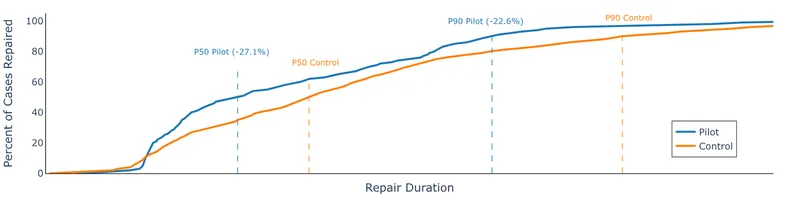
In an eight-day randomised A/B test with about 17,500 conversations per arm, the share of chats closed without a human rose from 63.3% to 80.8%. Operator time per customer fell by about 30%. Expert reviewers found at least one consultation error in 9.3% of agent chats, against 25.9% for the old bot. The authors report the agent now handles live referral-support requests. The paper is a preprint and has not been peer reviewed.
Our reading
In our reading, the most useful idea here is simple: treat a human's past answer as a set of claims to check, not a script to copy. A support agent that imitates an operator who could see a customer's full file will learn to state facts it has no way of knowing. Checking claims one by one turns that problem into two useful outputs: a to-do list for the knowledge base and a cleaner training signal.
The live results are stronger evidence than most papers in this area offer. The comparison is randomised, large and measured on business outcomes, with expert review of errors on top. A concrete example: a customer asking why a friend's bonus has not arrived is now more likely to get a correct answer from the bot, rather than waiting for a person, and less likely to be told a deadline the bot invented.
The gains need a careful reading, though. The A/B test compares the whole new system with an old rule-based bot, not with another modern AI agent. In an earlier nine-day trial, a GPT-5.5 agent closed slightly more chats than the trained model. The authors chose their own model to run in-house and control cost, which is a sensible business reason, not a quality win.
The rest of this story is for members. Membership is free: read it at scienceunderway.com/articles/grpo-support-agent-closes-81-of-chats-without-humans-up-from-63
Read the rest of this story
Membership is free. You get every article in full, and can save stories and follow topics.
We send a sign-in link, no password needed. Already a member? Sign inReadiness assessment
| Level | Status | Evidence |
|---|---|---|
| I Lab only | Met | The method, reward formulas, training configuration (Table 19) and ablations are described in detail. |
| II Benchmarked | Met | The paper reports results on an offline benchmark of 500 production conversations, with judge-substitution checks and a second later sample. It is an in-house benchmark, not a public one, so this is a weak form of level 2. |
| III Open source | Not yet | No code, weights or data are released or linked. Customer data is proprietary. |
| IV In production | Met | The agent handles live referral-support requests at the authors' organisation, T-Tech. The paper reports a randomised A/B test of about 35,000 conversations and five weeks of monitoring with automation of 84.4% to 87.8%. The company is named only as the authors' affiliation, and the paper does not name the product, so this is documented use by the authors' own organisation. |
What would move it up
Releasing the code, reward implementation, Walker prompts or trained weights would add level 3 evidence. Replication in a second domain or company, with a public benchmark, would strengthen the case for wider use.
Correction
- We corrected the opening of Why it matters: the study does not say that many firms plan to train support bots on old chat logs.
The study
Dmitrii Stoianov, Olga Tsymboi, Danil Taranets et al.. Learning from Unreliable Operator References: Claim-Level Rewards for Customer Support Agents. arXiv, 25 November 2026. Read the paper
Notes
- Stoianov, Tsymboi, Taranets et al., Learning from Unreliable Operator References: Claim-Level Rewards for Customer Support Agents. arXiv preprint, 25 November 2026, not peer reviewed. Source
- No code, model weights or data are released with the paper.
- Offline results (Table 1): hallucination rate 8.6% for final GRPO against 13.6% for SFT; text-answer rate 88.9% against 60.2%; intent match 71.5% against 80.4%.
- Product A/B (Table 24): automation 63.3% to 80.8% (+17.5 p.p., 95% CI 16.4 to 18.8); operator time per user down 30.4%; repeat contact within 48 hours 34.1% to 28.9%; mean CSAT 4.45 to 4.38, not significant.
- Candidate-selection trial (Table 23): automation GPT-5.5 85.2%, final GRPO 84.4%, SFT 82.2%, style-reward GRPO 78.6%; critical errors 0.9% for final GRPO against 3.1% for SFT.
Edited and signed by
Stefan PerdalFounder. Twenty-five years of building digital products.160 stories editedStefan read the study, set the readiness level and approved this story. An AI system found the paper and wrote the first draft.
How this was made
An AI model read the study and wrote this article in the structure Science Underway uses. An editor reviewed it and approved it for publication. Check the original study before you rely on the details.