Google study: code written by Gemini and Claude lifts frozen robot policies
A preprint covering over 470,000 simulated robot attempts tests how to connect general AI models to robot control models. The best set-up depends on how strong each model is, and the combined recipe changes no model weights.
scienceunderway.com/articles/google-study-code-written-by-gemini-and-claude-lifts-frozen-robot-policies

What the study shows
Robots increasingly combine two kinds of AI. Vision-language models (VLMs) read images and text and can write code; the study uses Gemini, Claude and GPT models. Vision-language-action models (VLAs) are trained to move a robot arm smoothly but struggle outside their training. The authors call the layer that connects the two a policy harness, meaning the code, tools and rules that decide who does what and when.
The team, led from Google, ran over 470,000 simulated robot attempts across eight public benchmarks, 267 tasks, six VLMs and 15 frozen robot control models. They changed one design choice at a time, in seven studies. This is a preprint and has not been peer reviewed.
Asking a VLM to output exact 3D gripper positions failed in most attempts, even for the strongest model with extra reasoning. Passing short language instructions to a VLA, with a target point marked on the image, worked far better: on one memory benchmark, success rose from about 13% to about 52%.
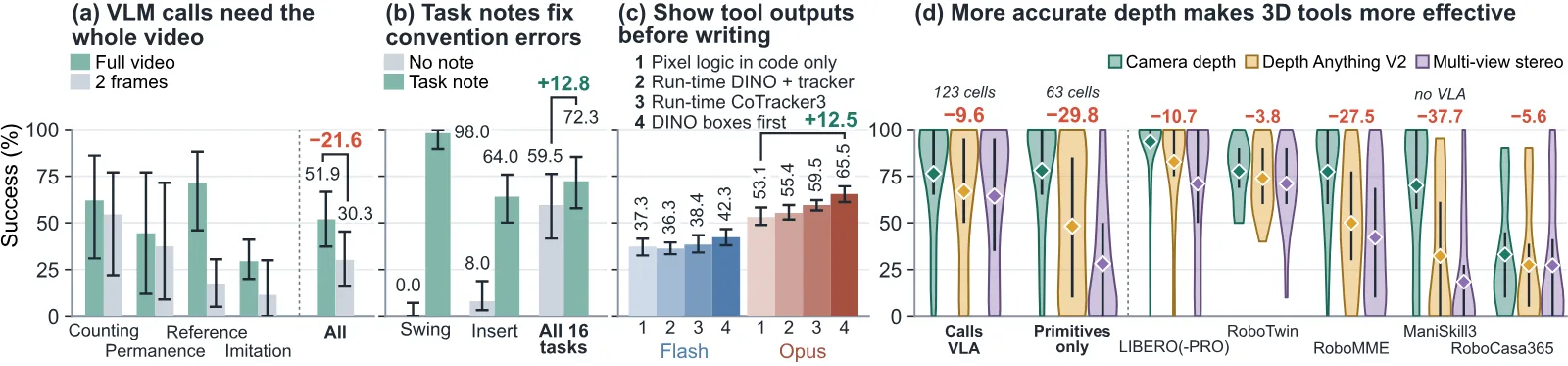
Code written once before testing, which checks live camera and robot feedback, ran at full speed with no waiting on the VLM. On the memory benchmark it beat VLM planners that were called about 11 times per attempt. Improving that code over four to eight rounds of practice runs gave most of the gain, provided each change was kept only if practice results improved.
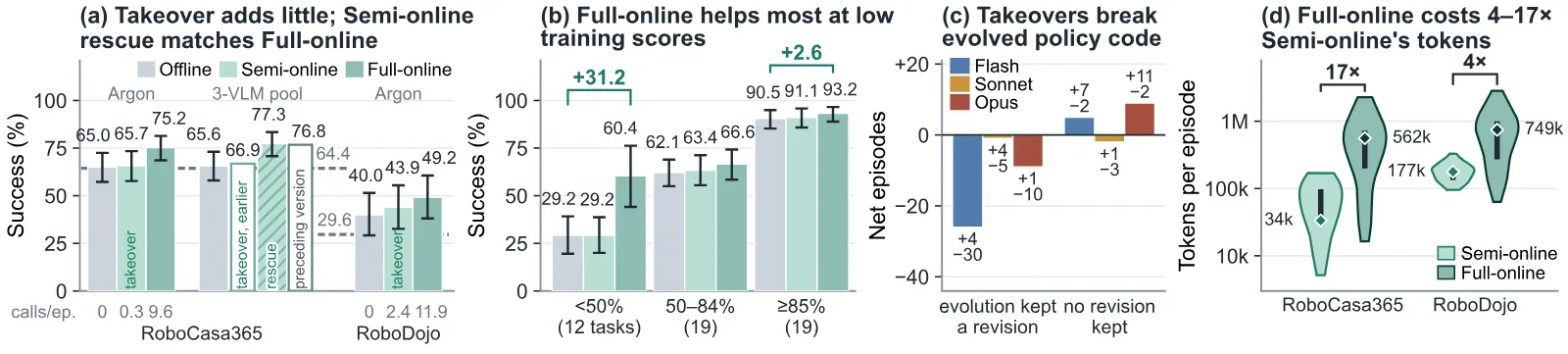
At run time, calling the VLM only when something went wrong matched calling it at every step, while using about 42% fewer tokens. Combined, the authors' recipe raised one reasoning benchmark from about 26% to 68% and a shifted-object benchmark from about 59% to 95%. On tasks the robot model already handled well, results stayed about level.
Our reading
In our reading, the main value here is less the headline gains than the map of trade-offs. The answer to most design questions is "it depends on the models": structured code templates helped the weaker Gemini Flash model by about 8 points but hurt the stronger Claude models. Calling the robot model helped weaker coders, while the strongest coder did better driving the arm through 3D perception tools.
The clearest practical lesson is about where the general model belongs. Routine step-by-step checks went into code that runs without the VLM, and the VLM was saved for failures. That removes the waiting that stalls robots when a cloud model is queried in the loop. As an example, a warehouse picking robot could run pre-tested code at native speed and only call a cloud model when a grasp fails.
The gains are uneven. The harness helped most where the robot model lacked memory or met objects in new positions, and added little where it was already strong. On fresh unseen test runs in one kitchen benchmark, the offline code gave a gain of under 2 points that was not statistically reliable; failure-triggered rescue was needed to reach about 8 points.

The rest of this story is for members. Membership is free: read it at scienceunderway.com/articles/google-study-code-written-by-gemini-and-claude-lifts-frozen-robot-policies
Read the rest of this story
Membership is free. You get every article in full, and can save stories and follow topics.
We send a sign-in link, no password needed. Already a member? Sign inReadiness assessment
| Level | Status | Evidence |
|---|---|---|
| I Lab only | Met | Controlled experiments across seven design studies in simulation. |
| II Benchmarked | Met | Results are reported on public benchmarks with paired bootstrap confidence intervals: RoboMME, LIBERO-PRO, RoboTwin 2.0, RoboCasa365, RoboDojo, SimplerEnv, VLABench and ManiSkill3. Comparisons are against official leaderboard and rerun VLA baselines. |
| III Open source | Met | The paper states that the evaluation suite, evolved policy code and 470,000+ rollout logs are released at github.com/google-research/x-as-policies. We have not verified the repository contents. |
| IV In production | Not yet | There is no documented production use by a named organisation. The only physical evidence is a small supplementary test on one YAM robot. |
What would move it up
Documented deployment of the harness on real robots by a named organisation, with reported success rates on live tasks. Broader independent real-world trials beyond two tasks would be a step towards this.
The study
Yuxiang Lai, Jike Zhong, Yu-Jhe Li et al.. Toward Agentic Robotics: A Large-Scale Study of Harness Design for Robot-Use Agents. arXiv, 25 November 2026. Read the paper
Notes
- Lai et al., Toward Agentic Robotics: A Large-Scale Study of Harness Design for Robot-Use Agents. arXiv preprint, 25 November 2026, not peer reviewed. Source
- Code, evaluation suite and rollout logs, as stated by the authors. Contents not verified by us. Source
- Key figures: on RoboMME with Gemini 3.8 Flash, raw gripper poses 13.1%, target-marked sub-goals 51.9%, VLA alone 46.5%. Full video versus two frames: 51.9% versus 30.3%. Templates: +7.6 (Flash), -5.9 (Sonnet), -3.0 (Opus).
- Combined recipe against the authors' reruns: VLABench 25.5% to 68.3% (pi0.5), LIBERO-PRO 58.6% to 95.4%, RoboMME 50.0% to 89.7%, standard LIBERO 97.2% to 96.1%. Semi-online multi-turn rescue on RoboCasa365: 77.3% versus 76.8% Full-online, with 42% fewer tokens.
- Readiness: level III, open source available (code release stated, not verified). Not level IV: no documented production use by a named organisation.
Edited and signed by
Stefan PerdalFounder. Twenty-five years of building digital products.173 stories editedStefan read the study, set the readiness level and approved this story. An AI system found the paper and wrote the first draft.
How this was made
An AI model read the study and wrote this article in the structure Science Underway uses. An editor reviewed it and approved it for publication. Check the original study before you rely on the details.
How we workNo corrections