Tumour-tracking agent on CT finds nearly twice the lesions Claude Code does
A preprint from DKFZ Heidelberg, Microsoft Research and Stanford wraps a large language model in tools, a lesion memory and a rule engine. It reads cancer patients' follow-up CT scans without any task-specific training and mostly agrees with radiologists.
scienceunderway.com/articles/tumour-tracking-agent-on-ct-finds-nearly-twice-the-lesions-claude-code-does

What the study shows
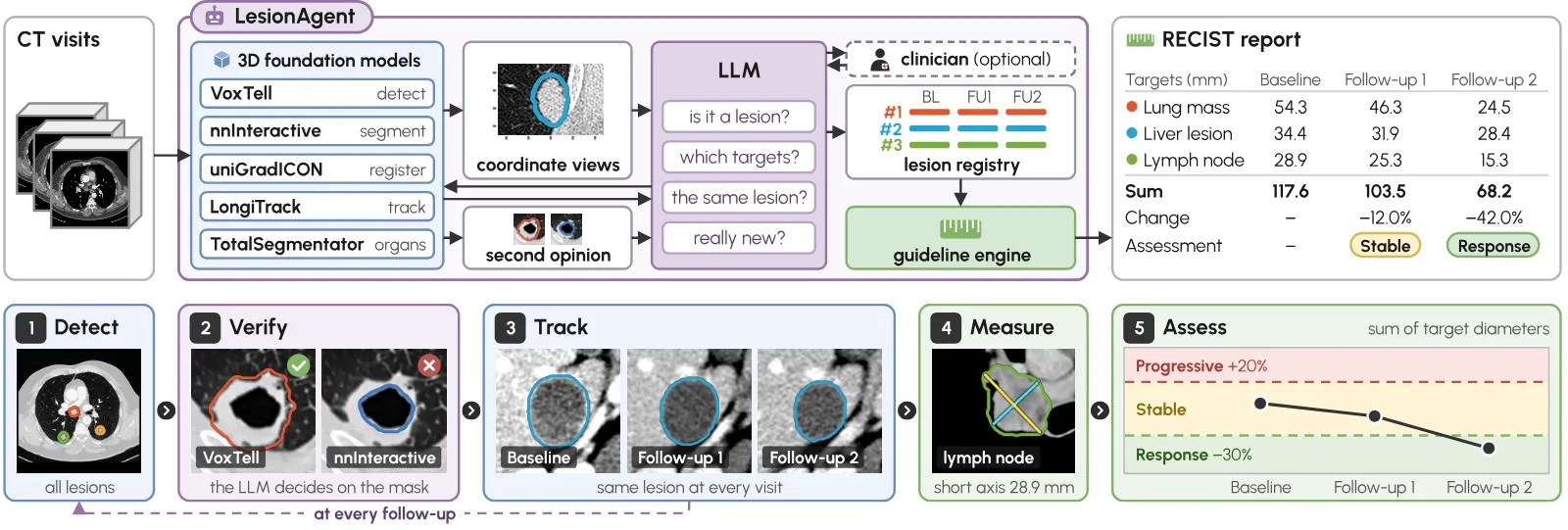
Cancer patients get a CT scan every few months. At each scan a radiologist follows a guideline called RECIST 1.1. They find the tumours, pick up to five to measure, match each one across scans and decide whether any spot is new. The result, response, stable or progression, decides whether treatment continues. The work is slow, and radiologists often disagree.
The paper is a preprint, not yet peer reviewed. The authors built LesionAgent, a large language model (LLM) that works in a loop of tool calls. Its 18 tools include existing 3D imaging models, used unchanged: VoxTell finds tumour candidates, nnInteractive outlines a tumour from one click, uniGradICON aligns scans, and LongiTrack follows a tumour into the next scan. The LLM sees 2D slices labelled with coordinates, so it can turn what it sees into a 3D click. A registry, a table of every tumour at every visit, holds the state of the read outside the model. A second model rechecks every outline. A fixed rule engine does all the measuring and assigns the response, so the LLM never computes a number.
The authors compared it with the same 3D models chained by fixed rules. Across 56 follow-up visits on two datasets, the fixed pipeline wrongly called the cancer progressing 33 times. LesionAgent did so twice. The main cause in the pipeline was counting a tumour missed at the first scan as a new one. The agent checks each new spot against the first scan before recording it.
On real clinical follow-ups from a hospital dataset, the agent matched the radiologists' response at 20 of 23 visits. That included all four visits where the response changed.
The authors report that the surrounding setup, not the model, drives the result. Claude Code, an AI coding assistant, ran the same LLM (Claude Opus 5.5) with the same 3D models as Python functions but without the setup. It found about half as many tumours as LesionAgent. The open-weight Qwen3.8-27B, asked once with all scans in one prompt, found almost none, but found most of them inside LesionAgent.
On DeepLesion, a public benchmark for following tumours between scans, the agent had no training on the benchmark. It still retrieved slightly more tumours than the best tracker trained on it, 89% against 87%. Against radiologists on lung screening scans, it measured nodules as accurately and flagged fewer false ones. But it found fewer: about two thirds of larger nodules, against about four in five for radiologists.
Our reading
In our reading, the most useful finding is not the tumour scores. It is the design rule behind them: keep the model's job to judgement, and take memory and arithmetic away from it. The registry means no tumour is silently dropped between visits. The rule engine means the response category can be traced to measured outlines. When the authors let the LLM assign the response itself, agreement with radiologists fell from 95% to 79%.
The comparison with Claude Code is the part most builders should note. A capable general agent with the same model and the same imaging tools still measured only the tumours it needed for an answer. It often got a plausible response from an incomplete read. A one-shot model also named many responses correctly while finding few tumours. A single accuracy score would hide that. The authors score each step, which makes those shortcuts visible.
In practice, this could mean a radiologist opening a follow-up study that is already read. Every tumour would be outlined and linked across visits, with a few flagged questions such as which target set to use near a threshold. The authors released code and a reading app, so we rate it Readiness level III, open source available. It is not yet level IV: no hospital has documented using it, and the authors say it is not validated for clinical use.
The rest of this story is for members. Membership is free: read it at scienceunderway.com/articles/tumour-tracking-agent-on-ct-finds-nearly-twice-the-lesions-claude-code-does
Read the rest of this story
Membership is free. You get every article in full, and can save stories and follow topics.
We send a sign-in link, no password needed. Already a member? Sign inReadiness assessment
| Level | Status | Evidence |
|---|---|---|
| I Lab only | Met | Working end-to-end research system with ablations, case studies and a failure analysis. |
| II Benchmarked | Met | Results on public datasets (HCUCH, TumorMap, PanTrack, NCI-MATCH, DeepLesion, LIDC) against named baselines, including trained trackers on the DeepLesion benchmark. |
| III Open source | Met | Code and a napari reading app are stated as available at github.com/MIC-DKFZ/LesionAgent. The full skill prompt is released with the code. Whether the code runs as described was not verified by us. |
| IV In production | Not yet | No documented use by a named hospital or company in routine care. The paper says it is not validated for clinical use. |
What would move it up
Documented deployment or a prospective study in a named hospital, ideally with a reader study showing what clinicians add, plus larger cohorts with many more responses and progressions. Regulatory or clinical validation would also be needed.
The study
Maximilian Rokuss, Jeya Maria Jose Valanarasu, Alejandro Lozano et al.. LesionAgent: Training-Free Agentic Tumor Tracking and Response Assessment in Longitudinal CT. arXiv, 20 November 2026. Read the paper
Notes
- Rokuss et al., LesionAgent: Training-Free Agentic Tumor Tracking and Response Assessment in Longitudinal CT. arXiv preprint, 20 November 2026, not peer reviewed. CC BY 4.0. Source
- Code and napari reading app, as stated in the paper. We have not checked that it runs as described. Source
- HCUCH, fully automatic: detection F1 78% (LesionAgent, Opus 5.5) vs 62% (fixed pipeline), 41% (Claude Code with the same 3D models, Table 3), 31% (Claude Code without them, Table 2). Response balanced accuracy 95% vs 40% (pipeline). Qwen3.8-27B: 6% F1 one-shot, 73% in the harness, response 62%.
- False progression: 33 of 56 follow-ups for the fixed pipeline vs 2 for LesionAgent, HCUCH (23) plus TumorMap (33), Figure S1.
- DeepLesion DLS, 960 directed pairs: CPM@10 0.890 vs 0.874 (TLT, trained on the benchmark); mean centre error 4.4 vs 6.0 mm; empty masks 0.2% vs 20% (LongiTrack) and 37% (LesionLocator).
- LIDC fifth reader, 436 scans, nodules of 10 mm or more: sensitivity 67% vs 83%, false positives 0.07 vs 0.14 per scan, long-axis error 4.2 vs 4.1 mm.
- Ablation: LLM assigning the response itself instead of the rule engine, 79% vs 95%. Median cost per read about 101 tool calls and 2.7 US dollars with Opus 5.5. TumorMap three reads: response 77.4 ± 1.5%; 26 of 33 follow-ups same call in all three.
- Readiness: level III, open source available. Code stated as released; no documented clinical use; authors state it is not validated for clinical use.
Edited and signed by
Stefan PerdalEditor and publisher142 stories editedStefan read the study, set the readiness level and approved this story. An AI system found the paper and wrote the first draft.
How this was made
An AI model read the study and wrote this article in the structure Science Underway uses. An editor reviewed it and approved it for publication. Check the original study before you rely on the details.
How we workNo corrections