Tencent drafter reuses DeepSeek and GLM sparse attention for faster speculative decoding
A Tencent preprint describes a drafter model that keeps no memory of its own. It reads what a sparse language model has already stored and chosen, and its lead over two recent drafters grows on long prompts.
scienceunderway.com/articles/tencent-drafter-reuses-deepseek-and-glm-sparse-attention-for-faster-speculative

What the study shows
Speculative decoding speeds up a large language model without changing its output. A small "drafter" model guesses several next words. The large "target" model checks them all in one pass and keeps the ones it agrees with. The more guesses it keeps per step, the faster the reply.
Recent long-context models such as DeepSeek-V4, GLM-5 and Tencent's Hy4 use sparse attention. Each layer reads only a fixed number of past positions, picked for the current word by a small scoring component called an indexer. They also store a compact KV cache, the memory of past words that attention reads.
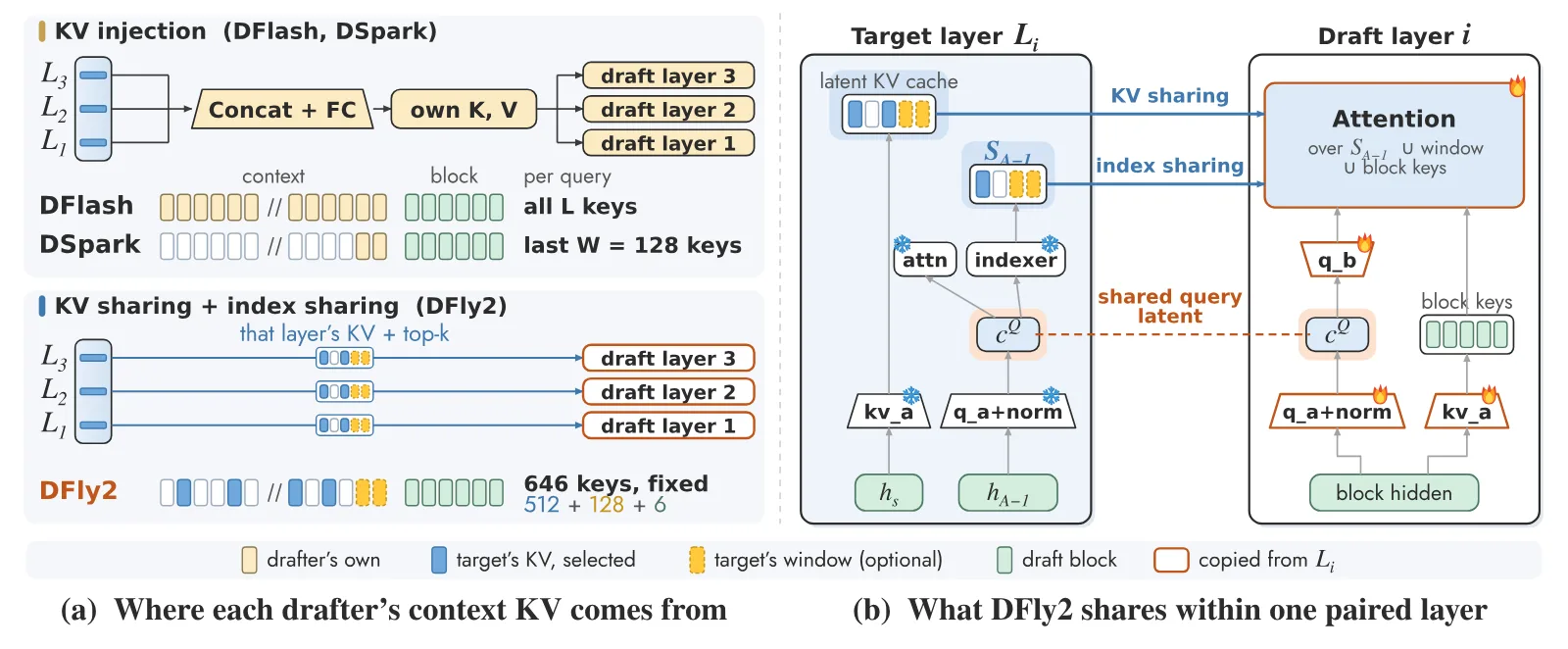
The authors argue that current drafters, such as DFlash and DSpark, were built for older dense models. DFlash keeps its own cache over the whole prompt. DSpark keeps a short window of recent words. Both add memory, and both must be built when the prompt is first processed, which delays the first word of the reply.
The new drafter, DFly2, keeps no cache. Each of its three layers reads the cache of one paired layer in the target, at the positions that layer's indexer already chose. It also starts from that layer's weights. The authors checked that a choice made one step early still holds for the next few words: on DS-V4.1-Flash it covered close to nine tenths of what later words would pick, against under a fifth for a recent window of the same size.
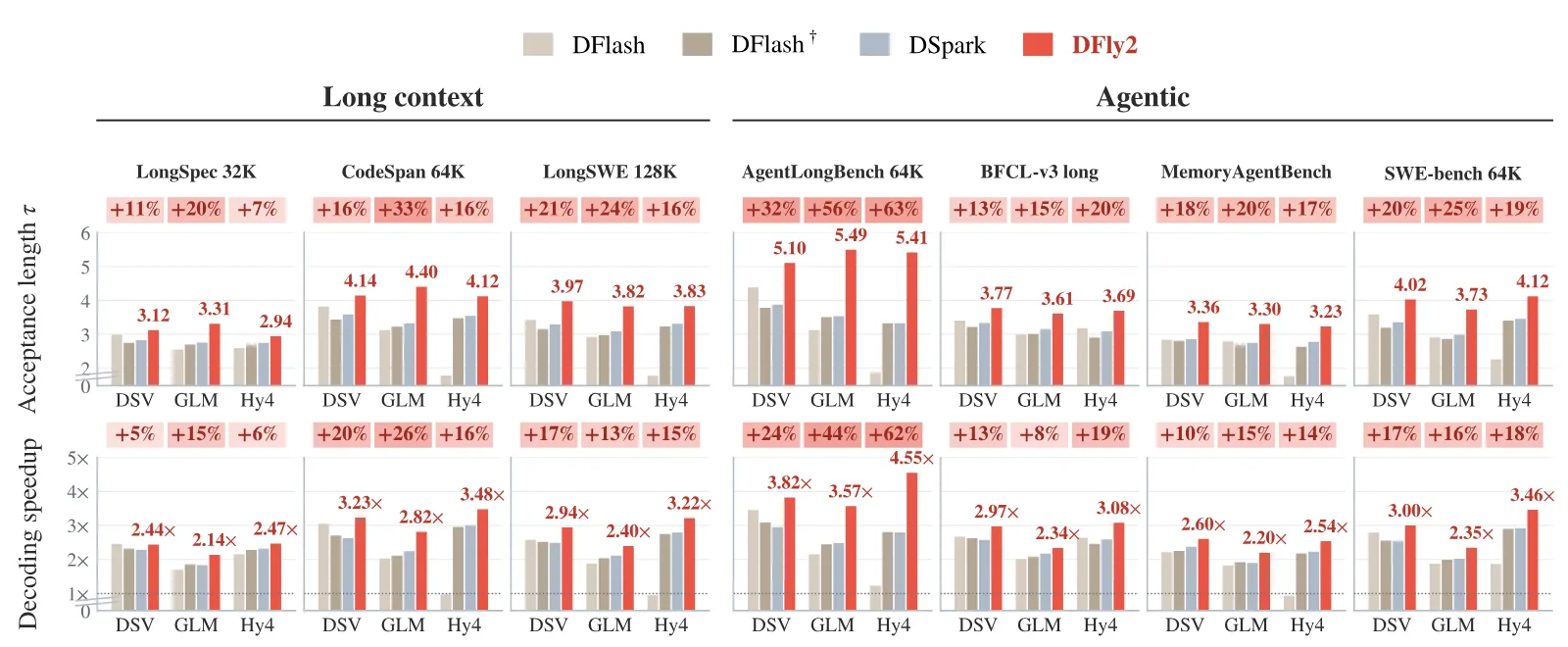
The authors tested on three targets: DS-V4.1-Flash, GLM-5.3-Flash and Hy4 flash. They trained DFlash and DSpark themselves on the same data and recipe. DFly2 kept more guesses per step on every benchmark tested. Its lead over the stronger rival was 3.9% to 10.5% on general tasks such as maths and code, and 10.0% to 31.5% on long-context and agent tasks of up to 128,000 tokens.
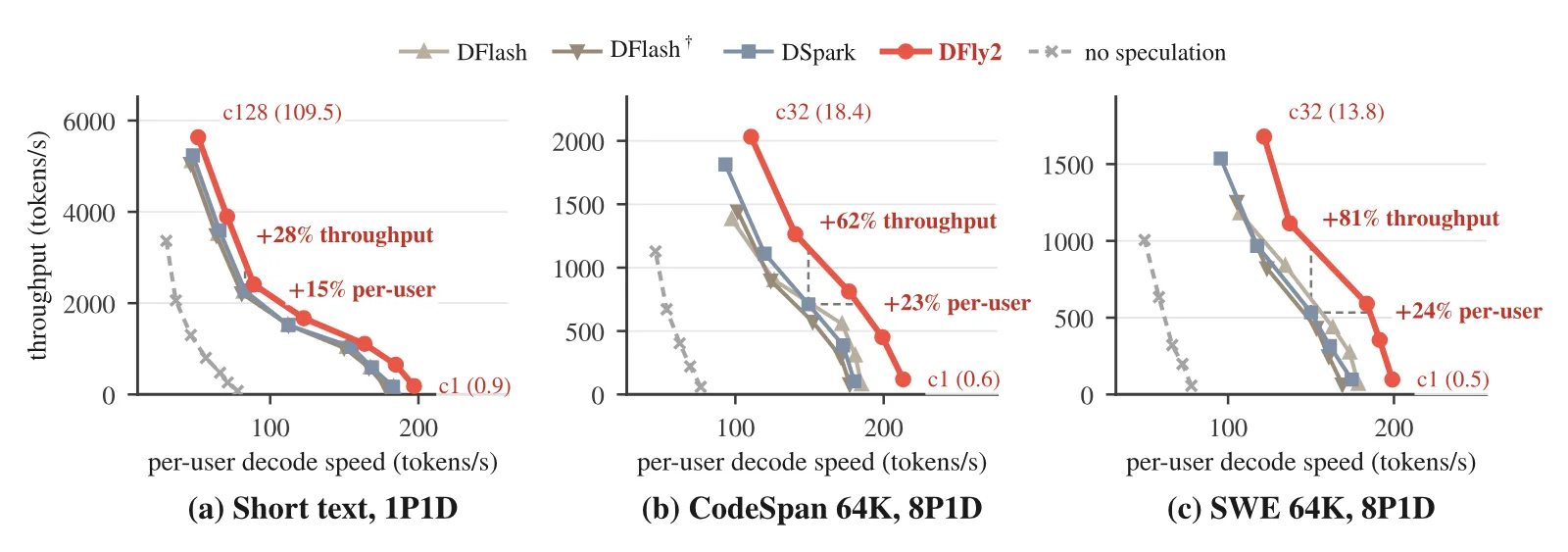
Under heavy load on DS-V4.1-Flash, at the same speed per user, DFly2 served about 28% more text than DSpark on short prompts and 62% and 81% more on two sets of 64,000-token prompts. This is a preprint and has not been peer reviewed.
Our reading
In our reading, the core idea is simple and sensible. A sparse model already pays to decide which past words matter. A drafter that copies that decision gets a good reading list for free, instead of guessing by recency or paying to score everything again. The gain is largest exactly where the reading list matters most: long prompts.
The long-context results are the most telling. The authors report that DFly2's accepted guesses on agent tasks stayed within 4% of its general average, while DSpark fell by 11% to 21%. On Hy4 flash, the full-cache DFlash almost stopped working past the 32,000-token training length, keeping close to one word per step. A drafter that reads a fixed number of well-chosen positions sees the same amount of context in training and in use, which plausibly explains why it holds up.
For a concrete case, picture a coding agent working through a 64,000-token session of files and tool output. On that kind of prompt, the authors' serving test shows the same hardware producing about four fifths more text per second than with DSpark, at equal speed for each user. If that holds in real services, it is a direct cut in cost per agent session.
The rest of this story is for members. Membership is free: read it at scienceunderway.com/articles/tencent-drafter-reuses-deepseek-and-glm-sparse-attention-for-faster-speculative
Read the rest of this story
Membership is free. You get every article in full, and can save stories and follow topics.
We send a sign-in link, no password needed. Already a member? Sign inReadiness assessment
| Level | Status | Evidence |
|---|---|---|
| I Lab only | Met | The method is described in full with ablations and a mechanism study (coverage measurement). |
| II Benchmarked | Met | Results on public benchmarks: GSM8K, MATH-500, AIME25, HumanEval, LiveCodeBench, MT-Bench, LongSWE-Bench, BFCL-v3, AgentLongBench, MemoryAgentBench, compared with DFlash and DSpark on three targets. |
| III Open source | Met | The paper links https://github.com/Tencent/AngelSpec. I could not confirm from the paper text that DFly2 code or weights are in it, so this rests on the link alone. |
| IV In production | Not yet | No named organisation is documented as running DFly2 in production. The paper reports only benchmark and serving-sweep tests. |
What would move it up
Confirmation that the repository holds usable DFly2 code and trained weights would firm up level 3. Documented deployment in a live service, such as Tencent's Hy4 serving, with real traffic results would reach level 4. Independent reproduction and comparison against drafters trained by their original authors would also help.
The study
Hong Liu, Rui Cen, Junhan Shi et al.. DFly2: Turbocharging Long-Context Speculative Decoding by Sharing the Target's Sparsity. arXiv, 25 November 2026. Read the paper
Notes
- Liu, Cen, Shi et al., "DFly2: Turbocharging Long-Context Speculative Decoding by Sharing the Target's Sparsity", arXiv preprint, 25 November 2026, CC BY 4.0. Source
- Code repository linked by the authors (Tencent AngelSpec). The paper does not state whether DFly2 code or weights are included. Source
- Readiness: level III, open source available, based on the linked repository; level II benchmark evidence is clear; no documented production use.
- Example figure: on DS-V4.1-Flash AgentLongBench 64K, greedy, DFly2 kept 5.10 tokens per step against 3.87 for DSpark (Table 7).
Edited and signed by
Stefan PerdalFounder. Twenty-five years of building digital products.160 stories editedStefan read the study, set the readiness level and approved this story. An AI system found the paper and wrote the first draft.
How this was made
An AI model read the study and wrote this article in the structure Science Underway uses. An editor reviewed it and approved it for publication. Check the original study before you rely on the details.
How we workNo corrections