SWE-bench Lite: test-derived failure diagnoses lift five coding agents' fix rates
A tool that compares passing and failing test runs, then adds a short account of where the failure departs to the bug report, helped every agent tested. An open-weight model given that account beat Claude Haiku 4.5 working without it.
scienceunderway.com/articles/swe-bench-lite-test-derived-failure-diagnoses-lift-five-coding-agents-fix-rates

What the study shows
The authors, from CISPA and Humboldt-Universität zu Berlin, built a tool they call FORECAST. It runs a program's failing tests and the passing tests that touch the same code. It records fine detail of each run, such as which conditions held and where values were set and used.
It then picks the observations that best separate the failing runs from the passing ones and lists them in the order they happen. The authors call this list a cause chain. Each item names a file and line and carries a score for how sharply it separates the runs. No language model is used to make it.
The chain is simply appended to the issue text an agent receives. The agent itself is not changed. Any agent that builds its prompts from the issue therefore sees it.
They tested this on all 300 issues of SWE-bench Lite, a standard benchmark of real GitHub bugs in 12 Python projects. Five agents of different designs ran with two models, the commercial Claude Haiku 4.5 and the open-weight Qwen3.5 27B, each with and without the diagnosis. That made 6,000 repair attempts, all judged by the official SWE-bench test harness.
The authors report that every agent fixed significantly more issues with the diagnosis, with both models. Over all agents the share rose from 48.5% to 70.9% with Haiku and from 31.2% to 56.1% with Qwen3.5. Gains per agent ranged from 8 to 45 percentage points. For each issue lost with the diagnosis, agents gained about 11 (Haiku) or 30 (Qwen3.5). Repeated runs kept the gains.
Several checks point to the content of the chain doing the work. Two agents already ran the same developer tests and still gained. Giving one agent the raw failing test output instead recovered only about 40% of the gain. Handing agents the chain from a different bug gave results about equal to no diagnosis. Shuffling the order or keeping only the locations lost most of the gain.
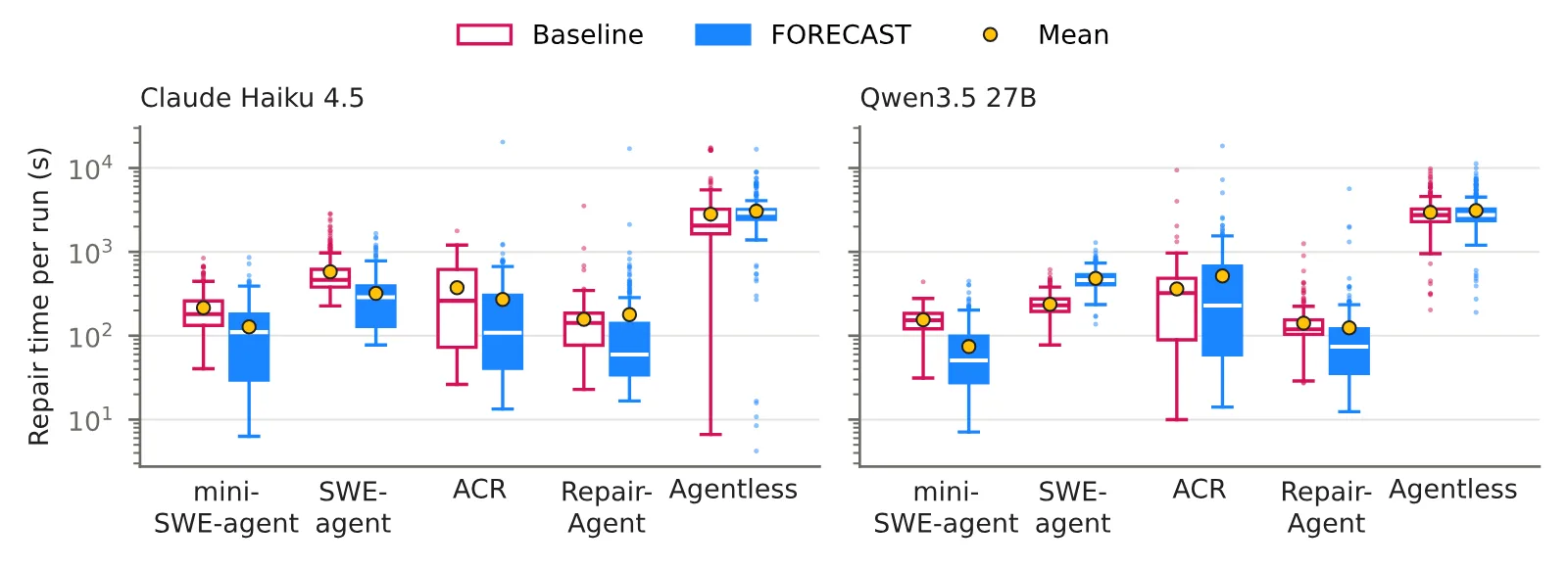
Patches stayed as small as before. Tokens used per fixed issue fell by about 60% with Haiku and 50% with Qwen3.5. Computing a diagnosis took a median of 40 minutes of machine time per issue. This is a preprint and has not been peer reviewed.
Our reading
In our reading, the striking point is where the gain comes from. Nothing about the agents or models changed. They simply received a more useful bug report, and the effect was larger than the gap between the two models.
The controls are better than usual for this kind of study. The unrelated-diagnosis test rules out the idea that any structured hint helps. The test-output test suggests the gain is not just from seeing the tests. Order mattered, while wording did not, which suggests agents use the sequence of where the run goes wrong.
A practical example: a team whose continuous integration flags a failing test could run this diagnosis overnight, attach it to the ticket, and let an agent attempt the fix in the morning. That fits the study's set-up, where a reproducing test already exists. On readiness, we rate this level III, open source available: the code is public under Apache 2.0, but we found no documented use by a named organisation.
The rest of this story is for members. Membership is free: read it at scienceunderway.com/articles/swe-bench-lite-test-derived-failure-diagnoses-lift-five-coding-agents-fix-rates
Read the rest of this story
Membership is free. You get every article in full, and can save stories and follow topics.
We send a sign-in link, no password needed. Already a member? Sign inReadiness assessment
| Level | Status | Evidence |
|---|---|---|
| I Lab only | Met | A working method is described and implemented, with a full pipeline and worked example. |
| II Benchmarked | Met | Evaluated on all 300 issues of SWE-bench Lite, a public benchmark, with five agents, two models, repeated runs and 13 ablation variants. Patches were judged by the official SWE-bench harness. |
| III Open source | Met | FORECAST and the evaluation scripts are open source under Apache 2.0 at https://github.com/smythi93/forecast, installable with pip install forecast-repair. Every diagnosis and run is archived on Zenodo (doi 10.5281/zenodo.23769792). |
| IV In production | Not yet | No documented use by a named organisation in real development or production. All evidence is from a benchmark with developer-written tests. |
What would move it up
Documented use by a named team on its own bug reports. That would need an automatic way to get a reproducing test when an issue has none, shown to give diagnoses as useful as developer tests. Independent replication on other benchmarks, languages and models, and a faster diagnosis than the current 40-minute median, would also help.
The study
Marius Smytzek, Martin Eberlein, Lars Grunske et al.. Improving Repair Agents with Cause-Chain Diagnoses. arXiv, 23 November 2026. Read the paper
Notes
- Smytzek, Eberlein, Grunske and Zeller, Improving Repair Agents with Cause-Chain Diagnoses, arXiv preprint, November 2026 (CC BY 4.0). Source
- FORECAST source code and evaluation scripts, Apache 2.0; installable with pip install forecast-repair. Source
- Archived evaluation data, including every diagnosis and run, on Zenodo (doi 10.5281/zenodo.23769792). Source
- Exact figures, all agents combined: Haiku 4.5 resolved 727 of 1,500 attempts (48.5%) without and 1,063 (70.9%) with the diagnosis; Qwen3.5 27B 468 (31.2%) and 842 (56.1%). Tokens per resolved issue: 2.30M to 0.92M (Haiku), 3.05M to 1.51M (Qwen3.5). Haiku cost per resolved issue: $0.85 to $0.49.
- Readiness: level III, open source available. Code is public; no documented production use by a named organisation.
Edited and signed by
Stefan PerdalEditor and publisher142 stories editedStefan read the study, set the readiness level and approved this story. An AI system found the paper and wrote the first draft.
How this was made
An AI model read the study and wrote this article in the structure Science Underway uses. An editor reviewed it and approved it for publication. Check the original study before you rely on the details.
How we workNo corrections