Small watcher model cuts OSWorld agents' time outside reasoning by a third
A 0.8-billion-parameter model that watches the screen tells a computer-use agent when to look again and when its plan has gone stale. On desktop tasks it saves time without hurting success; on fast-changing web pages it helps one of two agents succeed more often.
scienceunderway.com/articles/small-watcher-model-cuts-osworld-agents-time-outside-reasoning-by-a-third

What the study shows
Computer-use agents are AI systems that read screenshots and then click and type to complete tasks on a desktop or in a browser. Most run in a fixed loop: take a screenshot, reason, act, sleep for a set time, repeat. The screen does not wait for them. Pages load, pop-ups appear and content moves while the agent is still thinking.
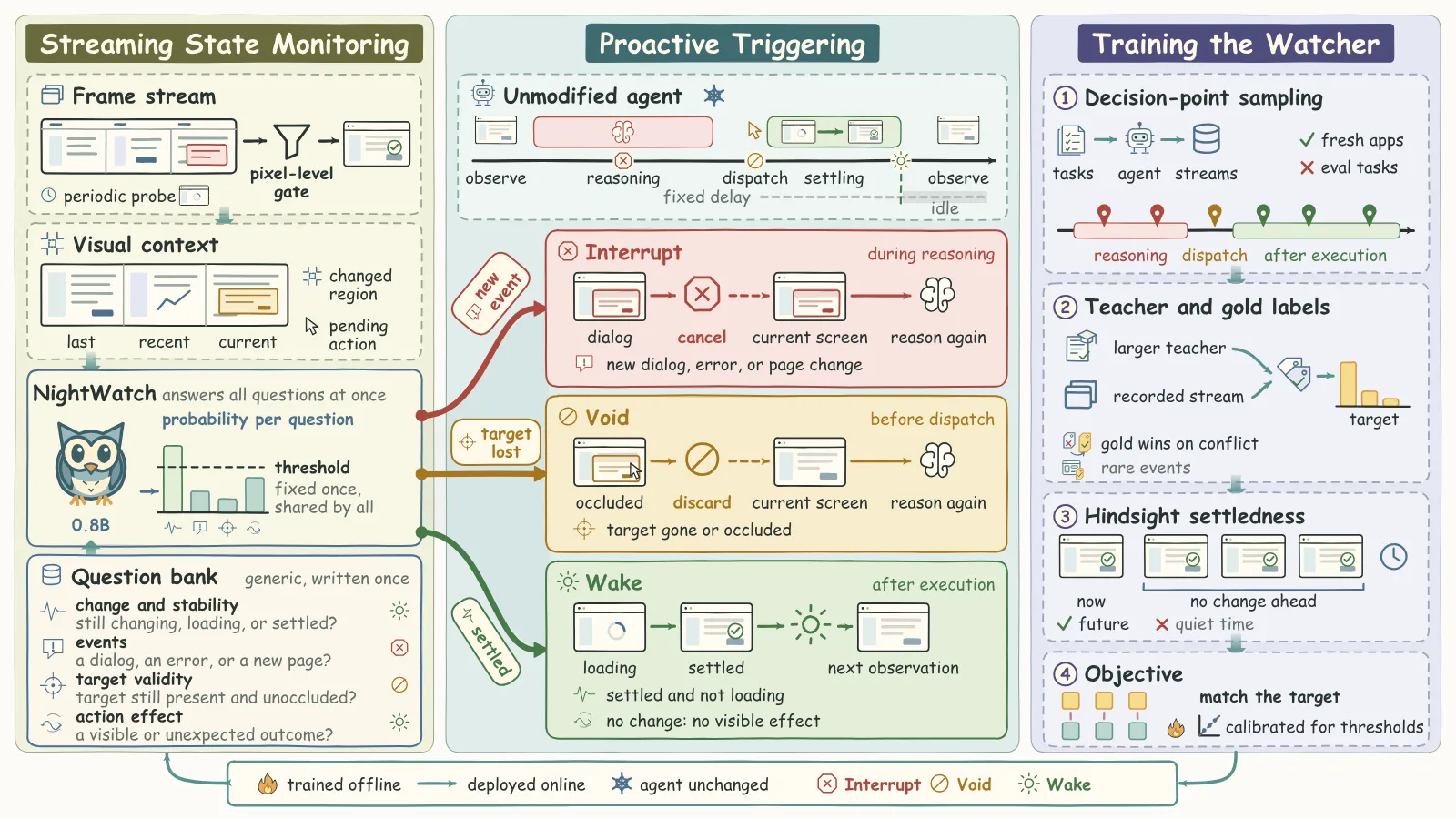
The authors, from the National University of Singapore, A*STAR, SenseTime and Hong Kong Baptist University, add a small "watcher" model of 0.8 billion parameters. It looks at the screen about ten times a second and answers 16 fixed yes-or-no style questions, such as "has a dialog appeared?" or "is the page still loading?". Simple threshold rules then do one of three things. They interrupt the agent's reasoning when something new appears. They cancel a click whose target has moved. Or they wake the agent as soon as the screen has settled, instead of after a fixed pause. The agent's model, prompt and actions are not changed.
The authors report results on 100 tasks sampled from OSWorld-Verified, a public desktop benchmark, with three runs each. With the larger agent, MiMo-V2.6-Flash, time per task spent outside model reasoning fell by 33%, and the share of time wasted fell from about 16% to about 8%. Success was 68.0% against 66.3% for the unmodified agent, which the authors describe as on par. With a smaller agent, Qwen3.8-27B, time outside reasoning fell by 41%. The time savings passed a statistical test; the success differences were not tested.
On 49 fast-changing web tasks from DynaCU-Bench, such as live dashboards, carousels and games, success with the larger agent rose from 39.5% to 44.2%. With the smaller agent it stayed at 34.7%. Two earlier approaches that watch the screen more passively, AOI and PUSV, were slower on the desktop tasks, and PUSV did worse than the plain agent on the web tasks.
A concrete case from the paper: in a colour-matching game, the agent chose a cyan square, but the squares rotated during the few seconds it took to issue the click. The watcher spotted that the target had gone and cancelled the click, which would have hit an orange square. The agent looked again and got it right. The work is a preprint and has not been peer reviewed.
Our reading
In our reading, the most solid result is about time, not accuracy. The one-third saving is in time outside the model's own reasoning: waiting, screenshots and actions. Model calls still dominate. End to end, a desktop task took 8% less time with the larger agent and 11% less with the smaller one. That is useful, but it is not a one-third speed-up of the whole job.
The success gains are less certain. On the desktop benchmark the differences of 1 to 2 points sit well inside the run-to-run spread of about 4 points, and the authors claim only parity. The 4.7-point gain on fast web pages is more interesting but rests on 49 tasks and comes with no significance test. It also did not appear with the smaller agent.
The design choice we find most sensible is the division of labour. The small model only reads the screen; fixed rules make the decisions. That keeps the behaviour inspectable, and an engineer can see which question fired and why. Readiness: level III, open source available. The paper links code, weights and training data, though we have not checked them.
The rest of this story is for members. Membership is free: read it at scienceunderway.com/articles/small-watcher-model-cuts-osworld-agents-time-outside-reasoning-by-a-third
Read the rest of this story
Membership is free. You get every article in full, and can save stories and follow topics.
We send a sign-in link, no password needed. Already a member? Sign inReadiness assessment
| Level | Status | Evidence |
|---|---|---|
| I Lab only | Met | A working system with an approach, training recipe and experiments is described in the paper. |
| II Benchmarked | Met | Results on OSWorld-Verified (100-task sample) and DynaCU-Bench (49 tasks), both public benchmarks, with two agents and comparisons against Vanilla, AOI and PUSV. |
| III Open source | Met | The paper links code (github.com/SuJQ0722/NightWatch), model weights (nullptr04/NightWatch-0.8B on Hugging Face) and training data (nullptr04/NightWatch-Data). Not verified by us; the links are as stated in the paper. |
| IV In production | Not yet | No documented use by a named organisation in production. All results are on benchmarks. |
What would move it up
Documented use by a named team or product with live computer-use agents would move it to level 4. Independent replication on other benchmarks, agents and operating systems, plus tests on faster interfaces and mobile, would strengthen the case.
The study
Jiaqi Su, Jie-Jing Shao, Yichen Liu et al.. Don't Sleep, Keep Watch: Proactive Perception for Computer-Use Agents. arXiv, 21 November 2026. Read the paper
Notes
- Su, Shao, Liu, Huang and Yin, "Don't Sleep, Keep Watch: Proactive Perception for Computer-Use Agents", arXiv preprint, November 2026, CC BY 4.0. Source
- Code, as linked in the paper (not checked by us). Source
- Model weights, NightWatch-0.8B, as linked in the paper. Source
- Training data, as linked in the paper. Source
- Exact figures, OSWorld-Verified, MiMo-V2.6-Flash: non-reasoning time 197.4 s to 132.7 s; wasted-time share 16.3% to 7.7%; success 68.0% ± 3.6 against 66.3% ± 4.5; total loop time 666.0 s to 614.7 s. Qwen3.8-27B: non-reasoning time 190.2 s to 111.9 s; pass@3 69% to 77%; total 701.9 s to 625.4 s.
- Exact figures, DynaCU-Bench: large agent success 39.5% to 44.2%; small agent 34.7% both; watcher comparison 44.2% against 32.7% (D3-27B) and 36.7% (Jev API).
Edited and signed by
Stefan PerdalEditor and publisher142 stories editedStefan read the study, set the readiness level and approved this story. An AI system found the paper and wrote the first draft.
How this was made
An AI model read the study and wrote this article in the structure Science Underway uses. An editor reviewed it and approved it for publication. Check the original study before you rely on the details.
How we workNo corrections