Self-evolving agent skills such as SkillOpt rarely beat short human-written ones
A study of about 0.9 million agent runs finds that skills, harnesses and model choice interact. A skill worth 66 points under one setup can be worth 2 under another, and skills learned from an agent's own experience often stall.
scienceunderway.com/articles/self-evolving-agent-skills-such-as-skillopt-rarely-beat-short-human-written-ones

What the study shows
An AI agent is a language model wrapped in extra machinery. That machinery includes 'skills', which are reusable written instructions, and a 'harness', the code that formats answers, feeds back errors and allows retries. Each new add-on is usually reported as one average gain under its authors' own setup.
Researchers at the University of Southern California, with one author from Amazon, tested this. They crossed nine public benchmarks, four models (Qwen3.5-9B, Claude Sonnet 4.6, Sonnet 5 and GPT-5.6-sol), four skill conditions, four harness levels and three compute budgets. Each comparison changed one factor on the same tasks. The work is a preprint and has not been peer reviewed.
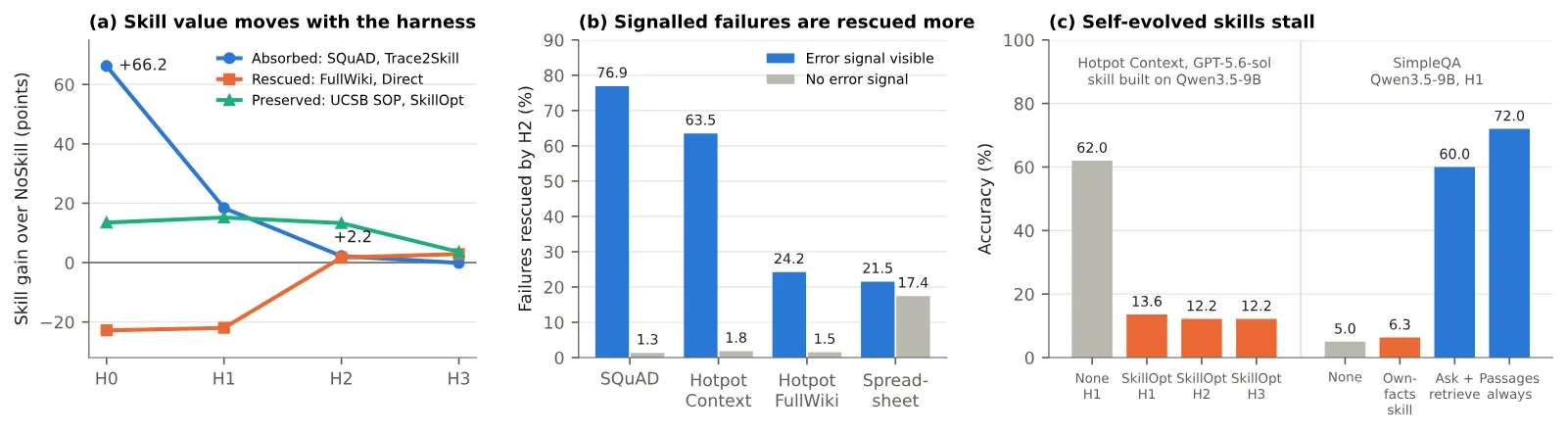
The authors report that no setup was best everywhere. On the SQuAD reading test, an 18-word skill added 66 points with a bare harness but only 2 once the harness enforced a short answer format. Re-scored on whether the right answer appeared at all, the gain was mostly about formatting.
They also report that the type of failure points to the fix. Missing facts responded to a stronger model. Execution errors, such as a failed tool call, responded to a harness that feeds errors back. But feedback mostly helped when the failure left a visible error. On SQuAD, failures with an error signal were rescued about 77% of the time, against about 1% for silent ones.
Self-evolving skills, which an agent builds from its own past runs, fell short in four ways. They rarely beat a short human-written skill. They could learn a dataset shortcut. They broke when moved to another model. And they could not supply missing facts. One skill built on Qwen3.5-9B cut GPT-5.6-sol's score on a HotpotQA test from 62 to about 14, because it made the model write a worksheet in the answer field.
On choosing what to use, per-task routing did not beat a fixed setup. A per-benchmark choice did. In an offline replay, running both a small and a strong model on 20 labelled tasks, then committing the whole benchmark to the winner, scored higher than always using the strong model at 36% lower cost.
Our reading
In our reading, the most useful result is not any single number. It is the evidence that an add-on's value depends on what else is in the stack. A skill gain reported without its harness and model tells a reader little about what happens in a different system.
The self-evolution findings are the sharpest. Trace2Skill's evolved skill failed to beat its short human-written starting point on five of seven benchmarks. On SimpleQA, a factual quiz, a skill built from the agent's own facts moved accuracy from 5% to about 6%. Supplying retrieved source passages lifted it to 60%. The point is plain: an agent cannot learn facts it never saw.
A practical example: a team running a support agent might adopt an optimised skill because it raised scores on a cheaper model. This study suggests checking it on the production model and harness first, and comparing it with a short hand-written instruction, before rollout.
The rest of this story is for members. Membership is free: read it at scienceunderway.com/articles/self-evolving-agent-skills-such-as-skillopt-rarely-beat-short-human-written-ones
Read the rest of this story
Membership is free. You get every article in full, and can save stories and follow topics.
We send a sign-in link, no password needed. Already a member? Sign inReadiness assessment
| Level | Status | Evidence |
|---|---|---|
| I Lab only | Met | Controlled experiments with frozen skills, harness levels and budgets across nine benchmarks, with failure labelling and replay analyses. |
| II Benchmarked | Met | All results are on public benchmarks: SimpleQA, SQuAD, HotpotQA (Context and FullWiki), SpreadsheetBench, LiveMathematicianBench, UCSB SOPBench, Amazon SOP and BigCodeBench-Hard. Scores use each benchmark's native evaluator, with bootstrap intervals. |
| III Open source | Met | Code, split identifiers and frozen skill artifacts are on GitHub, and the outcome ledger and failure labels are on Hugging Face. We did not inspect the repositories, so completeness is unchecked. The released items are an evaluation harness and data, not a deployable tool. |
| IV In production | Not yet | No named organisation is documented using the findings or the pilot-based switching policy in production. The routing and escalation results are offline replays. |
What would move it up
Documented use by a named organisation, for example a live agent deployment where a 20-task labelled pilot decides between a cheaper and a stronger model. Other labs reproducing the skill-harness interactions on other models and agent stacks would also strengthen the case.
The study
Zihan Jin, Gaoyuan Du, Jiate Li et al.. Which Failure Does an Intervention Repair? When Agent Interventions Help, and Where Self-Evolving Skills Stall. arXiv, 22 November 2026. Read the paper
Notes
- Jin, Du, Li, Ye, Li, Zhao and Cao. Which Failure Does an Intervention Repair? When Agent Interventions Help, and Where Self-Evolving Skills Stall. arXiv preprint, November 2026, CC BY 4.0. Source
- Code, split identifiers and frozen skill artifacts. Source
- Instance-level outcome ledger and failure labels. Source
- Exact figures: SQuAD Trace2Skill skill gain +66.2 at H0 and +2.2 at H2 (Qwen3.5-9B); signalled versus silent failure rescue 76.9% vs 1.3% on SQuAD; GPT-5.6-sol on Hotpot Context 62.0 without skill, 13.6 with the Qwen-built SkillOpt skill; SimpleQA 5.0% (no skill), 6.3% (own-data facts), 60.0% (search on request), 72.0% (passages always); pilot 57.4 vs 53.5 for always GPT-5.6-sol at 36% lower cost.
- Interaction models predicted held-out cells better on 7 of 8 benchmarks (mean leave-one-cell-out R² 0.729 to 0.812). Root-aligned gains: +9.58 points for execution failures from the richer harness, +64.54 for capability failures from a stronger model. 59.7% of comparisons had no tested action that succeeded.
Edited and signed by
Stefan PerdalEditor and publisher142 stories editedStefan read the study, set the readiness level and approved this story. An AI system found the paper and wrote the first draft.
How this was made
An AI model read the study and wrote this article in the structure Science Underway uses. An editor reviewed it and approved it for publication. Check the original study before you rely on the details.
How we workNo corrections