Privacy audit flags over half of AI agent skills handling personal data
A static check of 563 public AI assistant add-ons found that 307 may use people's data beyond what their descriptions say. It also flagged skills that NVIDIA's security scanner had already passed. The study is a preprint and has not been peer reviewed.
scienceunderway.com/articles/privacy-audit-flags-over-half-of-ai-agent-skills-handling-personal-data

What the study shows
Agent skills are small installable packages of instructions and code that extend AI assistants. Once installed, they work with the assistant's access to a user's files, accounts and data. People decide whether to install them from a short description.
The authors built a tool, SkillPrivus, that reads a skill's code and instruction files without running it. It breaks the skill into individual data operations, such as reading, saving, sending or inferring information. Each operation is pinned to the exact line of source it comes from.
An AI model then judges each operation using Contextual Integrity, a privacy theory that asks whether a flow of information fits its context. Here the context is what the skill claims to do and the norms of the data's domain, such as health or finance. Some cases are settled by fixed rules: credentials and sensitive health data must stay on the machine unless the skill explicitly asks for consent.
The authors collected 726 skills from public marketplaces, including ClawHub and SkillsMP, plus Anthropic's and NVIDIA's official collections. After setting aside skills with no personal data and some that failed analysis, 563 remained. The tool, run on the open-weight model gpt-oss-120b, flagged at least one potential violation in 307 of them, about 55%.
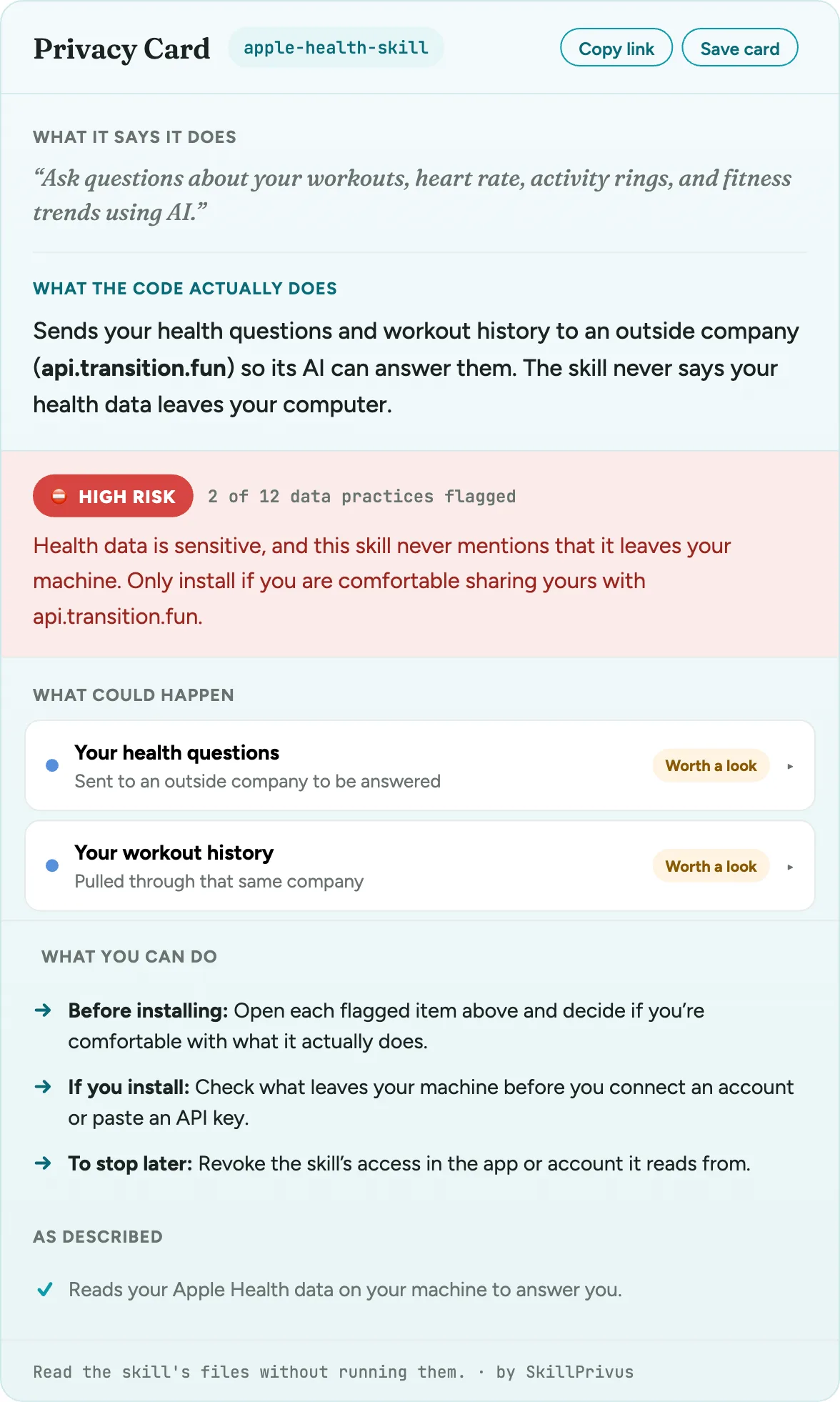
Most flags were not about attacks or especially sensitive fields. They were about a skill handling more kinds of data than its purpose covers, or sending data to a recipient the description does not mention. One example: a skill offering to let people 'talk to' their Apple Health data sends their health questions and an API key to an outside company its description never names.
On 37 NVIDIA Verified Skills, which pass NVIDIA's SkillSpector security scanner before publication, the tool flagged potential privacy problems in 24. The authors stress this does not mean the scanner failed. It was built to catch a different kind of risk.
To check the judgements, three doctoral students labelled 311 data operations from 21 skills without seeing the tool's verdicts. The tool agreed with them about as often as they agreed with each other, at roughly 83%.
Our reading
In our reading, the most useful idea here is the framing. Security work on agent skills asks whether a skill is malicious or over-privileged. This paper asks a different question: does an honest skill use its legitimate access for more than it told the user? That gap is real, and the Apple Health example makes it concrete.
The headline rate needs care. The 55% figure comes from one judge model. In a side test on NVIDIA skills, gpt-oss-120b flagged about 2.7 times as many data operations as GPT-5, and the two models ranked skills differently. The authors themselves say the absolute rate depends on the model. We would read 55% as 'common', not as a precise measure.
We rate this work at level II, Benchmarked, and a weak II. It is tested on a large real corpus and against human labels, but both are the authors' own, not a public benchmark. The paper mentions a released codebase but gives no link, so we cannot place it at level III.
The rest of this story is for members. Membership is free: read it at scienceunderway.com/articles/privacy-audit-flags-over-half-of-ai-agent-skills-handling-personal-data
Read the rest of this story
Membership is free. You get every article in full, and can save stories and follow topics.
We send a sign-in link, no password needed. Already a member? Sign inReadiness assessment
| Level | Status | Evidence |
|---|---|---|
| I Lab only | Met | A working pipeline is described and applied to real skills, with worked examples. |
| II Benchmarked | Met | Evaluated on a corpus of 726 public skills and against a human-labelled reference set (83.2% agreement, kappa 0.346). Caveat: the corpus and human labels are the authors' own, not a public benchmark. This is a weak level 2. |
| III Open source | Not yet | The paper refers to a released codebase with prompts under prompts/, but gives no URL or repository link in the text. The corpus, labels and tool were not shown to be public. |
| IV In production | Not yet | No documented use by a named organisation. The Discussion says use as a pre-release scan or published Privacy Card 'remain to be evaluated'. |
What would move it up
Publish the code, prompts, skill corpus and human labels with a stable link, so others can check the work (level 3). For level 4, a marketplace or skill publisher would need to run it in a real review process, with reported results. Also useful: larger expert-labelled validation, precision and recall figures, and results across several judge models.
The study
Mariana Fernandez-Espinosa, Ivoline Ngong, Keerthiram Murugesan et al.. SkillPrivus: Uncovering PRIVacy of USe Harms in Agentic Skills. arXiv, 19 November 2026. Read the paper
Notes
- Fernandez-Espinosa, Ngong, Murugesan and Natesan Ramamurthy, 'SkillPrivus: Uncovering PRIVacy of USe Harms in Agentic Skills', arXiv preprint, 19 November 2026, CC BY 4.0. Not peer reviewed. Source
- NVIDIA SkillSpector, the security scanner used in NVIDIA's Verified Skills pipeline, as cited by the paper. Source
- Exact figures: 726 skills collected; 118 set aside as having no personal data; 45 failed analysis; 563 analysed. 22,158 data moves extracted, 2,144 (9.7%) flagged. 307 of 563 skills (54.5%) had at least one flag. Root causes: information type 54.2%, recipient 33.7%, subject 6.5%, derivation 3.2%, access 2.4%. Harm labels: Exclusion 1,156 (53.9%), Secondary Use 552 (25.7%).
- Human agreement: 311 moves from 21 skills, three annotators. Tool against humans 83.2%, Cohen's kappa 0.346. Between humans 83.4%, mean kappa 0.478, Krippendorff's alpha 0.380. Moves marked unresolvable were excluded.
- Backend comparison on 37 NVIDIA skills fully resolved by both models: gpt-oss-120b flagged 162 of 2,232 moves (7.26%) and 24 of 37 skills; GPT-5 flagged 73 of 2,743 moves (2.66%) and 18 of 37 skills. Rank correlation on flagged share 0.309, not significant.
- Readiness: level II, Benchmarked (weak). Evaluated on the authors' own corpus and labels. The paper mentions a released codebase under prompts/ but gives no link, so level III is not met.
Edited and signed by
Stefan PerdalEditor and publisher142 stories editedStefan read the study, set the readiness level and approved this story. An AI system found the paper and wrote the first draft.
How this was made
An AI model read the study and wrote this article in the structure Science Underway uses. An editor reviewed it and approved it for publication. Check the original study before you rely on the details.
How we workNo corrections