NAVER medical model built on Gemma lifts HealthBench without losing exam scores
NAVER's team trained separate medical specialists on Google's open Gemma model and merged them into one. Its scores on HealthBench, a test of health conversations, roughly doubled while exam-style accuracy held. Much of the lead over frontier models shrinks once long answers are penalised.
scienceunderway.com/articles/naver-medical-model-built-on-gemma-lifts-healthbench-without-losing-exam-scores

What the study shows
The KMed team at NAVER, a South Korean internet company, started from Gemma-4-31B-IT. That is an open-weight model from Google, meaning its trained parameters can be downloaded and run locally. The goal was a medical model that a hospital could host on its own limited hardware. The work is a preprint and has not been peer reviewed.
The authors start from a familiar problem. Training a model to hold better health conversations often makes it worse at exam-style questions, and the reverse. They argue the cause is that the tasks differ in two ways: what a good output looks like, and what feedback is available. Exam questions have one right answer. A clinician's open question does not, so it has to be marked against a rubric, a checklist of what a good reply should and should not do.
So they split medical training into four task types: open-ended questions, multiple-choice questions, diagnosis from a case report, and clinical inquiry, meaning free-text replies to patients and clinicians. They trained one specialist model per type, each with the reward that suits it. They then merged the four into a single model through distillation, where one model learns to copy others. Their merging method uses each specialist's learned change relative to the original pretrained model as the signal.
For clinical inquiry they built a synthetic corpus of simulated consultations. Cases were drawn from the clinical skills objectives of the Korean medical licensing exam. The simulated user often held back details, so the assistant had to ask for them.
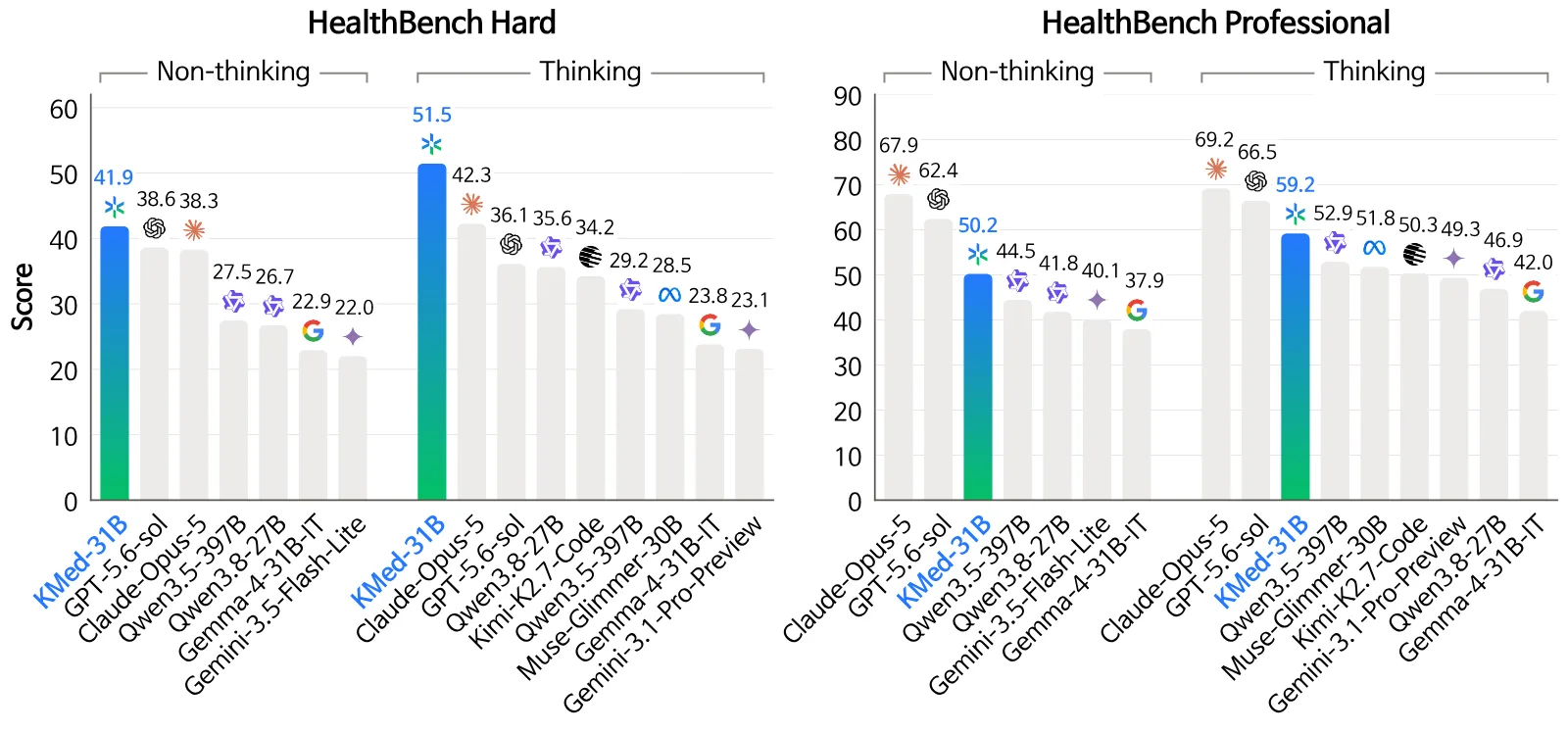
The authors report that HealthBench Hard, a set of 1,000 difficult health conversations, rose from about 23 to about 42 in the faster non-thinking mode. In thinking mode, where the model reasons step by step before answering, it rose from about 24 to about 51. On four multiple-choice medical benchmarks, scores stayed within a fraction of a point of the base model or improved slightly. Applying the same recipe to Qwen3.8-27B, a different open model, also raised all six medical scores.
On unadjusted HealthBench Hard, the model beat every compared model, including the proprietary GPT-5.6-sol and Claude-Opus-5. On HealthBench Professional, built from real clinician chats, it beat all compared open-weight models but stayed well behind those two proprietary models.
Our reading
In our reading, the most useful part is the diagnosis of the trade-off, not the leaderboard position. The paper shows the same pattern several times: a single mixed training run raised conversation scores but dropped the model below its starting point on three of four exam benchmarks. The specialist-then-merge route lifted all six. That is a practical lesson for anyone adapting an open model to a domain with mixed task types.
The headline ranking needs a caveat. HealthBench rubrics reward answers that tick more boxes, and longer answers tick more. The authors estimate KMed-31B's answers average over 4,000 characters, against about 1,700 for GPT-5.6-sol on HealthBench Hard. Under the length adjustment that HealthBench Professional defines, KMed-31B falls from first to third on HealthBench Hard in non-thinking mode, behind both proprietary models. The authors report this openly in an appendix, but the main claims use unadjusted scores.
The gains are concentrated where the training data pushed. The biggest jumps were in context awareness and in seeking missing information, which is exactly what the synthetic dialogues taught. Consider a clinician who asks for a drug dose without giving the patient's kidney function. A model trained this way is more likely to ask first. That is plausibly useful behaviour, but it has only been measured by an AI grader, not by doctors.
The rest of this story is for members. Membership is free: read it at scienceunderway.com/articles/naver-medical-model-built-on-gemma-lifts-healthbench-without-losing-exam-scores
Read the rest of this story
Membership is free. You get every article in full, and can save stories and follow topics.
We send a sign-in link, no password needed. Already a member? Sign inReadiness assessment
| Level | Status | Evidence |
|---|---|---|
| I Lab only | Met | The paper describes the method, training data construction, hyperparameters (Table 8) and ablations in detail. |
| II Benchmarked | Met | Results on public benchmarks: HealthBench Hard, HealthBench Professional, MedXpertQA Text, JAMA Clinical Challenge, NEJM AI QA, MedQA-USMLE, plus six general benchmarks. Compared with proprietary, open-weight and medical models. Self-run by the authors, not independently verified. |
| III Open source | Not yet | The authors say they plan to release an open-weight version 'in the near future'. No code, weights or data are linked in the paper. |
| IV In production | Not yet | No documented deployment by a named organisation and no clinical study. The authors state results do not show performance in patient care. |
What would move it up
Releasing the weights, the Synthetic Health Dialogue data or the training code would move it to level 3. Level 4 needs documented use in a named hospital or service, ideally with clinician review or a prospective evaluation. Independent replication of the HealthBench scores with the original graders and length control would also strengthen the case.
The study
KMed Team. KMed-31B Technical Report. arXiv, 21 November 2026. Read the paper
Notes
- KMed Team at NAVER, KMed-31B Technical Report, arXiv preprint 2611.28719, 21 November 2026, CC BY 4.0. Not peer reviewed. Source
- No code, weights or data are linked in the paper. The authors state they plan to release an open-weight version of KMed in the near future.
- Exact figures, non-thinking mode: HealthBench Hard 22.95 to 41.87; HealthBench Professional 37.92 to 50.20. Thinking mode: 23.80 to 51.48 and 41.97 to 59.18 (Table 2, avg@3, unadjusted).
- Length-adjusted, non-thinking (Table 9): HealthBench Hard KMed-31B 25.25, GPT-5.6-sol 41.21, Claude-Opus-5 31.97; HealthBench Professional 43.10, 59.08, 57.76.
- HealthBench: the benchmark of health conversations graded with physician-written rubrics (Arora et al., 2025). Source
- Integration comparison on Gemma, non-thinking (Table 4 and Section 5.1): six-benchmark averages 66.14 for the authors' merging method, 65.95 for standard multi-teacher distillation, 65.93 for mixed RL. Mixed RL scored below the base on three of four multiple-choice benchmarks.
- Qwen3.8-27B, thinking mode (Section 5.2): HealthBench Hard 35.64 to 50.14; HealthBench Professional 46.90 to 56.28.
- Readiness: level II, Benchmarked. Public benchmark results reported by the developer; no released code or weights; no documented deployment.
Edited and signed by
Stefan PerdalEditor and publisher142 stories editedStefan read the study, set the readiness level and approved this story. An AI system found the paper and wrote the first draft.
How this was made
An AI model read the study and wrote this article in the structure Science Underway uses. An editor reviewed it and approved it for publication. Check the original study before you rely on the details.
How we workNo corrections