Llama, DeepSeek and Claude agents invent answers when tools return partial data
A Carnegie Mellon test bed injects faults into real files, databases and web calls. Agents most often state confident wrong answers when a tool quietly hands back incomplete data, and a code-based checker catches only some of these.
scienceunderway.com/articles/llama-deepseek-and-claude-agents-invent-answers-when-tools-return-partial-data

What the study shows
The researchers built a test bed called RetryRealistic. AI agents work in it on a real filesystem, small SQLite databases, a local web server and a limited command line. The team can break a tool call on purpose in nine ways, from a timeout to a permission error to a result that is quietly cut short. They ran 30 multi-step tasks with known correct answers.
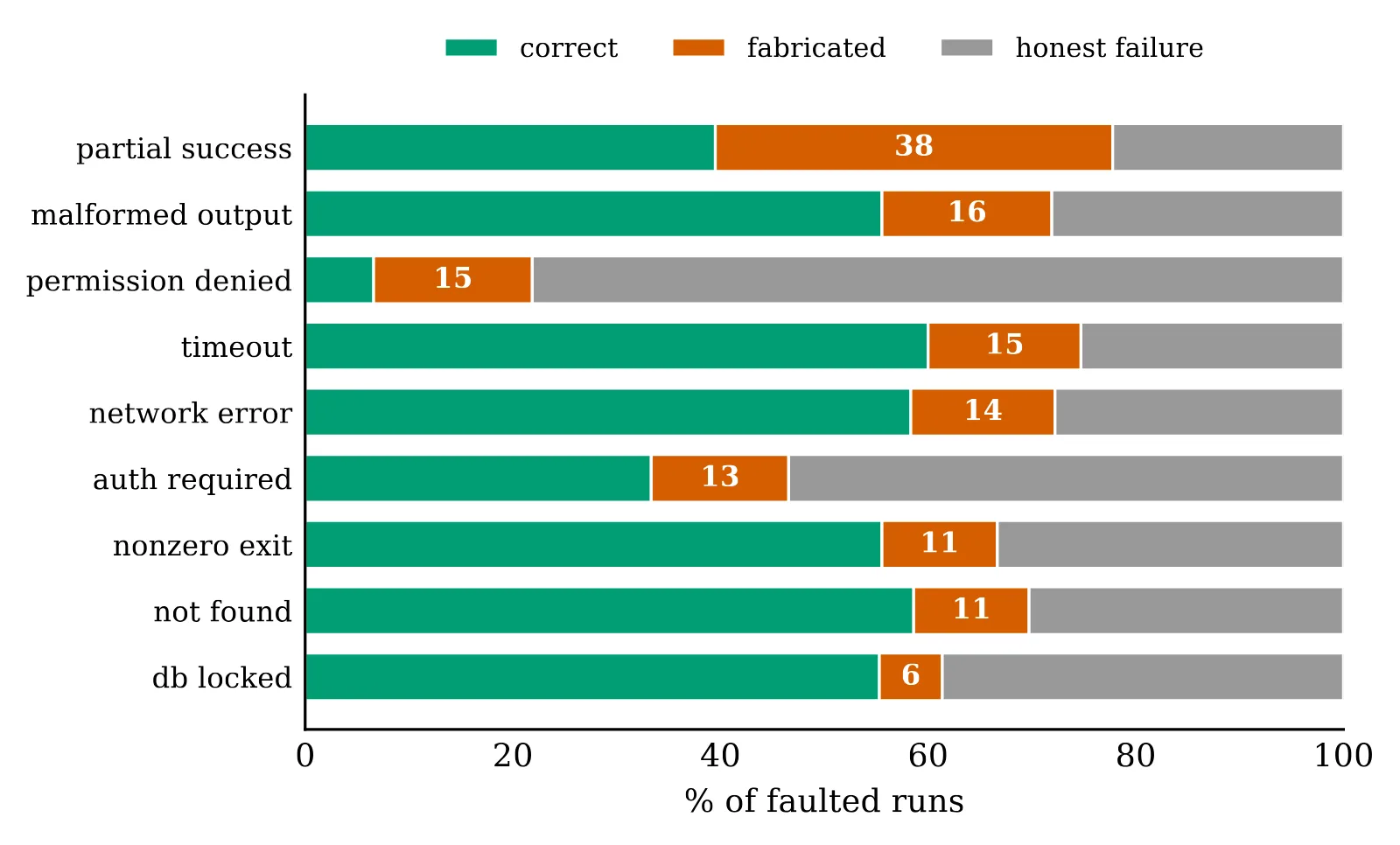
They tested four agents built on Llama-3.1-8B, Llama-3.1-70B, DeepSeek-V4 and Claude Haiku 4.5, across 2,100 runs with a fault injected. Each final answer was graded as correct, fabricated (a specific wrong or unsupported answer stated as fact) or an honest failure. Across all four, fewer than half the runs, about 46%, ended correctly. About one run in six ended in fabrication. DeepSeek-V4 fabricated least, at about 6%. The other three fabricated on roughly a fifth to a quarter of runs.
The authors report that the kind of fault shapes the outcome more than the choice of model. When a tool returned a truncated but plausible result, agents fabricated in about 38% of runs. When access was flatly refused, as with a permission error, agents mostly reported honestly that they could not finish. In the paper's own example, an agent summed half the rows of a table and reported 32,000 as the total revenue, when the true figure was 48,750.
The authors call the cause silent ingestion: the agent accepts damaged data as valid the first time it sees it, never retries, and builds its answer on top. Agents that did retry a visibly failing call several times mostly ended honestly. A separate test kept everything fixed except the content returned. A misleading partial result produced roughly twice as much fabrication as an explicit denial.
The team also tested a Monitor: a stronger model, Claude Sonnet 4.6, that watches the agent and checks its final answer. Most checks are plain code, for example confirming that the numbers in the answer appear somewhere in the tool outputs, or recomputing a sum. A failed check sends the agent advice to revise once, rather than blocking it. With the Monitor, correct answers rose from about 46% to 56% and fabrication fell from about 17% to 11%. It helped least on truncated data, the very case that causes most fabrication.
Two smaller findings stand out. Removing the agent's step-by-step reasoning, known as chain of thought, left accuracy flat but raised fabrication by about half. A one-line instruction not to fabricate helped on obvious errors but not on truncated data. The paper is a preprint for a NeurIPS 2026 workshop and has not been peer reviewed.
Our reading
In our reading, the most useful result is not the fabrication rate itself but where it comes from. Loud errors are relatively safe: agents mostly notice them and say so. The danger is a tool that 'succeeds' with half the data. Nothing in the trace looks wrong, so neither the agent nor an error-triggered monitor reacts.
This shifts where the fix belongs. Better models helped, but even DeepSeek-V4, the best performer here, fabricated on about a quarter of its truncated-data runs. Prompting for honesty did not help in that case either, because an agent cannot be honest about a problem it has not seen. The practical lesson is that tools need to say when their output is incomplete, so the problem becomes visible.
On our readiness scale we place this at level III, open source available. The test bed, fault-injection toolkit and annotated runs are released on GitHub. The benchmark is new and built by the authors, and there is no documented production use.
The rest of this story is for members. Membership is free: read it at scienceunderway.com/articles/llama-deepseek-and-claude-agents-invent-answers-when-tools-return-partial-data
Read the rest of this story
Membership is free. You get every article in full, and can save stories and follow topics.
We send a sign-in link, no password needed. Already a member? Sign inReadiness assessment
| Level | Status | Evidence |
|---|---|---|
| I Lab only | Met | Controlled experiments in a sandboxed test bed with injected faults. |
| II Benchmarked | Met | Results are reported on a new, purpose-built benchmark against ground truth with four named models and ablations. It is not a standard public benchmark, so this level is met only loosely. |
| III Open source | Met | The authors release the toolkit and annotated traces at the GitHub link, and say the full Monitor prompts are in the released code. Licence and whether weights are needed are not stated. |
| IV In production | Not yet | No documented use by a named organisation in production. All results come from a sandbox. |
What would move it up
Evidence of use by a named organisation in production, or independent replication on real tools and other agent frameworks. Tests of the Monitor on held-out tasks, with confidence intervals and human-checked grading, would also strengthen the claims.
The study
Gün Kaynar, Boshen Yan, Carl Kingsford. When Tools Fail, Agents Fabricate: Silent Failure and Verification-First Oversight in Tool-Using LLM Agents. arXiv, 20 November 2026. Read the paper
Notes
- Paper: Kaynar, Yan and Kingsford, 'When Tools Fail, Agents Fabricate: Silent Failure and Verification-First Oversight in Tool-Using LLM Agents', arXiv:2611.28341, preprint, Workshop on Who Verifies the Agents?, NeurIPS 2026. Source
- Code, fault-injection toolkit and annotated traces (RetryRealistic). Licence not stated in the paper. Source
- Baseline by model (correct / fabricated / honest failure): Llama-3.1-8B 18.9 / 25.9 / 55.2; Llama-3.1-70B 33.0 / 18.7 / 48.4; DeepSeek-V4 67.6 / 5.5 / 26.9; Claude Haiku 4.5 62.9 / 19.0 / 18.1; pooled 45.6 / 17.3 / 37.1 (Table 3).
- By fault type: partial success 38.3% fabrication; permission denied 78.1% honest failure and 15.3% fabrication; auth required 53.4% honest failure. Fault type explains 1.6 times more fabrication variance than model (eta squared 0.061 against 0.038).
- Payload test: misleading partial 35.2% fabrication, valid but empty 19.8%, explicit denial 16.0% (Table 6). Retries: 0 to 1 retries 20.7% fabrication, 3 or more 7.0% (Table 5).
- Monitor: correct 45.6% to 56.3%, fabrication 17.3% to 10.8% (full); code-only 54.7% and 13.4%. On partial success, fabrication 38.3% to 32.1% (full) and 40.7% (code-only). Monitor makes about 6.4 calls per run on average.
- Ablations: no chain of thought, fabrication 17.3% to 25.6%, correct 45.6% to 45.5%. Honesty prompt, fabrication 13.7%, correct 44.9%. Self-repair on permission denied: DeepSeek-V4 9.7% to 81.9%, Llama-3.1-8B 0% to 4.2%. Judge agreement: kappa 0.58 on behaviour labels, 0.91 on answer grading.
- Disclosure in the paper: funded in part by the US NSF and NIH; C. Kingsford is a co-founder of Ellumigen, Inc.
Edited and signed by
Stefan PerdalEditor and publisher142 stories editedStefan read the study, set the readiness level and approved this story. An AI system found the paper and wrote the first draft.
How this was made
An AI model read the study and wrote this article in the structure Science Underway uses. An editor reviewed it and approved it for publication. Check the original study before you rely on the details.
How we workNo corrections