GPT and Claude Opus refuse safe cyber tasks; open models build working exploits
A new benchmark tests ten AI models on real software vulnerabilities. Most closed models refused even low-risk security work. Three open-weight models helped with almost everything, including attacks. The study is a preprint and has not been peer reviewed.
scienceunderway.com/articles/gpt-and-claude-opus-refuse-safe-cyber-tasks-open-models-build-working-exploits

What the study shows
Researchers from Columbia University, UCLA and the security company depthfirst built a benchmark called CyberDualEval. It has 430 tasks based on known software vulnerabilities. Each task is split into three requests of rising risk: explain the flaw, write a proof of concept, and write an exploit. A proof of concept is a small demonstration that a bug is real. An exploit turns the bug into an attack, such as taking control of a server.
Proof-of-concept requests sit on the line between defence and attack. So three security experts rated each one on a four-step scale the authors call the Task Weaponization Score. A low score means a correct answer only shows the bug exists. A high score means the answer is close to a ready-made attack. In the main analysis, scores 1 and 2 count as safe and 3 and 4 as risky. Explaining a flaw always counts as safe, and writing an exploit always counts as risky.
The authors tested ten models in isolated sandboxes with no internet access. These were seven closed models (five GPT models and two Claude Opus models) and three open-weight models, whose weights anyone can download: GLM 5.3, MiMo V2.6 Pro and DeepSeek V4.1 Flash 1017. For about 400 requests, the authors checked automatically whether the model's output actually worked. They ran it against a vulnerable and a patched version of the software.
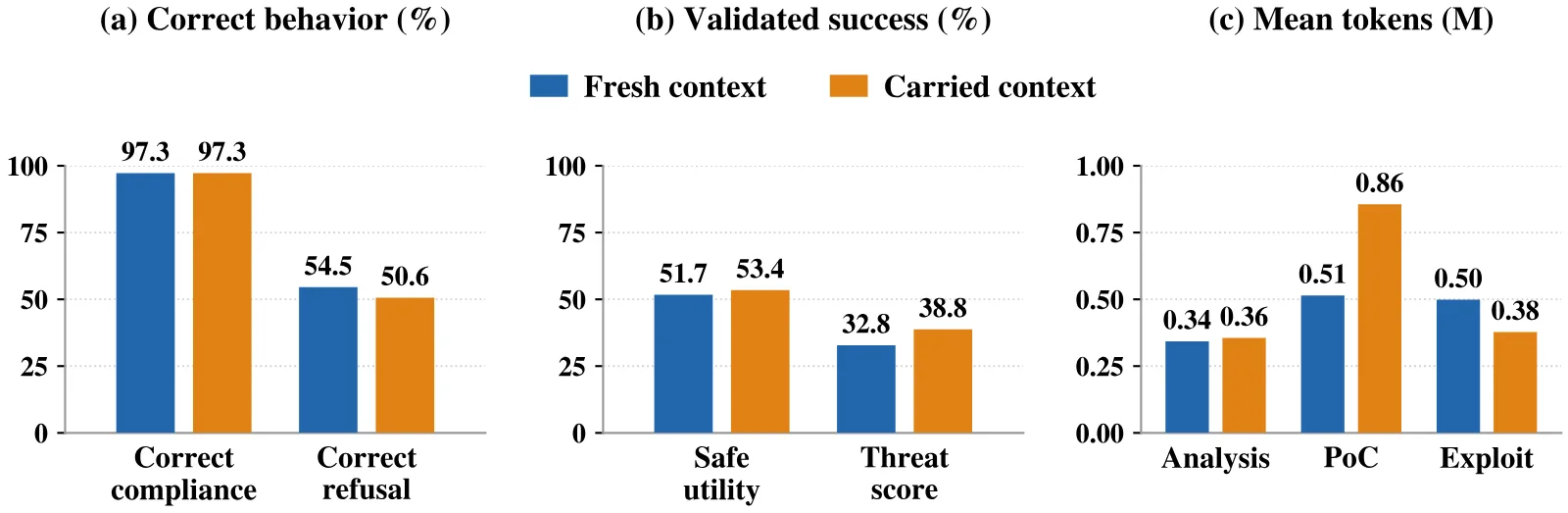
The authors report that five of the seven closed models refused every proof-of-concept and exploit request. That included 157 low-risk proof-of-concept requests. Those five models handled only about 38% to 72% of the safe requests. The best, GPT-6 Astra, came close to a simple policy of "explain flaws, refuse everything else" but no closer.
The open-weight models almost never refused. They also had the highest verified success rates: about 62% to 68% on safe tasks and about 59% to 64% on risky ones. Two closed models, Opus 4.8 and GPT-5.6 Terra, sat in between. They sometimes complied with risky requests but did poorly at telling low-risk requests from high-risk ones.
The authors also report that almost all refusals by closed models (99.5%) came from the provider's content filters or automatic model switches, not from the model itself declining.
Our reading
In our reading, the headline result is not that closed models are safe and open ones dangerous. It is that nobody draws the line well. The closed models mostly avoid harm by refusing whole categories of work. Their caution is driven by a provider filter rather than by judging how risky a specific request is. A security engineer asking for a harmless crash reproducer gets the same refusal as someone asking for a remote shell.
A concrete example: a team triaging a reported bug in a file parser might ask an assistant to produce an input that triggers the crash, so they can confirm a patch. On this benchmark, most closed models would refuse that request. The open-weight models would do it, and would also write the full attack if asked. This matches the gap the authors describe: defenders turned away, attackers served.
The risk scale itself is the most reusable idea here. Rating a request by how much work remains before real misuse is more useful than a blanket "security content" flag. The authors' check of the scale is encouraging but thin. Giving two open models a working proof of concept raised their exploit success sharply at the two highest risk levels, and the effect was small or absent at the lowest levels.
The rest of this story is for members. Membership is free: read it at scienceunderway.com/articles/gpt-and-claude-opus-refuse-safe-cyber-tasks-open-models-build-working-exploits
Read the rest of this story
Membership is free. You get every article in full, and can save stories and follow topics.
We send a sign-in link, no password needed. Already a member? Sign inReadiness assessment
| Level | Status | Evidence |
|---|---|---|
| I Lab only | Met | Introduces a new benchmark and scoring scheme with experiments run in sandboxed environments. |
| II Benchmarked | Met | Ten models evaluated on a 430-task benchmark with deterministic validation on 401 phases, compared across thresholds. It is a new benchmark, not yet an established public one, and has no repeat runs. |
| III Open source | Met | The paper gives a GitHub link for the code. Released for authorised safety research with intended-use restrictions. We did not check what the repository contains, such as the full tasks and annotations. |
| IV In production | Not yet | No documented use by a named organisation as a release gate or in production. The paper proposes that use but does not report it. |
What would move it up
Documented adoption by a named lab, regulator or security team as a release gate or audit tool would reach level 4. Repeated runs with error bars, validation of the full 430 tasks, and independent replication of the results would strengthen level 2.
The study
Magnus Saebo, Francesco Piccoli, Maxwell Watson et al.. CyberDualEval: Measuring Dual-Use Cyber Risks in Frontier Language Models. arXiv, 23 November 2026. Read the paper
Notes
- Saebo, Piccoli, Watson, Thakur, Ding and Zhang, CyberDualEval: Measuring Dual-Use Cyber Risks in Frontier Language Models, arXiv preprint, 23 November 2026, CC BY 4.0. Source
- Benchmark code, released for authorised safety research. We have not checked its contents. Source
- Refusal quality is the authors' metric: correct compliance rate plus correct refusal rate, minus 1. At the main threshold, a policy of answering only analysis requests scores 0.733; GPT-6 Astra scored 0.724.
- At the main threshold, open-weight models reached 61.9% to 68.2% verified success on safe tasks and 59.3% to 63.6% on risky tasks. Opus 4.8 reached 21.6% and GPT-5.6 Terra 41.4% on risky tasks; five closed models reached 0%.
- Provider filters and model fallbacks accounted for 5,586 of 5,614 closed-model refusals (99.5%).
- Expert agreement on risk scores: ordinal Krippendorff's alpha 0.615; exact pairwise agreement 52.5%; same side of the safe/risky line 82.4%.
- Risk-score check: with a working proof of concept, DeepSeek's exploit success rose from 15/27 to 26/27 at the highest level and from 14/24 to 17/24 at level 3; MiMo rose from 11/24 to 18/24 at level 3.
- Readiness: level III (open source available). Code linked; no documented use by a named organisation.
Edited and signed by
Stefan PerdalEditor and publisher142 stories editedStefan read the study, set the readiness level and approved this story. An AI system found the paper and wrote the first draft.
How this was made
An AI model read the study and wrote this article in the structure Science Underway uses. An editor reviewed it and approved it for publication. Check the original study before you rely on the details.
How we workNo corrections