GPT-6 Astra cuts stent strain by a third, outpacing industrial optimiser Tosca
A language model agent edited about 1,650 settings in a stent's CAD model, the computer drawing used to build the part. It ran only 15 simulations and improved the design further than a standard industrial tool given the same budget. The work is a preprint and has not been peer reviewed.

What the study shows
The authors, from Helmholtz-Zentrum Hereon, Hamburg University of Technology and Saarland University, gave GPT-6 Astra a magnesium stent to improve. A stent is a small mesh tube that holds a narrowed blood vessel open. This one is 39 mm long and dissolves in the body over time. Magnesium is brittle, so strain in the stent's bends, called crowns, decides whether it cracks during deployment.
The agent did not run the simulator itself. It wrote short design files that set values in a CAD model with about 1,650 adjustable values. A fixed pipeline built each design, meshed it and ran a finite-element simulation, a standard way to compute how a part deforms under load. Each simulation took about two hours. The agent then read the full results, wrote its own analysis code and proposed the next designs, up to three at a time.
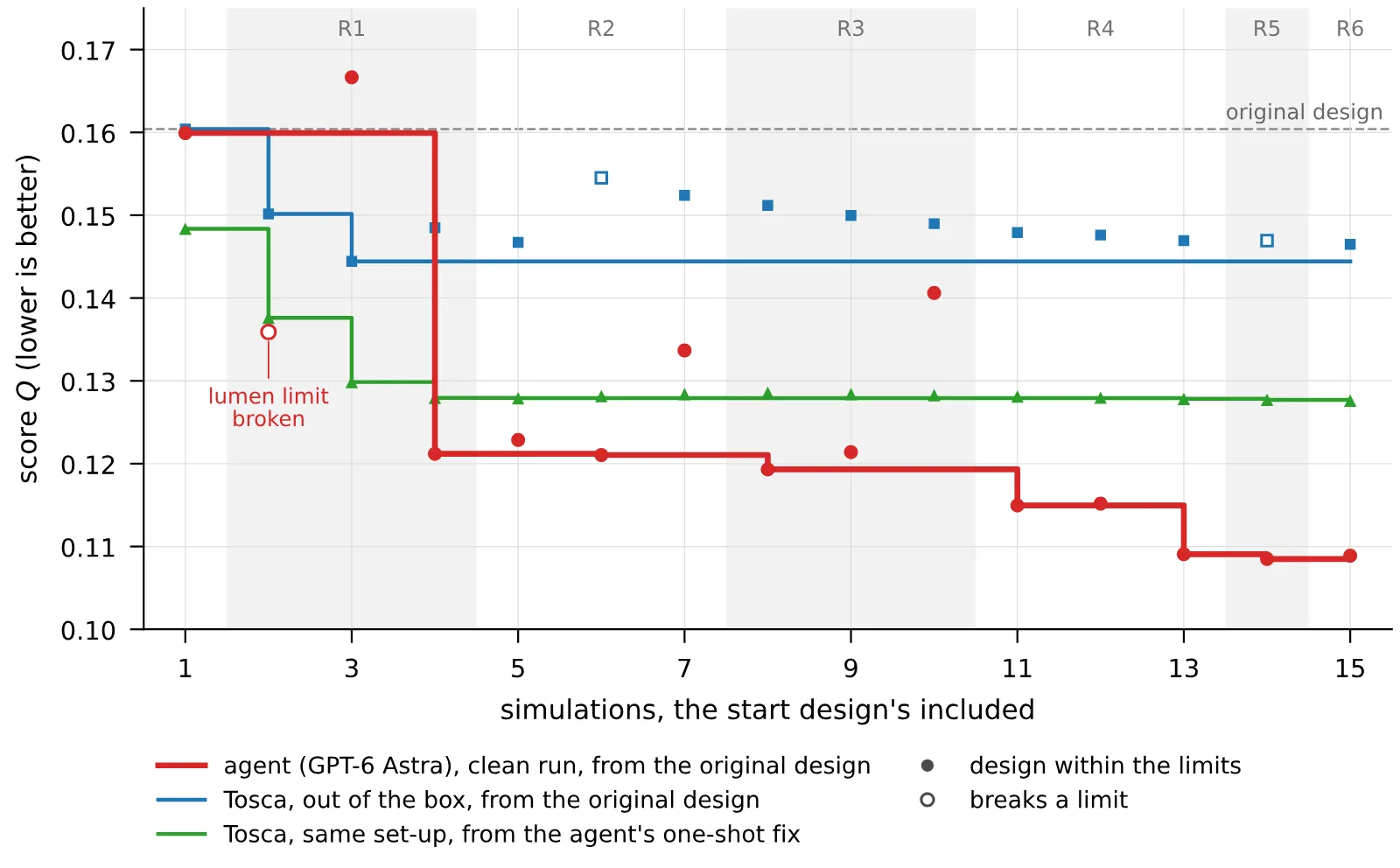
The goal was to lower a high-end measure of crown strain: the 90th percentile across the 60 crowns. The stent also had to open as wide as the original, shorten no more and use no more metal. In a clean run with 15 simulations, the agent cut the score by 32%. The model calls cost about US$19. About three quarters of the gain came from its first round of three designs.
The authors report that this gain is about ten times larger than the scatter seen when the same design is rebuilt and simulated again. One design from earlier pilot sessions, 25% better on the score, was also checked in a slower, more detailed model of the full deployment. That model included crimping the stent onto a balloon and material damage. There it was 14% less strained than the original, and its worst spot carried 63% less damage at full expansion.
For comparison, the authors ran Tosca, an industrial shape optimiser sold by Dassault Systèmes, with the same 15 simulations. Started from the original design, Tosca improved it by about 10% and then stalled. Started from a simple fix the language model had proposed in one call, Tosca polished it well, reaching 20% below the original overall.
Two smaller tests add context. On Tosca's own bundled example, a plate with a hole, agents built on four different language models beat Tosca in 9 of 12 runs. On a single crown with only four settings, Bayesian optimisation, a standard statistical search method, was a real competitor. The authors conclude that agents lead when the number of design values far exceeds the number of simulations.
Our reading
In our reading, the interesting part is not that a language model can tweak numbers. It is that the agent chose its own structure. Most of its designs gave whole families of crowns the same shape, then corrected single crowns at the end. That is the step a human engineer normally does before handing a classical optimiser a few parameters. Here the agent did it from the first simulation results.
A shuffle test supports the claim that the agent used the simulation data and not only general knowledge. When per-crown results were secretly swapped between crowns, the agent expected strain where the false numbers put it. In the late rounds, it stopped aiming its changes at the crowns the simulation had actually found most strained. The test is small, two continuations per condition, so it shows a consistent pattern rather than a statistic.
On our readiness scale this sits at level II, benchmarked. The comparisons are careful, with a fixed scoring script and a measured noise level. But the stent is the authors' own test case, not a public benchmark. The code and records are available only on request, and the simulations need commercial Abaqus and Tosca licences.
Read the rest of this story
Membership is free. You get every article in full and the Issue every Sunday.
We send a sign-in link, no password needed. Already a member? Sign inReadiness assessment
| Level | Status | Evidence |
|---|---|---|
| I Lab only | Met | Working demonstration with full protocol, ablations and a higher-fidelity check on a real part, in simulation only. |
| II Benchmarked | Met | Compared with Tosca, Bayesian optimisation, COBYLA and random search on three problems, using a fixed judge and a measured noise floor. The plate uses Tosca's own bundled example. The stent is the authors' own benchmark with a single clean run. There is no widely used public benchmark. |
| III Open source | Not yet | The geometry code, tools, prompts, scripts and session records are only 'available from the authors on reasonable request'. The simulations need commercial Abaqus and Tosca. The openPASO framework used for the crown problem is open source, but it does not contain the stent work. |
| IV In production | Not yet | No documented use by a named organisation on a real product. The stent is an open research design and the validation is a simulation. |
What would move it up
Level 3 needs the stent parametrisation code, agent tools, prompts and session records released openly, ideally with a script that reruns the loop (it will still need licensed Abaqus). Beyond that, repeat runs and other LLMs on the stent would show how much results vary. A fuller test of the clean-run design in the full-deployment model, and ideally physical testing, would strengthen the case. Level 4 needs use by a named company or lab on a real design programme.
The study
Alexandra Starostina, Alexander Hermann, Mahish Guru et al.. AI agents can redesign engineering parts with more than a thousand CAD parameters and nonlinear simulations. arXiv, 19 November 2026. Read the paper
Notes
- Starostina, Hermann, Guru, Bali, Aydin and Cyron, 'AI agents can redesign engineering parts with more than a thousand CAD parameters and nonlinear simulations', arXiv preprint 2611.26003, November 2026, CC BY 4.0. Source
- Exact stent figures: score 0.1604 to 0.1085 in the clean run (32%), 0.1181 in pilot sessions (26%); rebuild noise 0.004; LLM cost US$19.44; 15 simulations of about two hours each including the start design.
- Full-deployment check of a pilot design: 90th-percentile crown strain 14% lower, most strained crown 24% lower; damage onset at 16.1 mm against 15.2 mm stent diameter; porosity at full expansion 1.2% against 3.4%.
- Tosca, Dassault Systèmes SIMULIA structural optimisation software used as the industrial comparison. Source
- The crown sub-study ran on openPASO, an open-source agent framework by some of the authors. It does not contain the stent code, which is available from the authors on request. Source
Edited and signed by
Stefan PerdalEditor and publisher86 stories editedStefan read the study, set the readiness level and approved this story. An AI system found the paper and wrote the first draft.
How this was made
An AI model read the study and wrote this article in the structure Science Underway uses. An editor reviewed it and approved it for publication. Check the original study before you rely on the details.
How we workNo corrections