Google turns BMJ Best Practice guidance into 3,200 tests for medical AI
A Google Research preprint automatically converts a trusted clinical reference into patient cases to test Gemini models. It also finds that doctors wrote more complete plans after seeing AI advice, though only on paper cases.
scienceunderway.com/articles/google-turns-bmj-best-practice-guidance-into-3-200-tests-for-medical-ai

What the study shows
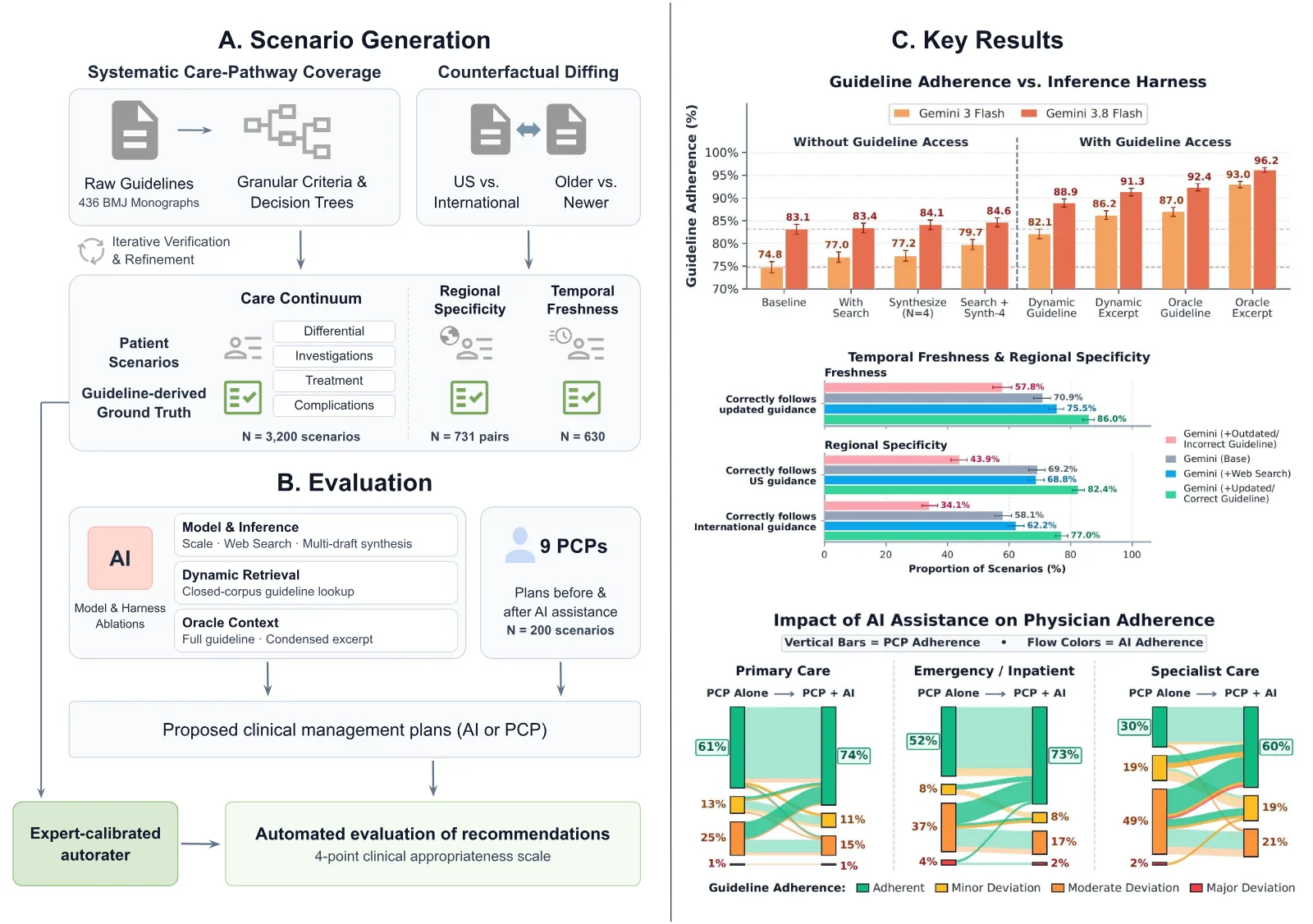
The team took 436 clinical topic summaries from BMJ Best Practice, a reference tool doctors use at the point of care. Of these, 354 were US editions and 82 were International editions. A Gemini model turned each one into structured checklists and branching treatment decision trees. It then wrote short patient stories, called vignettes, that follow each branch. Further automated checks compared every story against the source text.
The result is a core set of 3,200 cases covering diagnosis, tests, treatment and complications. Two smaller sets target change. One has 630 cases built on recently updated guidance. The other has 731 cases written twice, once for US guidance and once for International guidance, where the two editions disagree. No specialist clinician wrote or reviewed the individual cases.
To mark answers, the authors used another Gemini model as an automatic grader on a four-level scale, from fully adherent to a major, unsafe deviation. The authors report that it matched physician ratings exactly on 89% of 200 plans. Only one of those 200 plans had been rated a major deviation by physicians.
On the core set, adherence rose with model size and generation, from about 72% for the smallest model to 83% for Gemini 3.8 Flash. Web search added little on average. Generating four drafts and merging them helped more, and the two together helped most. Giving the model the exact guideline helped most of all. A short, structured excerpt beat the full document for every model.
On the targeted sets, models often fell back on outdated or US-style advice. Web search helped somewhat. Supplying the correct guideline helped far more, while supplying an outdated or wrong-region guideline pushed scores below baseline.
In a reader study, 9 primary care doctors each wrote plans for a share of 200 cases, then saw an AI recommendation and could revise. Adherence rose from about half of plans to 70%. Upgrades outnumbered downgrades roughly eight to one. The paper is a preprint and has not been peer reviewed.
Our reading
In our reading, the main contribution is the test-building method rather than any model score. Hand-written medical test sets are slow to build and hard to update. This pipeline reads a guideline and produces cases aimed at a specific branch, such as a patient with a particular drug allergy or a borderline risk score. When the guidance changes, the tests can in principle be rebuilt.
The regional results make the point concrete. One example in the paper is a 46-year-old woman with type 2 diabetes and a low heart risk score. US guidance says start a statin, a cholesterol-lowering drug. UK guidance, used in the International edition, says do not. A model trained mostly on US text may give the US answer to a UK patient. The models scored about 11 points lower on International cases than on US cases.
We rate this work at level II on our readiness scale, Benchmarked. Results are reported on a new benchmark with confidence intervals and a grader checked against physicians. It is not level III, because the cases and code are not public. BMJ licensing prevents release of the cases.
The rest of this story is for members. Membership is free: read it at scienceunderway.com/articles/google-turns-bmj-best-practice-guidance-into-3-200-tests-for-medical-ai
Read the rest of this story
Membership is free. You get every article in full, and can save stories and follow topics.
We send a sign-in link, no password needed. Already a member? Sign inReadiness assessment
| Level | Status | Evidence |
|---|---|---|
| I Lab only | Met | A working research pipeline and evaluation framework, demonstrated on 436 monographs with controlled experiments. |
| II Benchmarked | Met | Results are reported on the authors' own 3,200-case benchmark and two targeted suites, with bootstrap confidence intervals and an autorater validated against physicians (89.0% exact agreement). This is a new benchmark, not an established public one, and the cases are not public. |
| III Open source | Not yet | The BMJ monographs and the derived scenarios cannot be released because of licensing. The paper gives schemas, prompts and pipeline details, but no repository, weights or data link. |
| IV In production | Not yet | No deployment by a named organisation is documented. The reader study used text vignettes, not live clinical workflows. |
What would move it up
To reach level 3: release the pipeline code and prompts as a repository, and either the scenarios or a version built on openly licensed guidelines. To reach level 4: a prospective study in live clinical workflows, or a named organisation using the method to test or monitor clinical AI. Independent validation of the grader and clinician review of the cases would also strengthen it.
The study
Teya Bergamaschi, Bijal Rajput, Akshay Goel et al.. Scalable Evaluation of Medical AI using Evidence-based Practice Recommendations. arXiv, 20 November 2026. Read the paper
Notes
- Bergamaschi T. et al. Scalable Evaluation of Medical AI using Evidence-based Practice Recommendations. arXiv preprint, November 2026, not peer reviewed. Source
- BMJ Best Practice, the clinical reference used as the source. The monographs and derived cases are licensed and not released. Source
- No code repository is given. The paper's appendices include schemas and prompt templates.
- Exact figures: core baseline 74.8% (Gemini 3 Flash) and 83.1% (Gemini 3.8 Flash); Search + Synth-4 84.6%; Oracle Excerpt 96.2%; Oracle Guideline 92.4% (Gemini 3.8 Flash). Average gains: web search +0.8 pp, four-draft synthesis +2.2 pp, combined +2.8 pp. Temporal: web search +4.6 pp, updated guideline +15.0 pp. Regional: US–International gap 11.1 pp, web search +4.2 pp International and −0.4 pp US, matched guideline cuts gap to 5.4 pp. Reader study: 50.5% to 70.0%; specialist cases 30.2% to 60.4%; upgrades 25.5%, downgrades 3.0%.
Edited and signed by
Stefan PerdalEditor and publisher142 stories editedStefan read the study, set the readiness level and approved this story. An AI system found the paper and wrote the first draft.
How this was made
An AI model read the study and wrote this article in the structure Science Underway uses. An editor reviewed it and approved it for publication. Check the original study before you rely on the details.
How we workNo corrections