Driving AI models see hazards in their path but barely brake
A new benchmark pastes pedestrians and cars into real driving scenes. Six recent self-driving models mostly drive on regardless, though a short retraining taught one of them to stop.

What the study shows
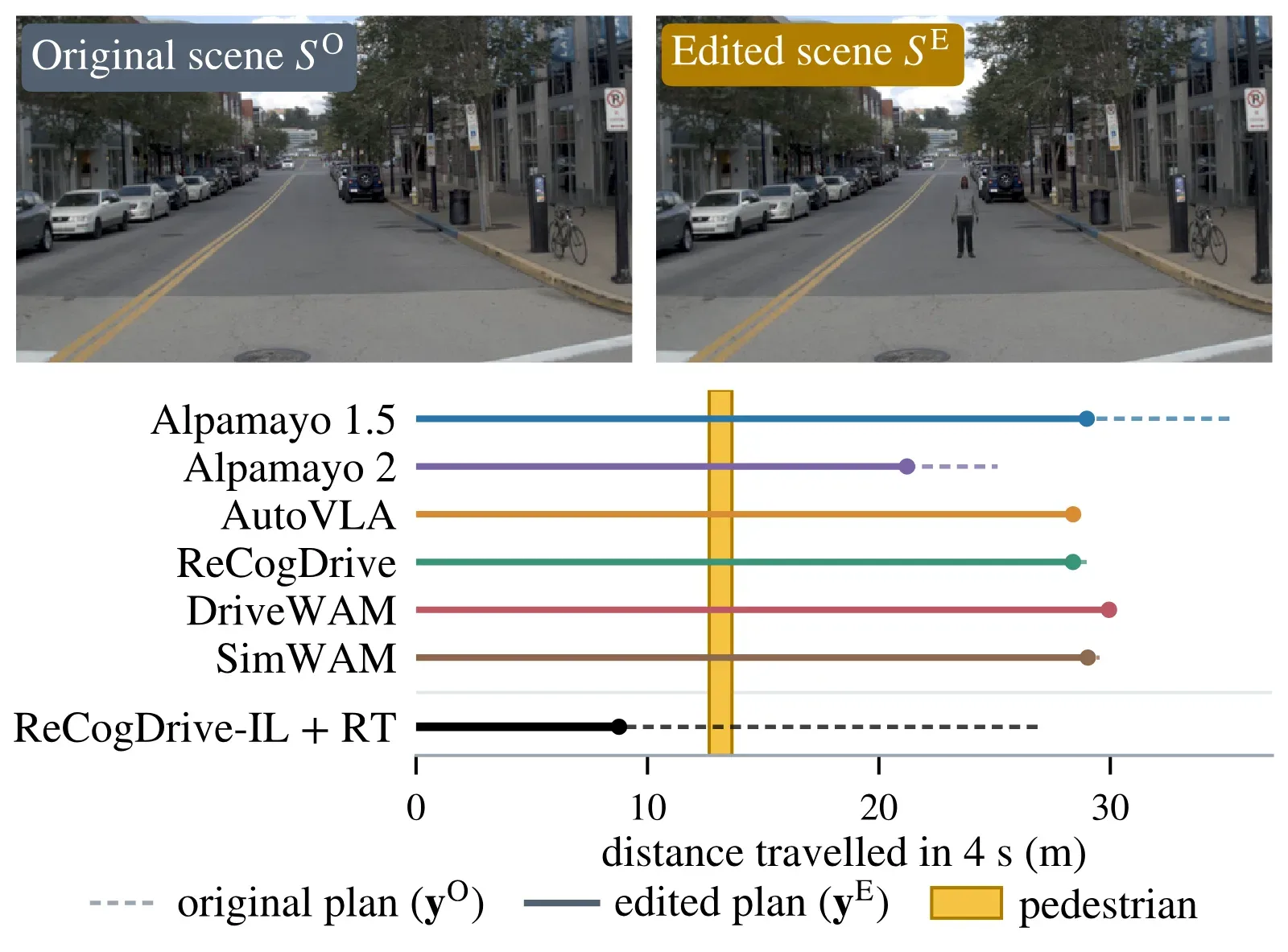
The researchers, from the University of Limerick and Valeo, built a test set called ReactBench-AD. It uses real recorded driving scenes from two public datasets. Into each scene they paste a 3D model of a crossing pedestrian, a standing pedestrian or a stopped car. The object sits on the exact path the car really drove, between half a second and two seconds ahead.
Only the pixels of the object and its shadow change. So each edited scene has a perfect twin without the hazard. Any change in the model's planned route can be put down to the object alone. An off-the-shelf object detector found the pasted objects in about 99% of front-camera images, so they are clearly visible.
The team tested six openly available models. Four are vision-language-action models: language models adapted to output driving routes. Two are world-action models: video-generation models adapted the same way. All six reacted weakly. For four of them, the share of collision-free plans rose by more than one percentage point only for stopped cars, with one small exception. For about a third of AutoVLA's crossing-pedestrian scenes, its plan moved by less than 5 cm.
NVIDIA's two Alpamayo models did best, mainly when the hazard was two seconds away. Even in Alpamayo 1.5's best case, a standing pedestrian, most of its plans were still unsafe. The Alpamayo models write out their reasoning before driving. For pasted pedestrians, that reasoning almost always said to slow or stop and named the person. The planned route mostly did not follow through.
Finally, the authors retrained only the part of one model, ReCogDrive, that turns its understanding into a route. They used about 23,000 edited scenes with hand-built braking routes, for a few minutes' worth of updates. Its collision-free gain on the test set rose from almost nothing to about 41 points. Its score on ordinary driving barely moved. It also braked more for animals it had never seen and for real stopped cars. The paper is a preprint and has not been peer reviewed.
Our reading
In our reading, the most useful finding is the gap between seeing and doing. The Alpamayo models describe the pedestrian and say they should stop, then plan a route that hits them. Even when the authors replaced the reasoning with an explicit order to stop immediately, Alpamayo 1.5 still collided in more than half of cases. The weak link appears to sit between the model's understanding and the part that draws the route. That reading rests on the two Alpamayo models only.
The retraining result points the same way. Only the route-drawing part was trained. The rest of ReCogDrive was frozen, yet it learned to brake for objects it had not been trained on. The authors take this as a sign the model already knew the path was blocked. It simply had never been taught what to do about it. Ordinary driving logs rarely contain a hard stop for a person in the road.
A practical example: a fleet testing one of these models on normal city routes could see excellent benchmark scores and smooth driving. The same model might still plan to drive through a pedestrian who steps out at close range. Standard driving scores would not reveal that, because they are built mostly from uneventful scenes.
Read the rest of this story
Membership is free. You get every article in full and the Issue every Sunday.
We send a sign-in link, no password needed. Already a member? Sign inReadiness assessment
| Level | Status | Evidence |
|---|---|---|
| I Lab only | Met | The work is a research study with controlled experiments on benchmark datasets. It is not a product. |
| II Benchmarked | Met | The benchmark scores six public models on two public-dataset subsets, with confidence intervals (Tables 1, 9). The fine-tuned model is scored on navtest and two held-out sets. The benchmark is the authors' own, and the work is not peer reviewed. |
| III Open source | Not yet | The paper says 'Code and data will be made publicly available' and promises compositing code and edited ReactNAV samples. No link is given. The PhysicalAI-based samples may only be released as regeneration scripts because of licence limits. |
| IV In production | Not yet | No named organisation is reported using the benchmark or the fine-tuned model in production. All results are open-loop on logged data. |
What would move it up
Releasing the compositing code, the edited ReactNAV data and the fine-tuned checkpoint would move it to level 3. Level 4 would need documented use by a named organisation, for example a developer adopting the benchmark in safety testing. Closed-loop tests of the fine-tuned model would also strengthen the case.
The study
Nikos Theodoridis, Reenu Mohandas, Sushil Sharma et al.. ReactBench-AD: Do Driving VLAs and World-Action Models React to Imminent Hazards in Their Path?. arXiv, 15 November 2026. Read the paper
Notes
- Theodoridis et al., ReactBench-AD: Do Driving VLAs and World-Action Models React to Imminent Hazards in Their Path? arXiv preprint, November 2026, not peer reviewed. CC BY 4.0. Source
- Code and data are promised by the authors but no link is given in the paper. Edited PhysicalAI scenes may only be released as regeneration scripts because of the dataset licence.
- Exact figures: Alpamayo 1.5 on PhysicalAI, standing pedestrian at 2.0 s: +35.69 points, 62.01% of plans still unsafe. AutoVLA: 34.9% of crossing-pedestrian pairs moved less than 0.05 m. Retrained ReCogDrive: edit effect +0.5 to +41.4 points; ordinary driving score (PDMS) 86.2 to 86.0; unseen animals +28.1; real scenes 54.2% against 6.8% collision-free.
- Reinforcement learning probe: with 32 candidates per scene, 26.3% of groups gave any learning signal and 1.3% would have reinforced a safe route.
Edited and signed by
Stefan PerdalEditor and publisher86 stories editedStefan read the study, set the readiness level and approved this story. An AI system found the paper and wrote the first draft.
How this was made
An AI model read the study and wrote this article in the structure Science Underway uses. An editor reviewed it and approved it for publication. Check the original study before you rely on the details.
How we workNo corrections

