Codex subagents raise coding scores slightly at up to 3.8 times cost
A University of Illinois preprint finds that letting Codex hand work to parallel helper agents adds only a few points on randomly chosen build-a-program tasks. On hard tasks the gain is larger, and a one-sentence prompt or a fresh start can recover much of it.
scienceunderway.com/articles/codex-subagents-raise-coding-scores-slightly-at-up-to-3-8-times-cost

What the study shows
The authors compared two set-ups in OpenAI's Codex coding assistant. In one, a single agent works alone. In the other, a main agent may delegate parts of the job to subagents: separate agents that run in parallel, share the same files and report back. The task was repository construction, meaning building a whole program or library from a description. Tasks came from two public benchmarks, NL2Repo and ProgramBench. Scores are the share of hidden tests passed, which the agent never sees.
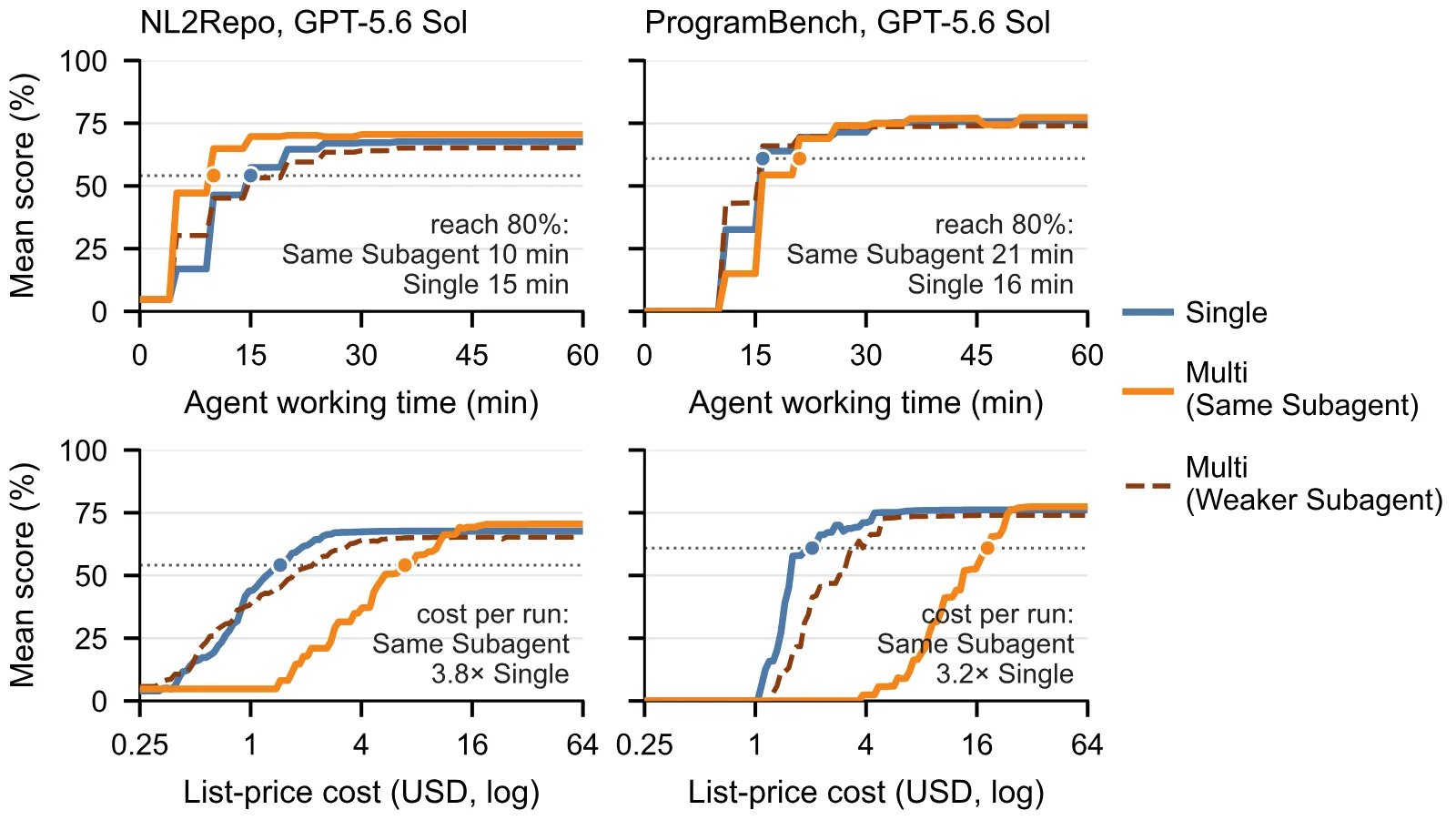
On 30 randomly drawn tasks per benchmark, subagents raised the final score by about 1 to 5 points across three generations of the GPT Sol models. They cost 2.6 to 3.8 times as much. At equal spend, the single agent matched or beat the subagent set-up on both benchmarks. Two repeat runs of the same set-up on one task differed by about 7 points on average, more than the typical gap between the set-ups.
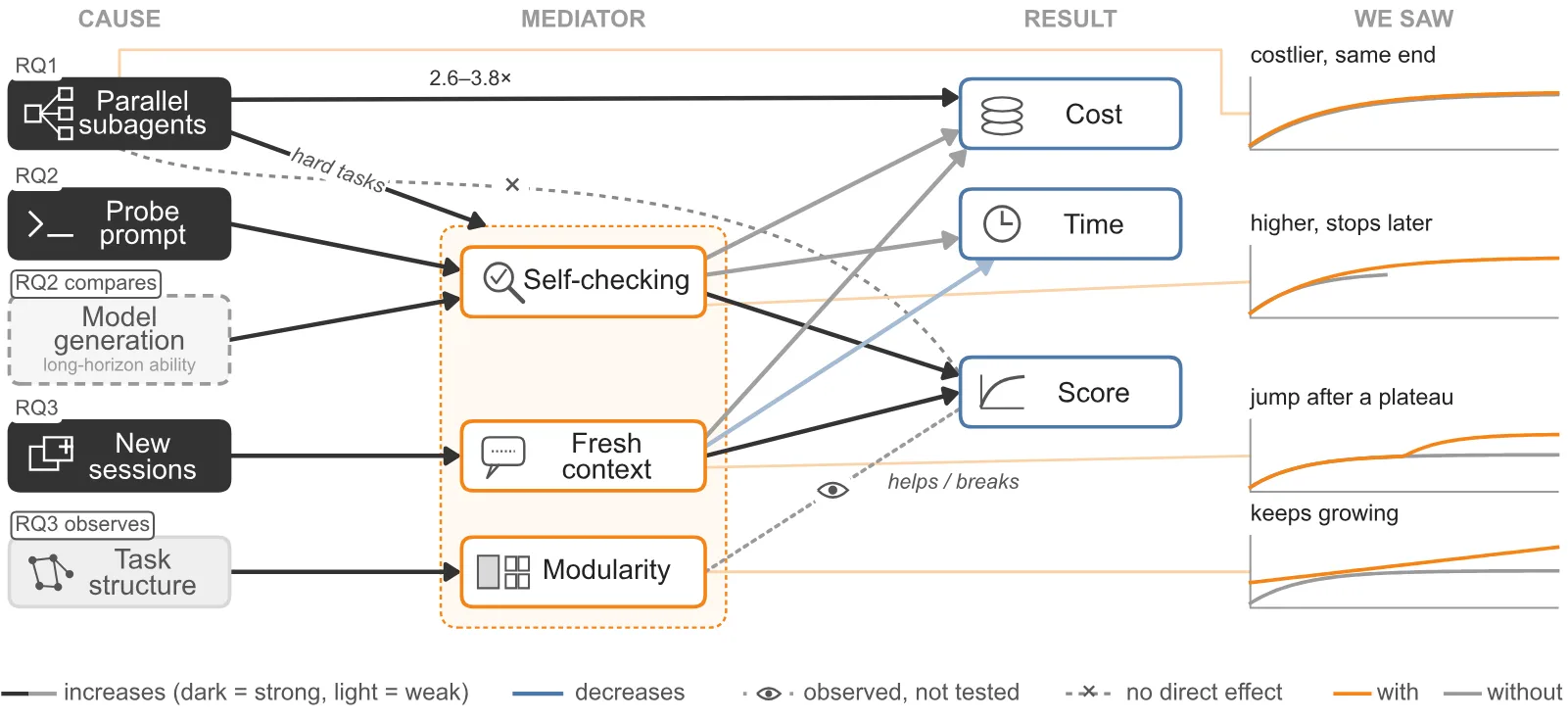
The gain was larger on ProgramBench's hard tasks. ProgramBench also gives the agent a working copy of the program it must rebuild, called the reference program, which the agent can run and compare against. The authors traced the hard-task gain to three factors. The first is self-checking: single agents tended to stop as soon as their own checks passed. On 16 hard tasks with GPT-5.6 Sol, one added sentence telling the single agent to probe the reference program first raised its score by 6.7 points, against 8.8 points for subagents, at a much smaller extra cost.
The second factor is fresh context. In long runs of up to 20 hours on three hand-picked tasks, restarting a single agent with an empty conversation every few hours made faster early progress than letting one long session continue. The third is modularity: the subagent set-up split its code into more files with shorter functions. On one task, delta (a tool for viewing file differences), where the single agent put nearly all its code in one file, subagents ended clearly ahead even at equal cost. On another, solar (a compiler), subagent edits to shared code broke working features and that set-up ended lower.
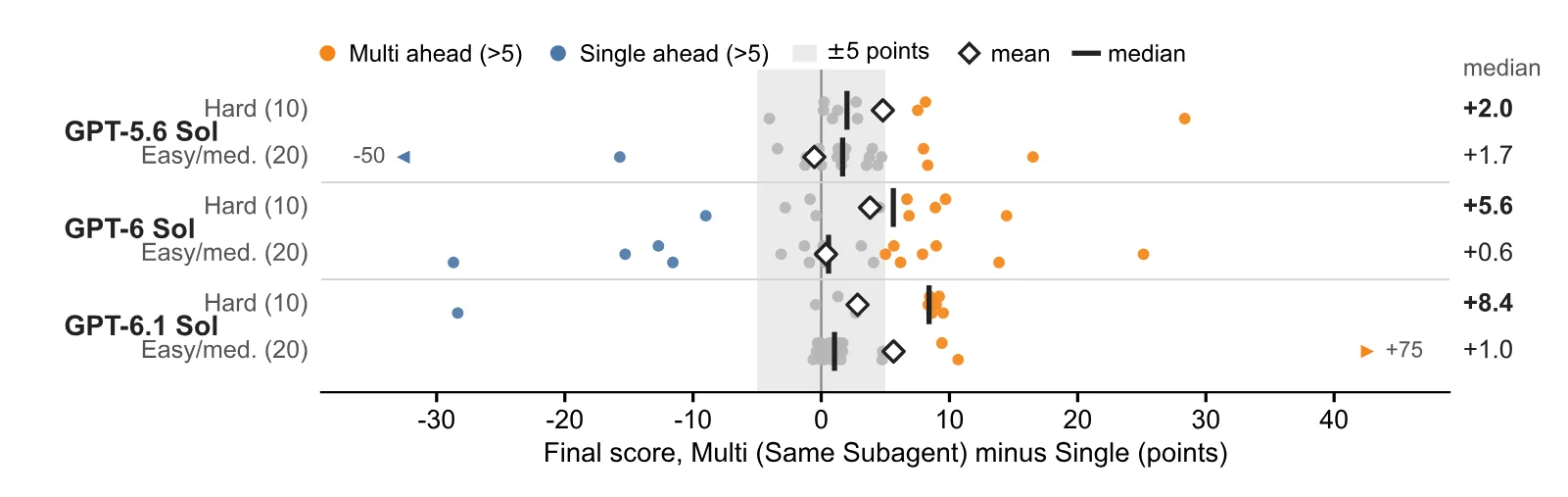
Newer models narrowed the gap on their own. On the hard tasks, the average subagent gain fell from about 9 points with GPT-5.6 Sol to about 3 with GPT-6.1 Sol, as newer single agents worked longer before stopping. A smaller repeat with Anthropic's Opus 5.5 in Claude Code, one run per setting, showed a similar overall pattern. This is a preprint and has not been peer reviewed.
Our reading
In our reading, the headline result is a cost result rather than a quality one. On ordinary tasks, subagents mostly buy a slightly higher score at a much higher price, and the gain is smaller than the noise between two repeat runs. For a team deciding whether to switch subagents on by default, that is a reason to leave them off.
The more useful finding is where the gain comes from. Much of it seems to come from checking work more thoroughly before declaring the job done, not from parallel effort as such. If one sentence can recover most of the gain for one model, the cheaper fix is to prompt or train a single agent to look for its own mistakes. For example, a team asking an agent to rebuild an internal command-line tool from an existing binary could first try a probe-first instruction and a scheduled fresh restart, and only add subagents if those stall.
The caveats are substantial. The probe sentence helped only one model generation, did not transfer to another agent harness or to NL2Repo, and depends on having a reference program, which most real projects lack. The long-run results rest on three chosen tasks with one or two runs each.
The rest of this story is for members. Membership is free: read it at scienceunderway.com/articles/codex-subagents-raise-coding-scores-slightly-at-up-to-3-8-times-cost
Read the rest of this story
Membership is free. You get every article in full, and can save stories and follow topics.
We send a sign-in link, no password needed. Already a member? Sign inReadiness assessment
| Level | Status | Evidence |
|---|---|---|
| I Lab only | Met | The study is a controlled experiment on benchmark tasks in sandboxed containers. |
| II Benchmarked | Met | Results are reported on public benchmarks NL2Repo and ProgramBench, with 30 random tasks each, plus 16 hard ProgramBench tasks, compared against a single-agent baseline across three model generations. |
| III Open source | Met | The paper states that prompts, configurations, scorers, per-snapshot scores, trajectories and analysis scripts will be released at https://github.com/cogito233/subagent-study. The wording is future tense ('will be released'), so availability is not confirmed from the paper alone. The study analyses existing products and models rather than offering a new tool. |
| IV In production | Not yet | No documented use by a named organisation in production. The study evaluates the products Codex and Claude Code in experiments, not a deployed system. The Anthropic C compiler report is cited work, not part of this study. |
What would move it up
Level 4 would need documented use by a named organisation, for example a team applying the probe-first prompt or fresh-session restarts in real projects with measured outcomes. Confirmation that the repository is public and complete would firm up level 3. More runs per setup and tasks sampled at random for the long-run experiments would strengthen the evidence.
The study
Zhiheng Lyu, Chengyu Yin, Lingming Zhang. When Are Parallel Subagents Effective for Coding? An Empirical Study on Repository Construction. arXiv, 25 November 2026. Read the paper
Notes
- Lyu, Yin and Zhang, 'When Are Parallel Subagents Effective for Coding? An Empirical Study on Repository Construction', arXiv preprint, 25 November 2026, not peer reviewed. Source
- Study materials repository; the paper says data, prompts and scripts will be released here. Source
- Random tasks, GPT-5.6 Sol: ProgramBench final score 77.4% with subagents against 76.2% alone, at about 3.2 times the cost ($18.32 against $5.69 mean); NL2Repo 70.6% against 67.7%, at about 3.8 times ($11.56 against $3.02). Across generations on ProgramBench the gain is 1.2 to 4.7 points at 2.6 to 3.2 times the cost.
- Hard tasks (16 ProgramBench tasks): average subagent gain +8.8, +6.0 and +2.8 points for GPT-5.6, GPT-6 and GPT-6.1 Sol. Probe sentence with GPT-5.6 Sol: +6.7 points at +50% cost, against +275% cost for subagents.
- Long run on delta, GPT-5.6 Sol: subagent set-up 91.5% at $1,201 against single agent 75.2% at $260; at an equal $260, 84.0% against 75.2%. On solar the subagent set-up ended at 46.0% against 66.4%.
- Claude Code replication with Opus 5.5, one run per cell: on ProgramBench 95.5% with subagents against 90.7% alone at 3.1 times the cost; on NL2Repo, 90.5% against 94.4%.
Edited and signed by
Stefan PerdalFounder. Twenty-five years of building digital products.160 stories editedStefan read the study, set the readiness level and approved this story. An AI system found the paper and wrote the first draft.
How this was made
An AI model read the study and wrote this article in the structure Science Underway uses. An editor reviewed it and approved it for publication. Check the original study before you rely on the details.
How we workNo corrections