AI agents in GIMP and Blender pick the right tools, wrong amounts
A new benchmark finds that GPT-6.1, Claude Opus 5.5 and a dozen open models can operate professional editing software. They mostly fail to judge how strong an edit should be, and they rarely check their own result.
scienceunderway.com/articles/ai-agents-in-gimp-and-blender-pick-the-right-tools-wrong-amounts

What the study shows
The authors built a benchmark of 500 editing tasks in five open-source applications: darktable and RawTherapee for photos, GIMP for raster images, Inkscape for vector drawings and Blender for 3D. Each task has a start image and a target image. The target was made by applying a hidden list of real tool settings, so the right amount of each edit is known.
The agent's edit is read back from the project file, rendered again by the application and compared with the target using CIEDE2000, a standard measure of colour difference. An edit passes if it covers most of the distance from start to target and the remaining error is small. No AI judge is involved in scoring.
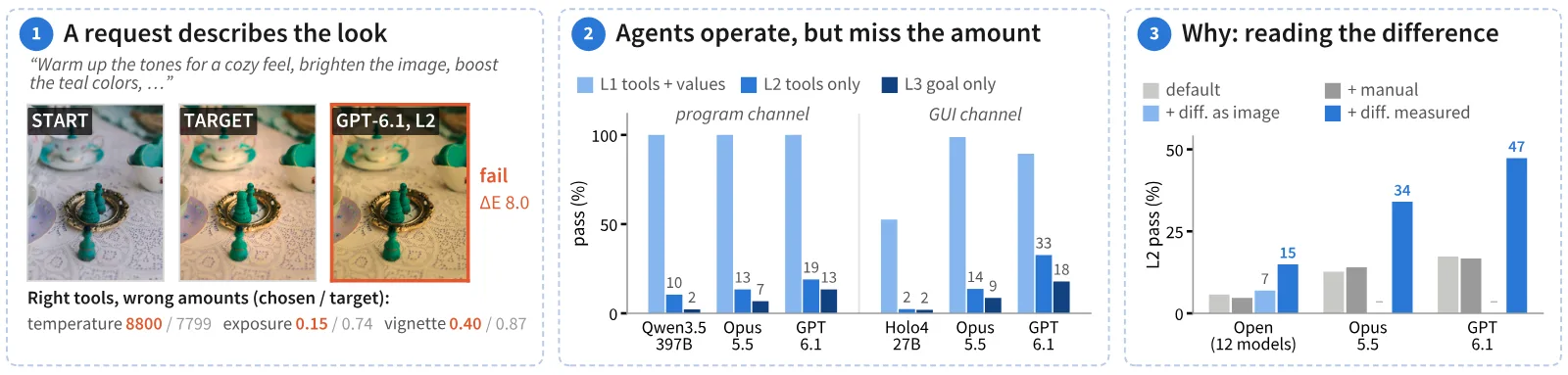
Each task is posed at three levels. At the first, the agent is told the tools and their exact values. At the second, it sees the target and is told which tools were used, but not how much. At the third, it sees only the target. Agents can act by writing a short edit program or by clicking through the real interface.
The authors tested 25 models: twelve open vision-language models (models that read images and text), eleven agents built to operate interfaces, and two closed models, GPT-6.1 and Claude Opus 5.5. Told the values, every program-writing model from 4 billion parameters up passes almost every task. Told only the tools, the best model, GPT-6.1, passes 19% with programs and 33% through the interface. Open models pass at most about 10%.
Bigger models do not close the gap. Across Qwen3.5 sizes spanning roughly 500-fold, the tools-only pass rate rises from about 1% to about 10%. With only the goal given, eleven of twelve open models on average move the image further from the target than where it started.
The authors then varied what agents were given. Software manuals and tool reference cards barely helped. Giving the measured difference between start and target as numbers more than doubled closed-model pass rates, with GPT-6.1 rising from 17% to 47%. Showing open models the same difference as a picture gave no significant gain.
Agents also skip checking. Allowed four tries, both closed models stopped after the first in almost every tools-only task. Forced to use all four, GPT-6.1 rose from 19% to 50% and Opus 5.5 from 13% to 30%. Open models gained little.
The authors also tested existing benchmarks. An AI judge used by the PSBench photo-editing benchmark passed more than half of edits applied at half or triple the right strength. This is a preprint and has not been peer reviewed.
Our reading
In our reading, the central result is clean because of the design. The same task, the same target and the same scoring are used at every level. Only the information given changes. So the drop from near-perfect to about one in five is hard to blame on the software, the interface or the task wording.
The interventions point to two practical weaknesses. Models struggle to read a size of difference from images, though they can act on it once it is given as numbers. And they treat their first attempt as final. Both look like problems of perception and habit, not missing knowledge about the tools.
A concrete case: a client asks an agent to warm up a portrait and darken the corners. The agent will likely choose a colour temperature tool and a vignette, which is correct. On this evidence it will probably set them too weakly or too strongly and return the image without comparing it to what was asked.
The rest of this story is for members. Membership is free: read it at scienceunderway.com/articles/ai-agents-in-gimp-and-blender-pick-the-right-tools-wrong-amounts
Read the rest of this story
Membership is free. You get every article in full, and can save stories and follow topics.
We send a sign-in link, no password needed. Already a member? Sign inReadiness assessment
| Level | Status | Evidence |
|---|---|---|
| I Lab only | Met | The work is a research benchmark with controlled experiments and validation studies. |
| II Benchmarked | Met | It reports results for 25 models on a 500-task benchmark. The authors check metric validity (human study, strength curves) and reproduce OpenCUA-72B's published OSWorld score (43% vs 45.0%). |
| III Open source | Met | The abstract links code on GitHub and data on Hugging Face, with a project page. The paper says test answers are released with the benchmark. Exact URLs beyond the project page are not in the text, so this rests on the abstract's links. |
| IV In production | Not yet | No documented use by a named organisation in production. It is an evaluation benchmark, not a deployed system. |
What would move it up
Level 4 would need documented adoption by named organisations, for example agent builders using GoldiBench in their evaluation or training pipelines. Independent replications, a multi-rater human study with professional editors, and coverage of local edits and more closed models would also strengthen it.
The study
Wang Yang, Xinpeng Li, Yanyan Zhang et al.. GoldiBench: Right Tools, Wrong Amount -- Benchmarking Agents on Effect Judgement in Professional Editing. arXiv, 23 November 2026. Read the paper
Notes
- Wang Yang et al., 'GoldiBench: Right Tools, Wrong Amount. Benchmarking Agents on Effect Judgement in Professional Editing', arXiv preprint, 23 November 2026, CC BY 4.0. Source
- Project page, with links to code on GitHub and data on Hugging Face. Source
- Readiness: level III, open source available. Public benchmark results for 25 models and linked code and data. No documented production use by a named organisation.
- Key figures: tools-only pass rates, program channel, GPT-6.1 19.0%, Opus 5.5 13.4%, open models 1.2 to 10.5%; GUI channel, GPT-6.1 32.7%, Opus 5.5 13.7%. Goal-only: GPT-6.1 13.4% (programs), 17.8% (GUI). Measured difference as statistics: GPT-6.1 17.3% to 47.3%, Opus 5.5 12.7% to 34.0%, open 5.7% to 14.9%; as an image, open 5.7% to 6.9%. Forced four rounds: GPT-6.1 19.0% to 50.4%, Opus 5.5 13.4% to 29.8%, open 5.6% to 8.2%; with distance shown, GPT-6.1 62.2%.
- PSBench judge stress test: passes 55% of half-strength and 58% of triple-strength results versus 84% of correct ones; a CIEDE2000 threshold passes 18% and 5%.
Edited and signed by
Stefan PerdalEditor and publisher142 stories editedStefan read the study, set the readiness level and approved this story. An AI system found the paper and wrote the first draft.
How this was made
An AI model read the study and wrote this article in the structure Science Underway uses. An editor reviewed it and approved it for publication. Check the original study before you rely on the details.
How we workNo corrections