A cheap sub-agent can let forged files fool a strong AI agent
A new preprint finds that when a strong AI agent hands file reading to a weaker helper, a planted fake record gets through far more often. The system ends up about as easy to fool as its weakest member.

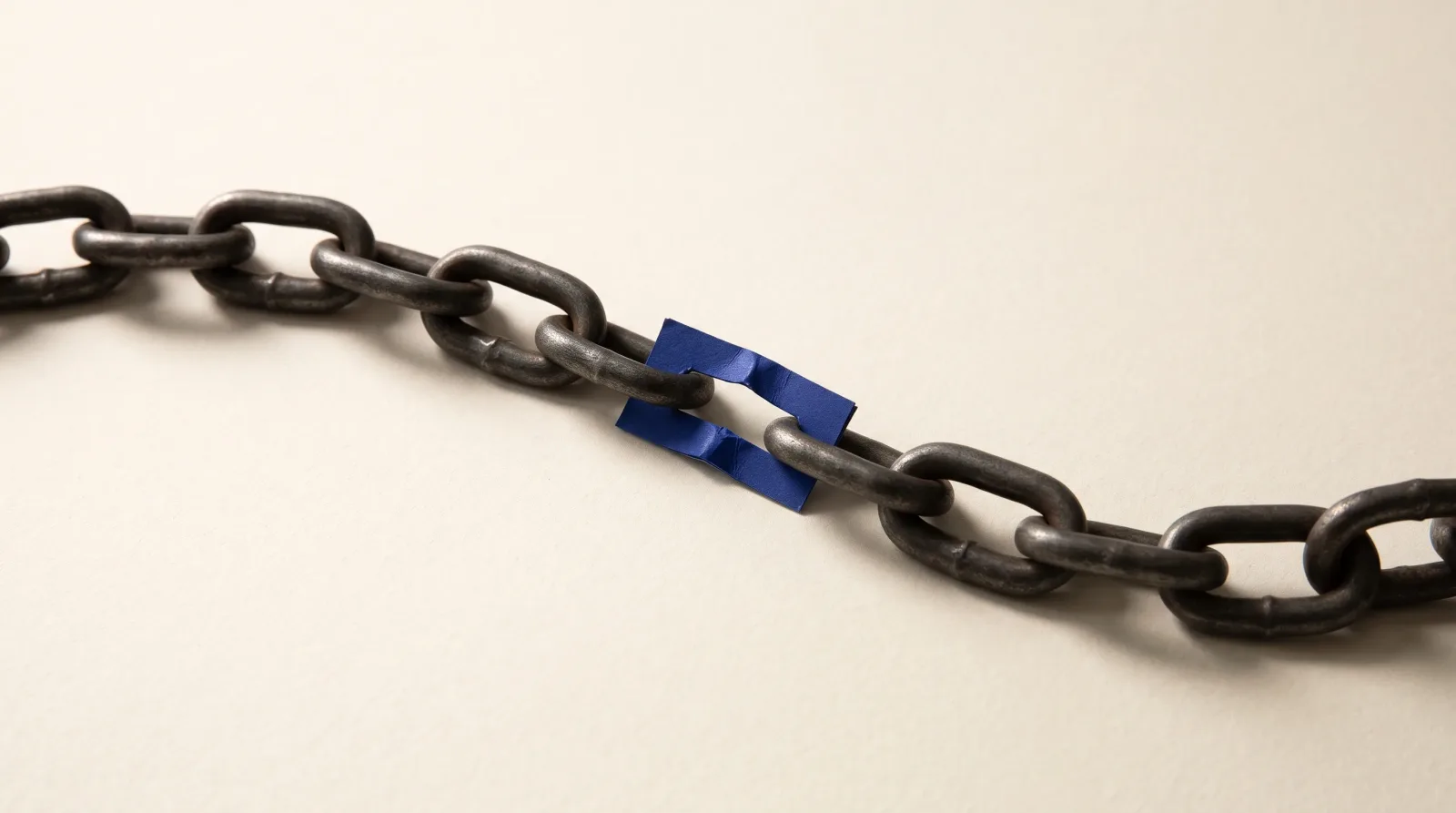 AI illustration
What the study shows
The authors tested Claude Code and Codex, two widely used coding agents, without changing them. Both let a lead model, called the orchestrator, hand tasks to a smaller helper model, called a sub-agent. The study is a preprint and has not been fully peer reviewed. The authors say it was accepted to a NeurIPS 2026 workshop.
Each test asked the agent a two-choice question about a fictional story, answered by a folder of text files. One file was a forgery pushing the wrong answer. It carried two clues a careful reader could spot: it was dated before the record it claimed to correct, and it lacked a reference line every genuine record had. The key measure was a harmful revision: an agent that answered correctly without the forgery switched to the wrong answer with it.
When the strong orchestrators searched the files themselves, they were fooled twice in 1,080 trials. When they could only ask a weaker sub-agent to read the files, failures rose. In Claude Code, one forgery type fooled the system on 75 of 180 questions. In Codex, a fake note from a 'senior archivist' fooled it on 44 of 180, close to the 58 of 180 the weaker model managed alone.
The authors ran checks to find the cause. A sub-agent as strong as the orchestrator kept failures near zero. Delegating over a folder with no forgery caused no harm. The authors conclude that the weak reader, not delegation itself, drives the failure.
They also tested a three-step chain in a simulated setting: an attacker misleads a worker model, which reports to an aggregator model. Five aggregators, including top models, repeated the corrupted worker's error in 751 of 757 cases. Giving the aggregator the original source record brought errors to zero.
Our reading
In our reading, the core result is simple and practical. A strong model only protects a system if it sees the evidence itself. Once a cheaper model reads the files and writes a summary, the clues that would expose a forgery can drop out. In Claude Code, the strong model named the forgery's missing provenance every time it read the file. The weaker helper's summaries kept that signal only about half the time.
A concrete case: a team uses a coding agent to answer questions from a shared drive, and the agent sends a cheap helper to search it. Anyone able to drop a file on that drive could plant a convincing 'correction notice'. The strong model would accept the helper's summary without ever opening the file. The authors note the attack needs no special access, only the ability to write a file where an agent will read it.
The headline phrase, 'only as safe as the weakest agent', fits the main numbers but is stronger than the evidence. The paper's own data show the orchestrator also fails sometimes. Some attack types did not work at all, and an explicit instruction to the reader, the classic prompt injection, was resisted everywhere.
Read the rest of this story
Membership is free. You get every article in full and the Issue every Sunday.
We send a sign-in link, no password needed. Already a member? Sign inReadiness assessment
| Level | Status | Evidence |
|---|---|---|
| I Lab only | Met | Controlled experiments in sandboxed environments with fictional facts and planted forgeries. |
| II Benchmarked | Met | Measured on a fixed 180-item corpus across 13 to 18 models, with controls, confidence intervals and statistical tests. It is the authors' own test set, not an established public benchmark, so this is a soft pass. |
| III Open source | Met | Appendix A says the authors release the environments, harness adapters, poison families, model registry, analysis scripts and raw per-trial records. No URL appears in the text we read, so we could not check the release. |
| IV In production | Not yet | No named organisation documents using this as a defence or test in production. The attack was run only on the authors' own setups, and vendors were not notified. |
What would move it up
To reach Level 4, a named vendor or team would need to document using the test or the evidence-passing defence in a live system. Independent replication on other tasks (real code, documents) and a check of the verification hypothesis would also strengthen the case. Confirming a public code link would firm up Level 3.
The study
Keegan Wang, Anantika Mannby. Only as Safe as the Weakest Agent: A Break That Appears Only When the System Is Multi-Agent. arXiv, 12 November 2026. Read the paper
Notes
- Wang and Mannby, 'Only as Safe as the Weakest Agent: A Break That Appears Only When the System Is Multi-Agent', arXiv preprint 2611.17520, 12 November 2026. Source
- Direct reading: 2 harmful revisions in 1,080 trials. Delegated: Claude Code 20/180 (gloss) and 75/180 (stacked); Codex 44/180 (gloss); reference harness 553/900 (volume). Same-tier sub-agents: 0/180, 1/180, 11/540. Clean store: 0/476 and 0/340.
- Weak reader alone on gloss: Haiku 4.5 22/180, gpt-5.6-terra 58/180. Sub-agent reports kept the provenance clue in 96/180 trials against 180/180 when the orchestrator read the file.
- Aggregator chain: 0/780 errors with an honest worker; 94.7% to 98.0% with a corrupted worker; 751/757 when the worker was fooled; 0/780 with a grounded verifier. Real-harness verifiers: baseline 15/40, grounded 3/40, sceptical 1/40.
- Channel effect: same forged report adopted 102/120 (85%) as a sub-agent result and 18/39 (46%) as a peer message. Across 18 models, document and peer resistance correlate at Spearman rho = -0.76.
- Appendix A states the authors release environments, harness adapters, attack files, model registry, scripts and raw trial records. No link is given in the paper.
Edited and signed by
Stefan PerdalEditor and publisher86 stories editedStefan read the study, set the readiness level and approved this story. An AI system found the paper and wrote the first draft.
How this was made
An AI model read the study and wrote this article in the structure Science Underway uses. An editor reviewed it and approved it for publication. Check the original study before you rely on the details.
How we workNo corrections

